Sword Coast Legends launched in 2015 for PS4, Linux, PC and XONE, and it still feels like a game trying to hold two identities at once. One side wants to be a Dungeons & Dragons tactical adventure built for a living room screen. The other side wants to be a dungeon-crawler that can be played alone or with friends. Neither identity gets fully realized, and the result is a game that fans of either genre will find frustrating in different ways.
The game asks players to pick a hero, gather a party of companions, and lead them through dungeons filled with monsters, traps and treasure. It is built around Wizards of the Coast’s 5th Edition rules, which means anyone familiar with tabletop D&D will recognize the dice rolls, the classes and the stat blocks. But the game also includes a mode for solo play, complete with a story campaign and a set of random encounters that can be played alone. That split ambition shows in almost every corner of the design.
Trailer, via IGDBcom.
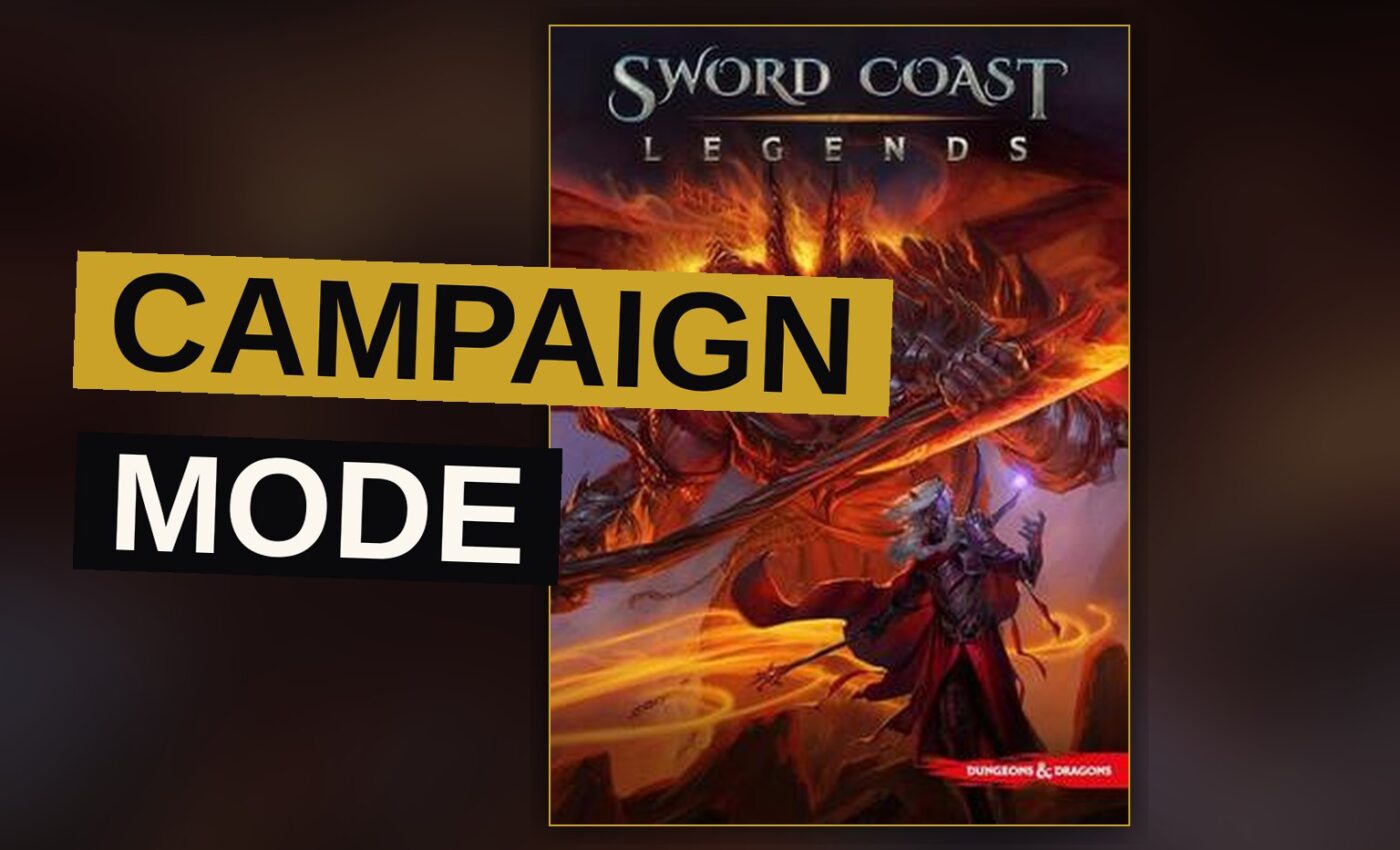
The Campaign Mode
The main story campaign is where Sword Coast Legends tries hardest to deliver a full adventure. Players guide a party through a series of dungeons, each tied to a location in the Sword Coast region of the Forgotten Realms. The campaign is structured around a branching narrative, with choices made in dialogue scenes affecting which paths open up later. It is a bold approach, but the execution falls short.
Dungeons are large and detailed, with multiple floors, secret rooms and hidden switches. Some encounters are genuinely clever, forcing players to think about positioning and timing. But the pacing suffers badly. Long stretches of walking and searching for the next encounter pad out the experience, and the game rarely tells players where to go next.
Combat itself is solid but unremarkable. Heroes attack in turn order, roll initiative, and use abilities drawn from their class. The system is simple enough to explain in minutes, but it does not offer much depth beyond that. There is no meaningful way to build a strategy over time, no resource management, no evolving tactics. Just a repeatable loop of rolling dice and clicking buttons.
The campaign mode is best enjoyed as a light diversion, not a deep strategic challenge. It is a pleasant enough way to spend an afternoon, but it lacks the hooks that keep players coming back for more.
The Solo Mode
Beyond the campaign, Sword Coast Legends offers a solo mode with procedurally generated dungeons. These dungeons are built from a pool of rooms, traps and enemies, and each run feels fresh. The mode is accessible for players who want to jump in without a group, and it offers a steady stream of rewards for completing runs.
The difficulty curve is uneven. Early runs are forgiving, almost too easy, while later runs demand precise positioning and careful planning. This swing can frustrate players who expect a smooth climb. The game does not clearly signal when a run has become harder, so the sudden increase in challenge often feels unfair rather than satisfying.
The solo mode also includes a selection of pre-made adventures, designed by Wizards of the Coast. These are shorter than the main campaign but offer a different take on the story. They are worth playing for fans of the setting, even if they do not add much new content.
The Multiplayer Mode
The multiplayer mode is where Sword Coast Legends shows its deepest problems. Players can join a dungeon together, either by hosting a private game or joining a public lobby. The idea is sound: a group of friends can gather in a living room and fight through dungeons together. But the implementation is thin.
Communication is the biggest issue. The game does not support voice chat, so players who want to coordinate plans have to type everything out. Typing in combat is slow and awkward, and the game does not provide any tools to make it easier. This limits the flow of the game significantly, since coordination is essential for success.
The dungeon generation in multiplayer is less varied than in solo mode. Players get a handful of standard layouts, and the enemy placement tends to follow predictable patterns. This makes the multiplayer experience feel repetitive compared to the solo mode.
There is also a competitive mode, where teams fight against each other. This mode adds a layer of tension, since players are working against a rival team rather than a neutral dungeon. But the lack of voice chat and the limited dungeon variety mean the mode never reaches its full potential.
The Classes and Abilities
Sword Coast Legends draws its classes directly from the 5th Edition ruleset. Each class has its own strengths, weaknesses and abilities, and the game does a decent job of explaining them to new players. Fighters are durable, wizards are fragile but powerful, and rogues excel at mobility and stealth. The variety is welcome, though some classes feel more rewarding to play than others.
Abilities are where the game stumbles. Many abilities are simple attacks with minor effects, and there is little incentive to experiment with different builds. Players who want to customize their characters will find the options limited, and the game does not offer much guidance on how to build a strong party.
The game also includes a companion system, where players can recruit non-playable allies to join their party. These companions have their own abilities and stats, and they can be leveled up over time. This adds a layer of depth, but it is not enough to compensate for the weak ability system.
| Class | Strength | Weakness |
|---|---|---|
| Fighter | Durability | Limited mobility |
| Wizard | Power | Fragility |
| Rogue | Mobility | Limited durability |
The Setting and Sound
The Forgotten Realms setting is rich, and Sword Coast Legends captures some of its flavor. The game includes locations familiar to longtime fans, and the lore is woven into the story and dialogue. The world feels lived-in, with towns, castles and wilderness areas rendered in a painterly style.
The music is atmospheric, drawing on orchestral arrangements that suit the fantasy setting. Sound effects are competent, though they do not always match the action on screen. The audio design is serviceable but not memorable.
The visual presentation is adequate, with detailed character models and environments. The game does not push technical boundaries, but it looks polished enough for its target audience. The frame rate holds steady during combat, which is a relief given the complexity of the battles.
The Technical Performance
Sword Coast Legends runs well across its platforms, though performance can vary depending on the hardware. The PC version performs best, with a stable frame rate and fast loading times. The PS4 and XONE versions handle well, though they can suffer from occasional slowdown during busy battles. The Linux version is less tested, and its performance depends on the underlying hardware.
The game does not include any major technical issues, but small bugs do appear from time to time. Combat animations can glitch, menus can freeze, and save files can corrupt. These problems are rare, but they are annoying when they happen.
| Platform | Performance | Pros | Cons |
|---|---|---|---|
| PC | Best | Stable frame rate | None |
| PS4 | Good | Decent performance | Occasional slowdown |
| XONE | Good | Decent performance | Occasional slowdown |
| Linux | Variable | Unknown | Unknown |
Final Word
Sword Coast Legends is a competent but flawed game. Its best moments come when the campaign delivers a clever encounter or when the solo mode generates a fresh dungeon. Its worst moments come when the multiplayer mode fails to connect players effectively or when the ability system feels thin. The game never quite resolves its identity conflict between a campaign-driven adventure and a multiplayer dungeon crawler.
The game’s score reflects this mixed picture. Critics have generally agreed that Sword Coast Legends is a solid, if unremarkable, entry in the genre. The game does not reinvent the wheel, but it executes its ideas well enough to justify a look.
For players who want a Dungeons & Dragons experience on their console, Sword Coast Legends is a decent option. For players who want a deep tactical game, it falls short. The game is best enjoyed as a casual diversion, not a serious strategic challenge.
The game is available on PS4, Linux, PC and XONE, and it remains playable today. If you have the hardware and the interest, it is worth a try. Just lower your expectations.
The game is not a failure, but it is not a triumph either. It is a game that tries to do too much and ends up doing neither as well as it could. The Forgotten Realms setting deserves better, and so do the players who love it.
Get the Notebook.
The day's best stories and every fresh verdict, in plain English, in your inbox by seven. One email a day, no more.