
The Ten Thousand Buddhas ‘Monastery’ in Hong Kong is not a monastery, and it does not have ten thousand Buddhas. It has more than 12,000 statues, and no monks live there at all.
The site is actually a Buddhist temple complex run by a team of laypeople who handle the day-to-day operations. The name has stuck for decades, even though both parts of it are factually wrong.
Construction began in 1948 on a bamboo forest hillside overlooking the small village of Pai Tau and its agricultural fields. The complex was completed in 1957, the same year a market township called Sha Tin Hui was built on the unused fields at the base of the hill.
Climbing Past 500 Gold Arhats
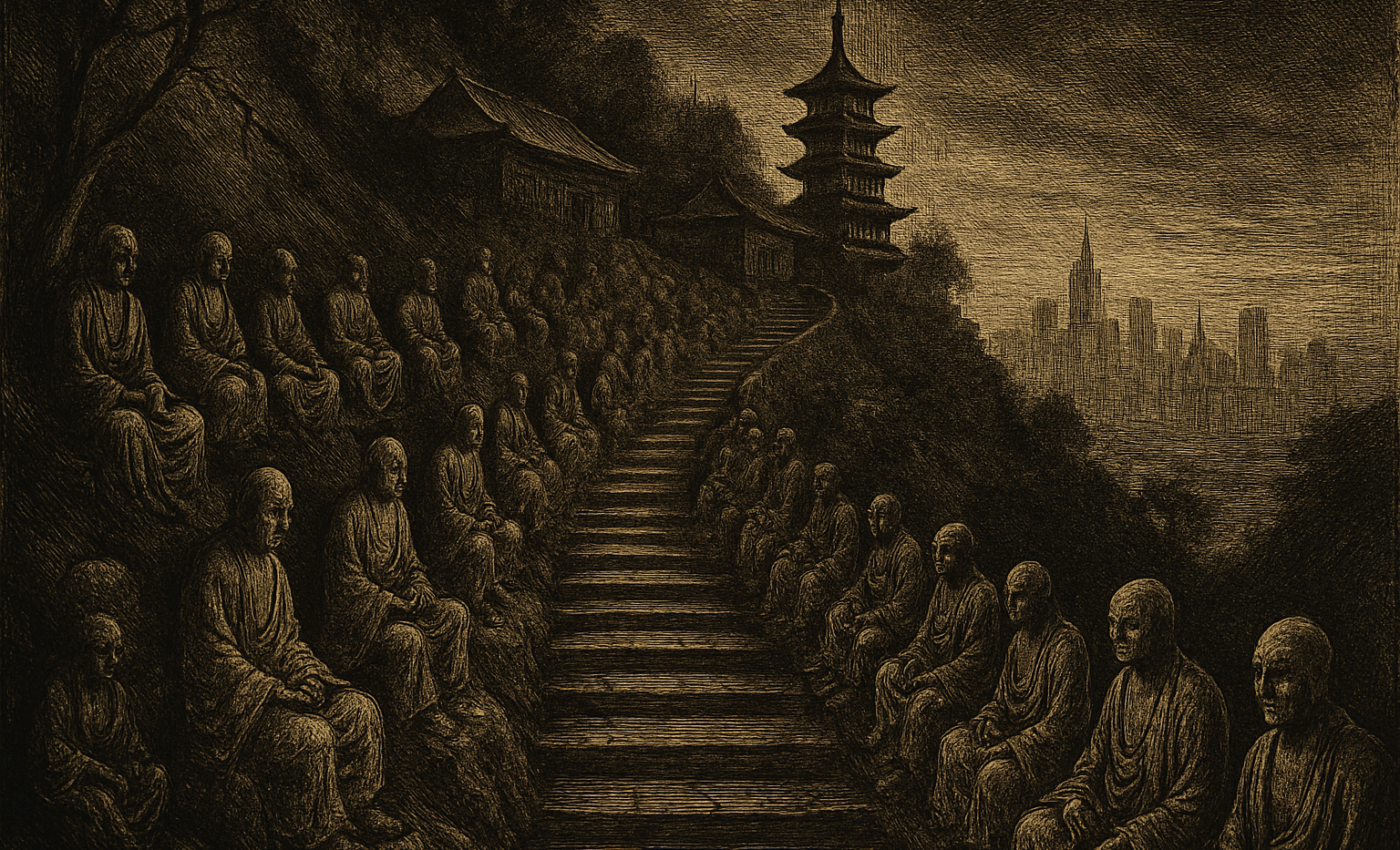
Visitors do not simply arrive at the temple. The approach is a steep concrete path lined with 500 life-size gilded Arhat statues on both sides of the path, every figure in a unique pose.
The Arhats are made from fiberglass and painted bright gold. They are the work of artists in Yunnan and Guangdong, and they exude an air of calm and spirituality as visitors make the steep ascent.
The climb is part of the experience. Each statue offers a different posture and expression along the way.
What Sits at the Top
The full complex spreads over 8 hectares and includes five temples, four pavilions, one verandah and a 9-storey pagoda. There are numerous statues of deities on display throughout the grounds.
“Groundbreaking and construction began in 1948, at a bamboo forest hillside location overlooking the small village of Pai Tau and its agricultural fields.”
One of the most unusual features is the gold-covered embalmed body of the monastery’s founder, Yuet Kai. His body was exhumed eight years after his burial, and it remains on display at the complex.
Sha Tin Hui and the Development That Erased It
When the monastery was completed in 1957, Sha Tin Hui stood at the base of the hill. It was a market township built on the unused fields that had once been farmland.
The township lasted until the late 1970s. It was then demolished to make way for the Sha Tin New Town development.
The agricultural fields were built over entirely. What was once a rural hillside lookout now faces the urban expanse of Sha Tin town.
Sanctuary on the City’s Edge
The monastery now sits on the fringes of a dense urban area. It provides a peaceful sanctuary that contrasts sharply with the city below.
The site has survived the development that erased the village and the fields it once overlooked. The laypeople who run the complex keep it maintained.
The Arhats, Statue by Statue
The 500 Arhat statues are a major part of the experience. They line the path on both sides, and each one is distinct.
- The statues are life-size, roughly matching human proportions.
- They are made from fiberglass, a modern material choice.
- They are painted bright gold, giving them a uniform appearance.
- They were created by artists in Yunnan and Guangdong.
- Each statue has a unique pose, so no two are identical.
The gold paint is bright. The workmanship is attributed to the artists from the two Chinese provinces.
Yuet Kai’s Gold-Covered Body
Yuet Kai founded the monastery, and his embalmed body is one of the most talked-about features of the site. The body is covered in gold and displayed within the complex.
The fact that his body was exhumed eight years after burial and then preserved adds an unusual element to the visit. The body remains a central part of the site’s identity.
The View Today
What visitors see from the top is not the village or the fields that were there in 1948. It is the urban expanse of Sha Tin town.
The contrast is stark. The monastery is quiet, green and still, while the town below is busy and built up.
That contrast is part of what makes the site appealing. It offers a retreat that is physically close to the city but feels far removed from it.
The complex has stood for decades, outlasting the village it once overlooked and the township that replaced the fields. It remains a place of calm, even as the city has grown up around it.
For anyone visiting Hong Kong, the climb up the path, past the 500 gold Arhats, to a complex with more than 12,000 Buddha statues, is a singular experience. The name may be wrong on both counts, but the place itself is very real.
Source: atlasobscura.com
Get the Notebook.
The day's best stories and every fresh verdict, in plain English, in your inbox by seven. One email a day, no more.