
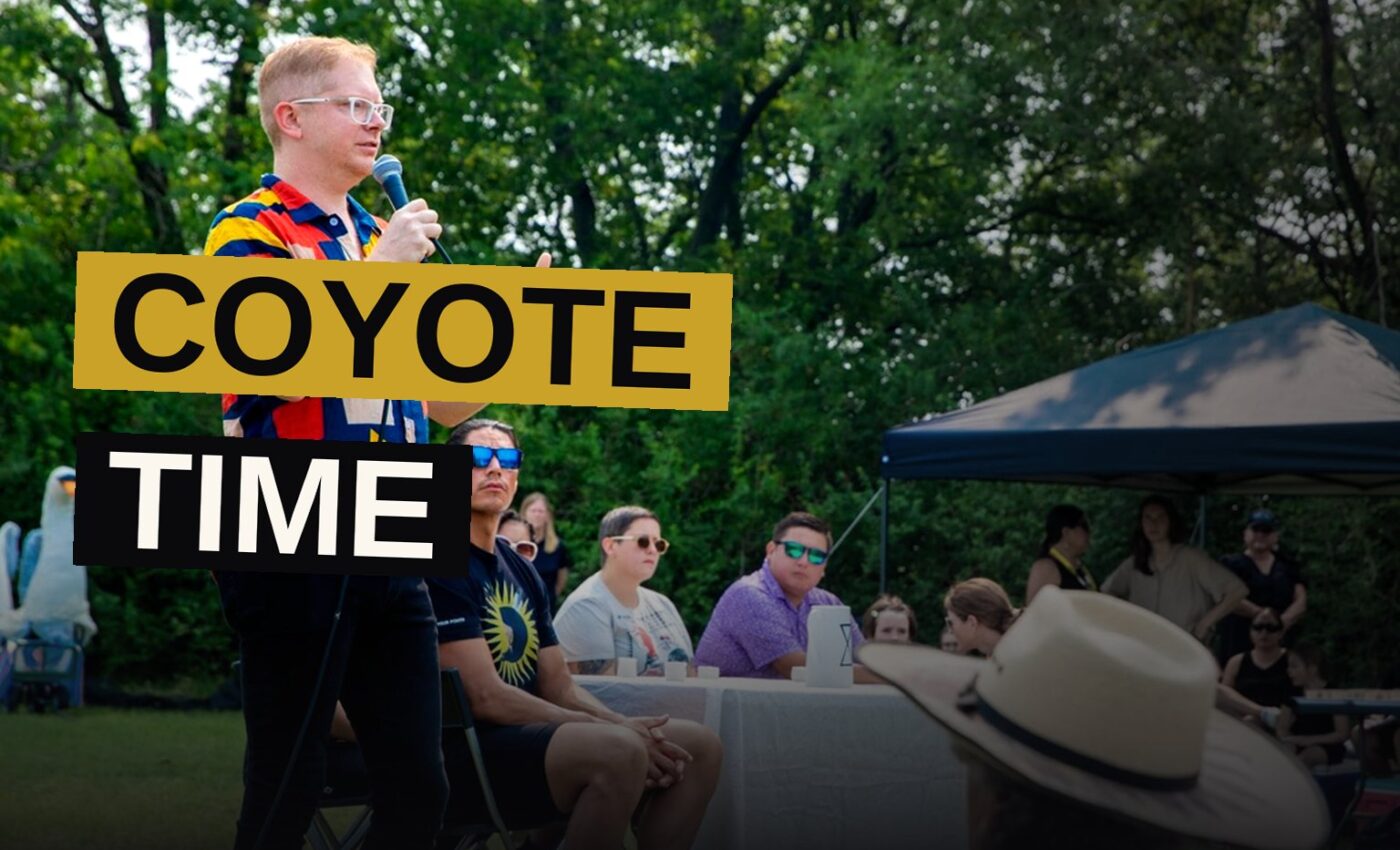
Tomorrow, on Thursday, September 10, the Counterpublic Triennial comes back to St. Louis, and this time it spans five main sites for its third edition. The event is called Coyote Time, and according to co-founder and artistic director James McAnally, the move outward is not simply about growth for growth’s sake. Instead, he says it is built around backing work that is actually connected to real change.
In an interview with Sara Reisman, “We think of our work as an invitation to do more, to take action, and to operate differently,” McAnally spoke to Hyperallergic.
This three-year exhibition presents public space on altered terms, with its core ideas revolving around accountability, access, climate, infrastructure, agency, and Native sovereignty. The art remains on display for three months, while the whole undertaking operates on a three-year schedule.
An Ensemble, Not a Team
Counterpublic does not use a traditional curatorial team. Instead, it relies on what it calls a curatorial “ensemble,” a structure that balances individual authorship with a collective voice. The ensemble members were selected from 80 peer-recommended candidates, and each curated a section tied to a specific theme in a specific part of St. Louis.
Wanda Nanibush and Stefanie Hessler concentrate on the river’s environment and how the city has become separated from its three major North American watersheds. Jordan Carter looks at scores, staging, and rehearsals in The Ville, a St. Louis neighborhood that contains an operating high school along with other institutional locations. Raphael Fonseca uses his experience as a teacher to create collaborative projects with students and to work at a refugee resettlement center. Nora N. Khan investigates speculative infrastructures and technology in Sauget, the former Monsanto town, and in other parts of the city.
The Meaning of “Public”
Counterpublic echoes the late artist Vito Acconci’s idea that for something to be “public,” it must connect at least three people. That framing runs through the triennial’s approach to its sites and audiences.
McAnally was asked which artists’ practices have influenced his approach. He cited Richard Serra, whose first permanent public work, “Twain” (1982), stands in downtown St. Louis. He added that he also takes inspiration from the intimacy engendered by artists like Chloe Bass, whom he is married to, and Felix Gonzalez-Torres.
From The Luminary to Counterpublic
The Luminary was founded in St. Louis by McAnally back in 2007, and from there grew the foundation for what would become the triennial. Counterpublic began life as an exhibition in 2015, before it was established as a triennial in 2019. The two platforms share the same purpose: linking art, thought, and action with the aim of bringing about social change.
The Luminary’s reason for being grew out of the alternative space movement, according to McAnally. His aim was to give artists a setting apart from the standard institutional viewpoint. When the group began, McAnally worked as a musician, while co-founder Brea Youngblood served as an artist and photographer. Other members added their own points of view.
“The common thread was the understanding that there was a lack of space for artists to gather, think, and build together,” McAnally said. That commitment eventually sparked projects like Contemporary Art Review and March.
At the same time he was writing criticism for outlets like Hyperallergic, he kept spotting the same repeated complaints. These criticisms concerned biennials and triennials, their selection procedures, their audiences, and how they allocated resources.
“Critique alone isn’t enough; if we can’t imagine and build the institutions we want, critique becomes another instance of speaking to power without changing it,” McAnally said. “Counterpublic grew out of asking whether we could build the alternatives we imagined.”
| Platform | Founded | Form |
|---|---|---|
| The Luminary | 2007 | Artist-run organization and space |
| Counterpublic | 2015 exhibition, 2019 triennial | Public art triennial on a three-year cycle |
Three months of the third edition begin tomorrow, stretching across St. Louis. The sites span a working high school in The Ville to the industrial grounds of Sauget, a place that was once home to Monsanto.
The interview shows a consistent framing from McAnally: the work serves as an invitation. It does not simply invite looking. Instead, it pushes visitors to act, to function in altered ways among one another and in public spaces.
Source: hyperallergic.com
Get the Notebook.
The day's best stories and every fresh verdict, in plain English, in your inbox by seven. One email a day, no more.