
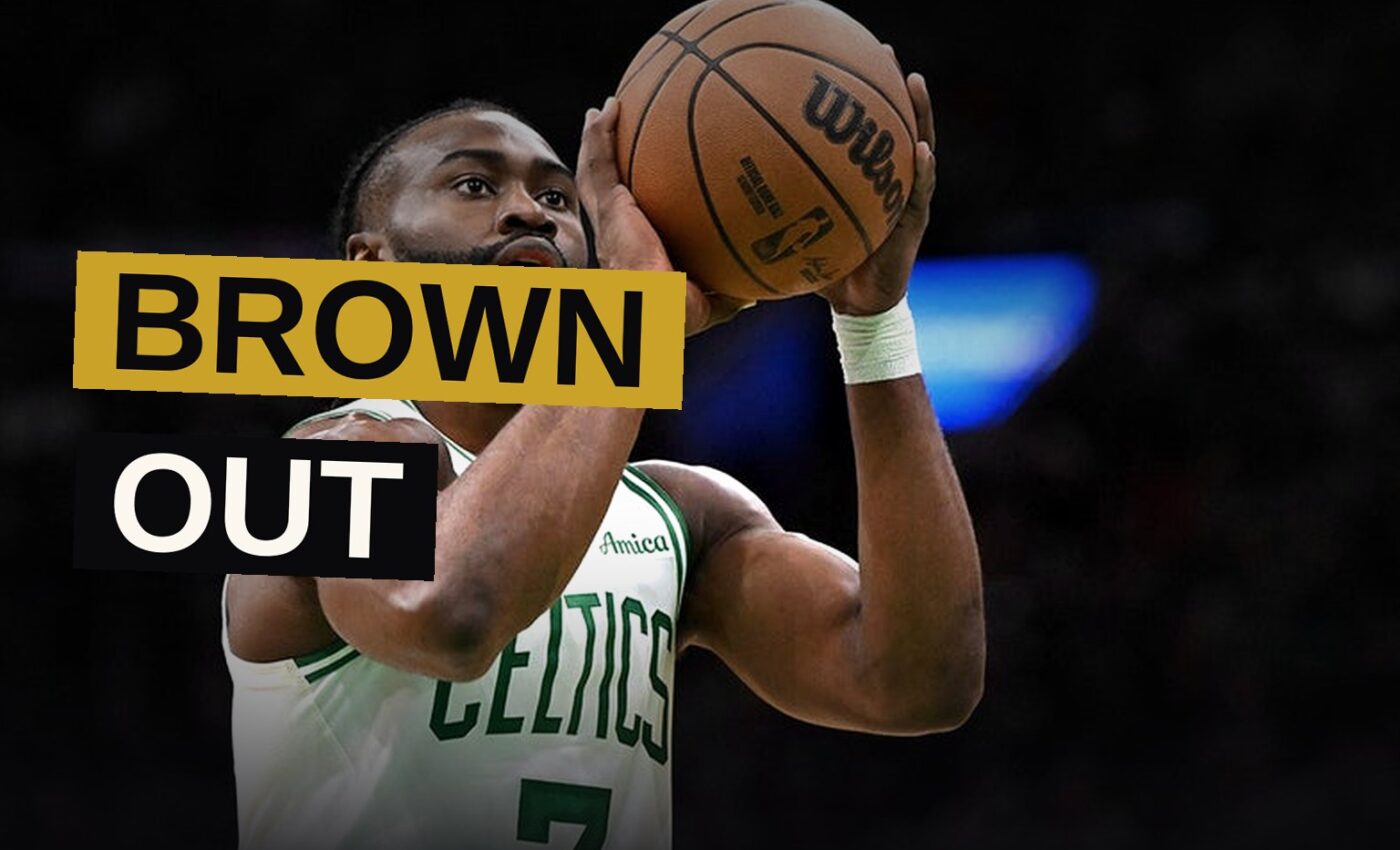
Jaylen Brown no longer calls himself a basketball player. The title he now holds comes from outside the sport.
In a Hollywood Reporter piece, the new Sixers star told Oscar winner Mahershala Ali that he will not accept being treated as merely an entertainer. Instead, he insists on being recognized as someone more significant.
“I refuse to adopt the idea that me being an athlete, I’m just here to entertain people,” Brown said.
The comments have drawn sharp criticism from OutKick’s Alejandro Avila, who called the interview “ridiculous” and described Brown’s remarks as pseudo-intellectual posturing. It is the latest chapter in a long-running saga of Brown insisting the world take him seriously as a thinker, not just a player.
What Brown Actually Said
In the Hollywood Reporter, Brown sat down with Ali for a polished profile that was meant to cover basketball and culture. Instead, Brown turned it into a statement of his own unwillingness to be confined by expectations.
“They want our athletes, our musicians, our entertainers, our people of influence to think that we just here for entertainment purposes,” Brown said. “I’m going to forever disagree with that.”
It’s plain to see what’s going on here. Those who spend their dollars on tickets and jerseys aren’t merely hoping to catch a game. They appear to be settling in to take in the cultural insight of a man who makes over $300 million a year to play basketball.
Brown draws fans who come to watch him play, not to listen to him lecture, according to Avila’s plain case.
A History of Big Statements
Brown is no stranger to posing as the NBA’s resident philosopher-king. Years have passed during which he has cultivated a reputation as the smartest man in any room he enters.
In a 2022 interview with The Ringer, Brown described how people react when he speaks.
“When I open my mouth and talk, sometimes people say they are amazed of my intellect,” Brown said. “I don’t know if that’s because I truly speak in a way that people can understand or feel a certain way, or because they don’t expect it.”
Reports emerged that NBA front-office personnel saw Brown’s “smartest guy in the room” persona as a locker-room turnoff, and he responded to that criticism head-on during an Instagram Live session.
“No offense to everybody in sports,” Brown said, “but the bar is f***ing low.”
Questionable Causes
Some of the doubt about Brown’s intellectual brand stems from his own history, with him attaching himself to causes that have proven questionable.
Brown stood by Kyrie Irving after he promoted a film hostile to Jews, and he kept supporting Kanye West’s Donda Sports even as other brands abandoned it. He also said he had no opinion on whether the Earth was “undecided”, while Irving went down that rabbit hole.
A magnetic necklace marketed as a device capable of altering the body’s energy frequencies through a smartphone app was worn by Brown, much like a Q-Ray-style item.
Avila says these are not the moves of a man who has split the atom; they are the moves of a man whose academic posturing hides poor judgment. Brown desires the reputation of being a public intellectual, according to Avila, yet his decisions keep damaging that image.
The “Shut Up and Dribble” Complaint
For years, Brown has argued that athletes are unfairly told to stay in their lane. He complained in a 2017 interview with The Guardian that athletes were still expected to “shut up and dribble.”.
Avila reports that no one is instructing Jaylen Brown to be quiet. The request instead concerns his habit of acting as if he had split the atom.
Brown holds a significant standing among NBA players, and his platform rivals that of nearly anyone else in the league. He makes use of it without pause. Avila contends that the claim he faces suppression does not hold up against what can be seen.
MIT Fellow Bravado
Avila writes that NBA media fanboys enjoy boasting about Brown’s “MIT Fellow,” credential, which carries an impressive sound.
The academic branding has been embraced by Brown, who has presented himself as a link connecting sports with intellectual pursuits.
Avila’s complaint is that the credential does not match the output. Brown frequently lets his public statements drift into pseudoscience and conspiracy-adjacent territory.
Brown doubles down instead. He says people are amazed by his intellect. He says the bar for athletes is low. He says he is not here to entertain anyone.
What Fans Actually Want
Brown’s central claim rests on a contradiction: fans hand over money for tickets and spend more on jerseys so they can see the game played, yet the very spectacle they fund is built around a single player who rarely touches the ball.
The NBA functions as an entertainment product, and describing it that way is not meant to be insulting. As Avila puts it, the league is run by LeBron, and the game has always revolved around putting on a show for audiences.
More than just an artist, Brown aspires to be a cultural figure who is also a thinker with real influence. He wants to be viewed as a sociopolitical visionary and a cultural force, someone whose work carries weight beyond its artistic merits. What he wants most is to be regarded seriously as a thinker.
He is not being stopped from sitting down with Oscar winners for magazine profiles. That has already happened, and he can keep doing it.
What he cannot do is control how people react to him. And when he says things like “the bar is f***ing low,” people are going to respond. When he defends an antisemitic film, people are going to notice. When he dabbles in flat Earth theory, people are going to remember.
Deflection Tactics
Avila says Brown has taken a genuine grievance and turned it into a tool for avoiding real criticism. He responds to any pushback against his ideas by framing it as anti-athlete bias, and he answers questions about his judgment by labeling them as low expectations. The complaint in question is the “shut up and dribble”, which Brown has employed to deflect from actual criticism, according to Avila.
Brown can be wrong and never have to admit it, thanks to a handy maneuver that lets him off the hook.
Avila’s claim is that Brown is not the intellectual giant he takes himself to be. The more Brown presses his own greatness, the clearer that gap grows.
Brown has convinced himself over many years that he is the smartest person in any gathering he joins. The NBA has a long history of foolish quotes, but Brown routinely delivers gems so profoundly pseudo-intellectual that they would belong in a Hall of Fame for tone-deaf vanity.
That is saying something in a league run by LeBron.
Being a professional athlete does not mean Jaylen Brown must remain silent on his views or hope to be seen as anything less than a serious person. He has every right to express himself, to hold opinions, and to demand respect beyond the game.
It is not permitted for him to insist that everyone concur with his views. It is not permitted for him to declare the standard weak and then complain when people judge him by that very standard.
Brown made a deliberate decision to feature an interview with Mahershala Ali, and then used it as a platform for preaching about his own significance. He elected to present his refusal to be considered merely an entertainer as a kind of resistance.
What Avila returns to again and again is this: fans aren’t tuning into the NBA for lectures. They’re there for the action on the court. They’re there for the drama that unfolds during a contest. They’re there for the moments that make them leap out of their seats.
Brown offers that kind of amusement. He delivers it, and his compensation exceeds $300 million for doing so. That is the nature of his employment.
No one should feel ashamed about it. What would be shameful is acting as if nothing was wrong while still taking home the salary.
Here is how Avila’s case against Brown’s intellectual brand breaks down:
- Brown dismisses the idea that athletes exist to entertain, despite making over $300 million to play basketball.
- He claims people are “amazed” by his intellect while defending antisemitic films and flat Earth speculation.
- He complains about being told to “shut up and dribble” while using his platform constantly.
- He calls the bar for athletes “f***ing low” while demanding to be taken seriously as a thinker.
- He wants the prestige of a public intellectual without the accountability of one.
Source: foxnews.com
Get the Notebook.
The day's best stories and every fresh verdict, in plain English, in your inbox by seven. One email a day, no more.