
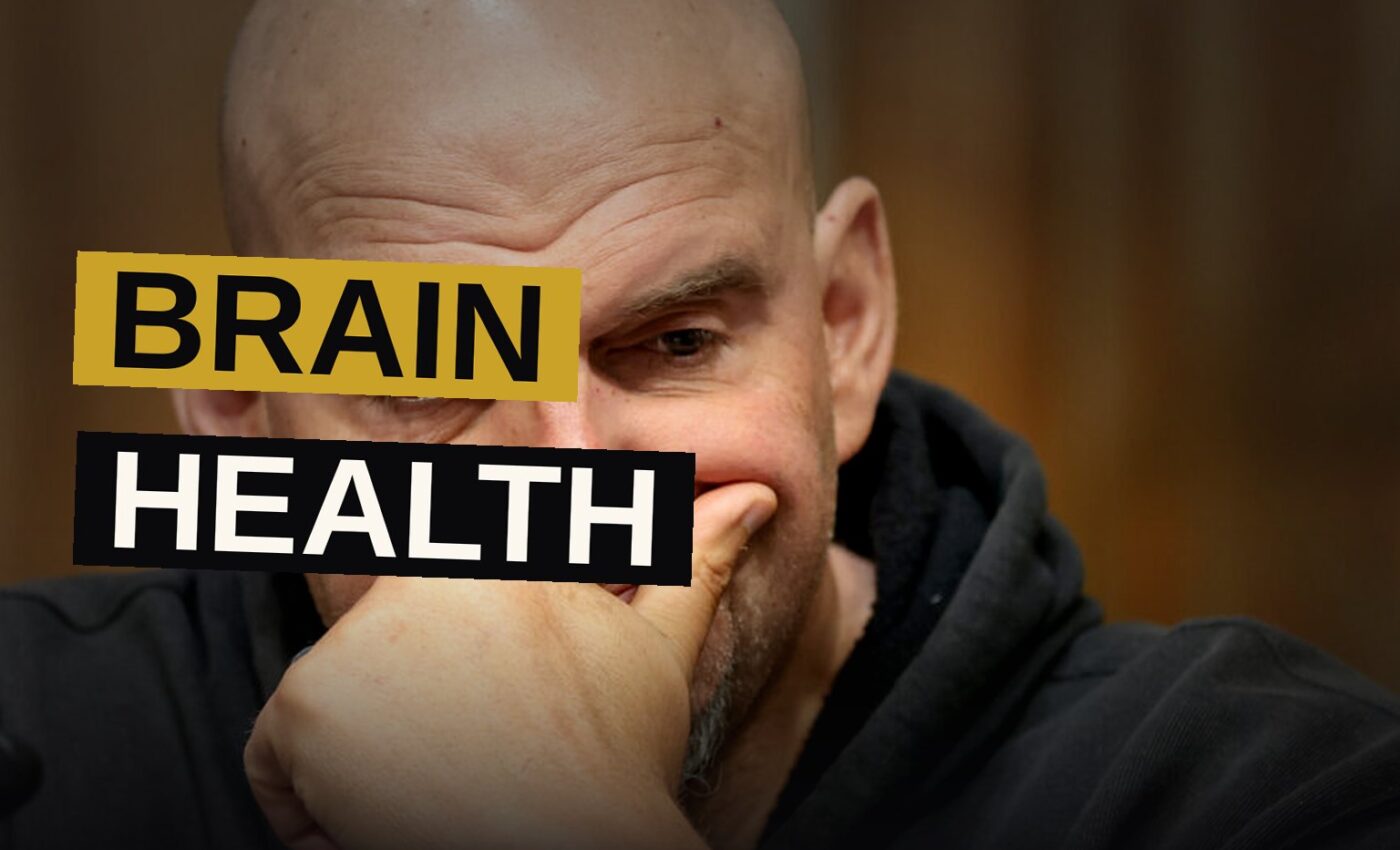
Two physicians who specialize in treating the behavioral outcomes of neurological diseases are asking the public to consider a medical explanation for Sen. John Fetterman’s post-stroke behavior. Their argument, published as an opinion piece, does not diagnose the senator. But it warns that the country is unprepared for the brain health realities of its politicians.
The physicians wrote that nothing in recent reporting on Fetterman is medically surprising. They point to a Wall Street Journal investigation that described a senator skipping 11 of 12 hearings in one stretch, dismissing Children’s Hospital of Philadelphia officials as wanting “free trips to D.C.,” and calling a three-hour funeral for slain police officers “a nonstarter.”
Fetterman suffered a stroke in 2022, toward the end of his Senate campaign. The striking difference between the campaigning Fetterman and the legislating Fetterman deserves a closer look, they argue.
Boyle’s ‘Laziness’ Complaint
Rep. Brendan Boyle, a fellow Pennsylvania Democrat, called Fetterman “a disgrace” and “lazy” in the Journal’s account. The physicians say that word choice is a problem.
A stroke survivor’s behavioral changes are often misread as character faults, they write. Many stroke survivors develop “apathy,” a symptom distinct from depression. It is not sadness but a blunting of initiative, a withdrawal from effortful and immediately unrewarding tasks.
About a third of stroke survivors develop it in a clinically measurable form, they write. It traces to disrupted circuits linking the frontal lobes to the brain’s reward system. The profile in the Journal’s account — a senator who won’t sit through a hearing, who cancels on veterans, who finds a funeral not worth the hours — matches that symptom almost point for point.
“Lazy is a character judgment requiring atonement, while apathy is a syndrome requiring treatment,” they write.
None of this excuses the behavior, they add. But a change of brain function, rather than a change of heart, is something constituents need to consider.
The Israel Turn
Then there is the other Fetterman. The strident one. The one who tore off his Harvard hood in support of Israel, feuded publicly with Sen. Bob Menendez (D) over his refusal to step down during his corruption investigation, and hardened into one of his party’s most vocal critics of loose U.S. border policy.
His support of Israel in May 2024 earned him ill will in an increasingly pro-Palestinian Democratic caucus. Sen. Cory Booker tried to rehabilitate his colleague’s image, casting the still-aphasic stroke survivor as an “inspiring figure” whose “moral voice” had “only grown stronger” despite his language impairments.
That was 15 months before the Journal investigation.
Psychiatry’s diagnostic manual formally recognizes personality change due to brain injury like stroke, the physicians write. Frontal lobe damage has been tied to altered judgment and disinhibition since a tamping iron was driven through Phineas Gage’s skull in 1848.
More recent work maps a “moral brain network” distributed across frontal, temporal, and cingulate cortex. A stroke severe enough to impair speech, as Fetterman’s was, often touches that territory, since language and that circuitry share real estate in the front of the brain.
“When Fetterman’s words and deeds are affected, they have a broader impact than those of a patient refusing to shower for weeks or eloping from the house at midnight,” they write. “Fetterman’s words become the nation’s deeds.”
Paradoxical Facilitation
Brain injuries often impair a person’s abilities, but they can sometimes enhance or exaggerate cognitive function. Newfound artistic creativity with certain forms of dementia is one well-documented example.
The mechanism is called “paradoxical facilitation.” Healthy brain areas, previously regulated by the injured region, are no longer suppressed. The loss of function in one faculty indirectly produces a gain of function in another.
Decades of research link right brain activity to moral judgment and its inactivity to deficiencies, even to the point of sociopathy. The left brain commands language processing. Following a stroke to the left brain, a person can develop not only a communication disorder but often post-stroke depression as well.
The physicians note they do not know which side of Fetterman’s brain was affected. They are not diagnosing him.
But if the senator’s moralism has been unfettered by his stroke, with a shift toward right-brain moralistic processing, that does not diminish his sincere intent or its effect. In fact, it could buffer against accusations of political expediency.
Applied cautiously, this suggests a stroke could intensify, not fabricate, the force of a person’s convictions, including ones that predate the injury.
Apathy and Zeal Together
Read together, apathy and moral zeal look contradictory. They are not, the physicians argue.
Apathy is domain-specific. Patients disengage from routine, effortful obligations while remaining fully capable of intense engagement with whatever still feels urgent or relevant.
A senator who cannot be bothered with a hospital’s Medicaid concerns but will cancel a schedule to go on Fox News over Israel is not necessarily inconsistent. Both actions may derive from the same underlying changes.
The physicians are explicit that none of this settles anything. It should not be mistaken for a defense. An authentic, brain-mediated intensified focus of conviction is not the same as sound judgment.
The Timeline
Fetterman’s stroke was public. But the behavioral changes that followed have been interpreted mostly through a political lens, not a medical one.
The physicians offer a corrective. They do not excuse the behavior. They do not diagnose the man. They simply ask that the public hold two ideas at once: that a stroke survivor’s behavior can change for neurological reasons, and that those reasons do not erase the consequences of the behavior.
The timeline of Fetterman’s public trajectory shows how quickly the narrative shifted:
| Date | Event |
|---|---|
| 2022 | Fetterman suffers a stroke during his Senate campaign |
| May 2024 | His support of Israel draws criticism from pro-Palestinian Democrats |
| May 2024 | Cory Booker calls him an “inspiring figure” with a growing “moral voice” |
| September 2025 | Wall Street Journal investigation describes skipped hearings and canceled events |
| September 2025 | Boyle calls him “a disgrace” and “lazy” in the Journal’s account |
Whether Fetterman’s constituents find the medical distinction persuasive is another matter.
Source: statnews.com
Get the Notebook.
The day's best stories and every fresh verdict, in plain English, in your inbox by seven. One email a day, no more.