
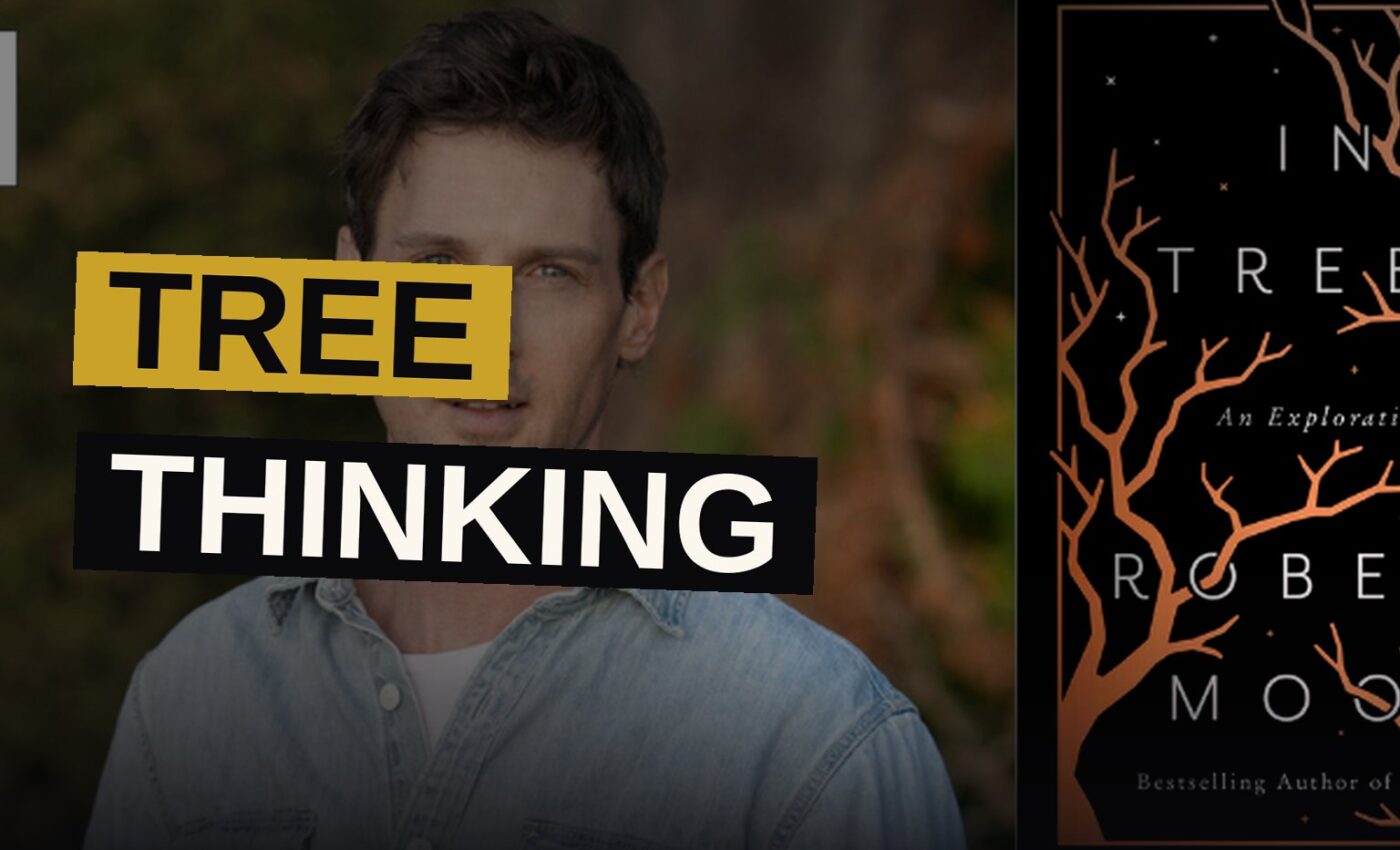
Robert Moor has a new book out called In Trees, and he wants you to think about the world differently — not as a ladder, but as a canopy.
The nonfiction writer joined Christian Barter and Jennifer Maritza McCauley on the Fiction/Non/Fiction podcast to discuss the book and the concept of “tree thinking,” a concept developed by evolutionary biologist Robert J. O’Hara. The idea is simple: instead of organizing knowledge and experience in rigid hierarchies, tree thinking emphasizes branching, growth, and pruning. Moor argues that this way of seeing things can reshape how we approach creativity, aging, and even the environmental movement itself.
In Trees uses the structure of trees — branching, pruning, gnarling, rooting — as chapter headings and organizing principles. Along the way, Moor takes readers from the giant sequoias to a tree sit in Vancouver, Canada, where he joined activists protesting an oil pipeline.
Wordsworth’s Narrowing Mind
One of the most striking sections of the book deals with the poet William Wordsworth. Moor uses Wordsworth as a cautionary tale about what happens when people stop branching.
“To back up a little bit, the chapter begins when I go to try to climb a tree near my house here where I live, and it is something I’d done as a kid, as you say,” Moor told Barter. “I imagine most people do, and then interestingly enough, most people stop for some reason.”
That realization sent Moor into the neuroscience of aging. He found that the human brain is at its most connected around age two, and then spends the rest of life pruning away neural connections. The question, he said, becomes how to stay “branchy” — how to keep making new connections rather than letting life narrow you down.
Wordsworth, Moor argues, failed that test. The poet who helped found the English Romantic movement and shaped modern reverence for nature grew narrower as he aged, both creatively and morally. Moor described Wordsworth as a brilliant poet and one of the founders of the Romantic movement, but noted that as the poet found success and suffered personal tragedies, his world and his mind narrowed.
Moor noted that he believes Ralph Waldo Emerson met Wordsworth and found him a very narrow person. Critics have suggested that if Wordsworth had died at 30, almost all of his best poems would still exist. He lost the radicalism of his youth and became, in Moor’s words, “more and more and more cautious.”
Tolstoy’s Branching Genius
The counterexample is Leo Tolstoy. Where Wordsworth narrowed, Tolstoy kept branching. Moor sees in Tolstoy’s life and writing an example of someone who retained enough youthful branchiness to flower into genius.
Moor’s comparison of the two writers is the heart of his branching chapter. The difference, he suggests, is not just about talent but about habits of mind — a willingness to keep taking risks, to stay uncomfortable, to resist the pull toward the familiar.
Barter found the comparison especially thought-provoking, and Moor’s own life reflects the theme. He wrote the book while wrestling with his own cautiousness, a feeling he said had infected his writing.
“I was taking fewer risks,” he said. “I was sort of falling into a rut that had been carved out.”
The branching chapter opens with Moor trying to climb a tree near his home, something he had done freely as a kid. He was reading Italo Calvino’s The Baron in the Trees — the story of a boy who climbs up and never comes down — and wondering why he had stopped.
The Sequoia and Modern Conservatism
Tree thinking also has political implications. Moor explores the role the giant sequoia played in founding modern conservatism.
Moor’s own activism has been direct. He participated in a tree sit in Vancouver, Canada, with activists protesting an oil pipeline. The experience raised questions for him about the ethics of climate activism.
“I was taking fewer risks. I was sort of falling into a rut that had been carved out.”
The podcast episode, produced by Whitney Terrell, includes Moor reading from In Trees. Listeners can find the full conversation on iTunes, Google Play, Stitcher, Spotify, or their favorite podcast app. Video versions of the interview are available on the Fiction/Non/Fiction Instagram account and YouTube channel.
From Papua New Guinea to Vancouver
The book is also a travelogue. Moor’s journeys take him from Papua New Guinea to Vancouver.
In Vancouver, he climbed into a tree and stayed there as part of a protest.
These experiences ground the book’s abstract arguments in physical reality. The book’s argument is that tree thinking might help activists re-imagine the environmental movement for a new age.
Related Reading
For those who want to go deeper, the podcast’s show notes point to a cluster of related works:
- The Baron in the Trees by Italo Calvino
- “The Trouble with Wilderness” by William Cronon
- On the Origin of Species by Charles Darwin
- Nature by Ralph Waldo Emerson
- How to Blow Up a Pipeline by Andreas Malm
- Walden by Henry David Thoreau
- Fiction/Non/Fiction Season 9, Episode 56: Matthew Wolfe on the Secret History of Radical Environmentalism
Moor’s own books — In Trees and On Trails — are available through Moon Palace Books.
The Costs of Caution
The stakes of Moor’s argument are personal as well as political. Narrowing, he suggests, is what happens when people stop taking risks. It happens to writers. It happens to activists. It happens to everyone.
But it is not inevitable. The brain’s pruning is real, but so is the capacity to resist it. The trick, Moor suggests, is to keep doing things outside your comfort zone, to retain stray neural connections that might otherwise be lost.
The tree climber’s vertigo he felt that day near his house was not just a fear of heights. It was a fear of doing something stupid — the sense that climbing a tree is something adults simply do not do.
Tree thinking, he suggests, is available to anyone willing to branch out.
Source: lithub.com
Get the Notebook.
The day's best stories and every fresh verdict, in plain English, in your inbox by seven. One email a day, no more.