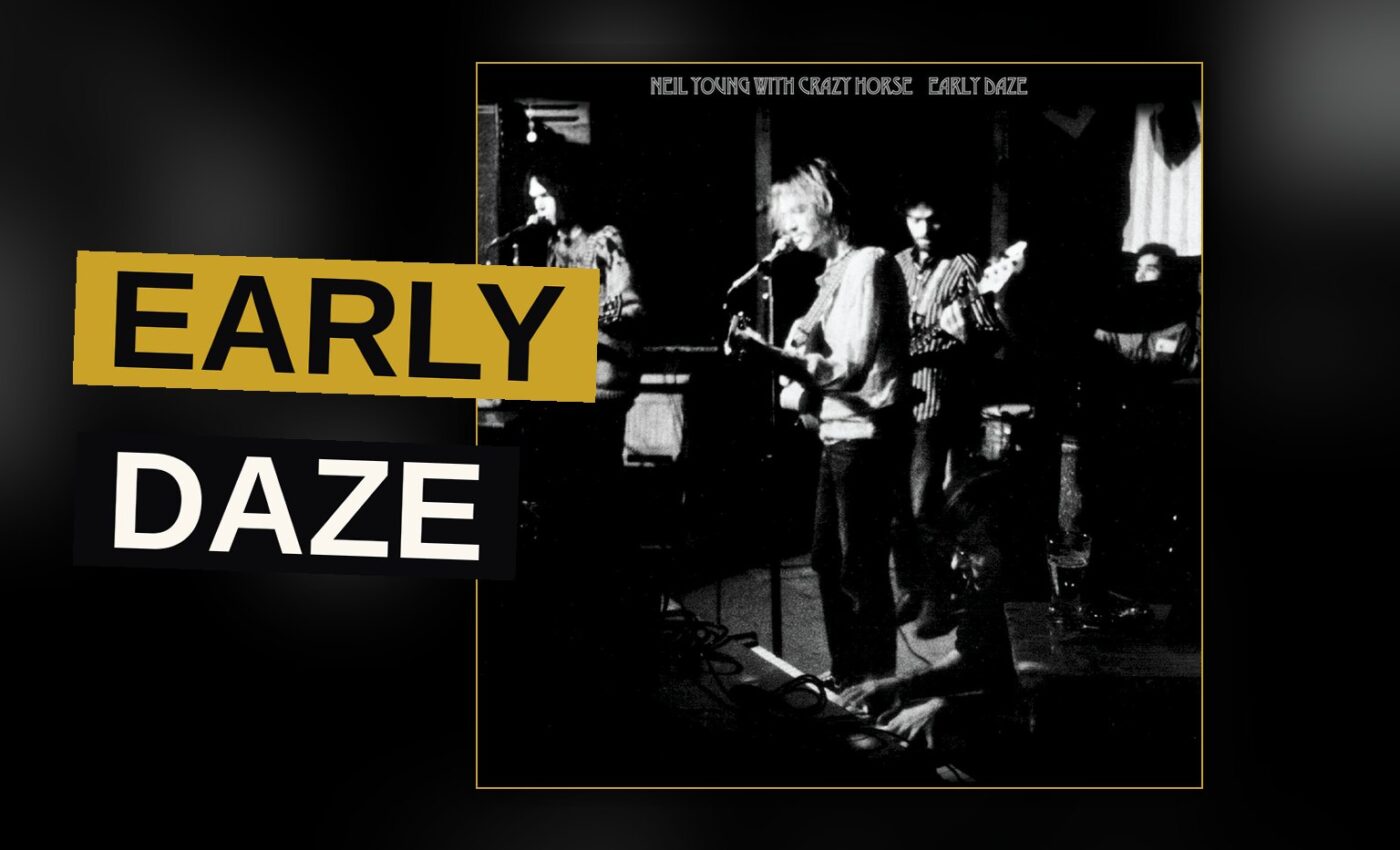
Neil Young and Crazy Horse have been digging through the vaults for a while now, and Early Daze is the latest artifact to see the light of day. Released in 2024, this ten-track album collects early versions of songs that would go on to define the band’s ragged, hypnotic sound. It is not a greatest hits package, nor is it a polished studio statement. It is a snapshot of a moment, capturing the group as they were finding their footing in the late 1960s, before the world knew exactly what to make of them.
The record is trying to do something simple: show the rough edges of a creative partnership. These are not the final, familiar versions of the songs. They are earlier takes, looser and less refined, with the seams still showing. For the devoted fan, that is the appeal. For the casual listener, it might feel like a footnote. Either way, the album exists to illuminate process over product, and it does that with a quiet, unassuming charm.
Shape of the Collection
The track list is a brisk listen. Ten songs, none of them overstaying their welcome except for the sprawling closer, which stretches past nine minutes. The album opens with “Dance Dance Dance,” a light, tentative version that feels like the band is still figuring out the rhythm. It is a pleasant start, though not a thunderous one.
“Come On Baby Let’s Go Downtown” follows, and this is where the record starts to find its pulse. The song has a live-in-the-room energy, with the guitar lines weaving around each other in a way that feels spontaneous rather than rehearsed. It carries a sense of place, of a band playing together in real time, with all the small imperfections that come with that.
Winterlong and the Early Highlights
“Winterlong” is the third track, and it is a clear highlight. The song is a slow-burning ballad, with Young’s vocal sitting high in the mix, fragile and searching. The version here is stripped back, letting the melody do the work. It is the kind of song that sounds like it has always existed, even in this earlier form, and it stands as one of the most complete moments on the record.
“Everybody’s Alone” is a shorter piece. It does not leave much of a mark, but it does not need to. It functions as connective tissue, a brief pause before the more substantial material arrives. “Wonderin’” is next, and it has a bounce to it that feels uncharacteristically playful for the band. The track is slight, but it has a charm that is hard to resist.
“Cinnamon Girl” arrives at track six, and this is where the album faces its biggest challenge. The final version of this song is one of the most iconic in Young’s catalog, a riff that has become part of rock’s identity. The version here is earlier, rougher, and it cannot help but suffer by comparison. That is not a knock on the take itself, which has its own scrappy appeal. It is just that the shadow of the finished product is long, and this rendition does not escape it.
Middle Stretch
“Look at All the Things” is a two-minute burst that feels like a sketch rather than a finished thought. It is not bad, but it is forgettable, and it passes without much ceremony. The album picks back up with “Helpless,” a song that would later become a cornerstone of After the Gold Rush. This early version is slower, more meditative, and it carries a weight that the later, more polished take would smooth over. It is a genuine highlight, and it shows that the band’s instincts were sharp even before the arrangements were fully formed.
“Birds” follows, and it is a delicate, acoustic-leaning piece that feels intimate, almost like a demo recorded in a quiet room. It is a nice change of pace, even if it does not reach the heights of the tracks around it. The record closes with “Down by the River,” the long epic that has become a live staple over the decades. This version is long and winding, but it lacks some of the tension that makes the definitive take so gripping. It is still a strong finish, but it is not the definitive statement.
Critics Weigh In
The reception to Early Daze has been mixed but generally favorable. The record holds a Metacritic score of 79 out of 100, which places it in the solidly positive range. That number feels about right. This is not a revelation, but it is not a cash grab either. It is a modest archival release that offers some insight into how the band worked, and it does not pretend to be anything more than that.
The reviews reflect that split. Mojo called it “short but sweet,” which captures the album’s appeal in four words. Uncut was less kind, describing it as “repetitive, labour intensive hackwork,” a harsh assessment that speaks to the record’s rough edges. PopMatters landed somewhere in the middle, noting that the album “adds only a little bit to our understanding of who the musicians were and are.” That is a fair reading. It does add something, but it is a small something, not a seismic shift.
What This Record Actually Does
The value of Early Daze is not in its polish. It is in the glimpses it offers of a band in transition. These are songs that would go on to become classics, and hearing them in their earlier forms is a reminder that greatness is not born fully formed. It is built, layer by layer, take by take, through trial and error. The album is a document of that process, and for fans of the band, that is enough.
It is also a record that rewards patience. The shorter tracks, the ones that feel like sketches, are not filler in the traditional sense. They are part of the picture, showing the range of ideas the band was working with at the time. The stronger tracks, like “Winterlong” and “Helpless,” carry the weight, but the lesser ones provide context. Together, they paint a portrait of a group that was still figuring out what it wanted to be.
That is the real story here.
Comparison of Versions
| Track | Early Daze Version | Known Later Version |
|---|---|---|
| “Dance Dance Dance” | Light, tentative, early feel | Later takes exist in the band’s catalog |
| “Cinnamon Girl” | Rough, scrappy, less defined | Definitive version on Everybody Knows This Is Nowhere |
| “Helpless” | Slower, more meditative | Polished take on After the Gold Rush |
| “Down by the River” | Long, winding, less tension | Tightened classic on Everybody Knows This Is Nowhere |
The table makes the point clearly. The versions on Early Daze are not inferior because they are worse. They are just earlier. They lack the confidence of the final takes, but they have a rawness that is its own kind of appeal. For a band like Neil Young and Crazy Horse, where the live energy is part of the identity, hearing these songs in a less finished state is not a drawback. It is a feature.
Bottom Line
Early Daze is not an album that will convert anyone who was not already a fan. It is not a lost masterpiece, and it does not rewrite the history of the band. What it is, is a thoughtful, restrained look at a creative partnership in its early days. It is a record for people who want to hear the gears turning, who are interested in the process as much as the product.
The album is a modest success. It does what it sets out to do, and it does it without overstaying its welcome. The highlights are real, the context is useful, and the overall experience is a pleasant one. It is not essential, but it is not disposable either. It sits somewhere in the middle, a solid addition to the catalog for those who care enough to dig.
For a band with as deep a history as Neil Young and Crazy Horse, Early Daze is a footnote, but it is an interesting one. It does not demand attention, but it rewards it. That is a fair trade. It is a record that knows what it is, and it does not try to be anything more. That honesty is part of its appeal. It is a small, quiet document of a moment in time, and it is worth a listen for anyone who wants to understand how the songs got to where they ended up.
Get the Notebook.
The day's best stories and every fresh verdict, in plain English, in your inbox by seven. One email a day, no more.
- Dance Dance Dance2:36
- Come On Baby Let’s Go Downtown4:13
- Winterlong3:40
- Everybody’s Alone2:32
- Wonderin’2:19
- Cinnamon Girl3:02
- Look at All the Things2:59
- Helpless4:39
- Birds3:38
- Down by the River9:04