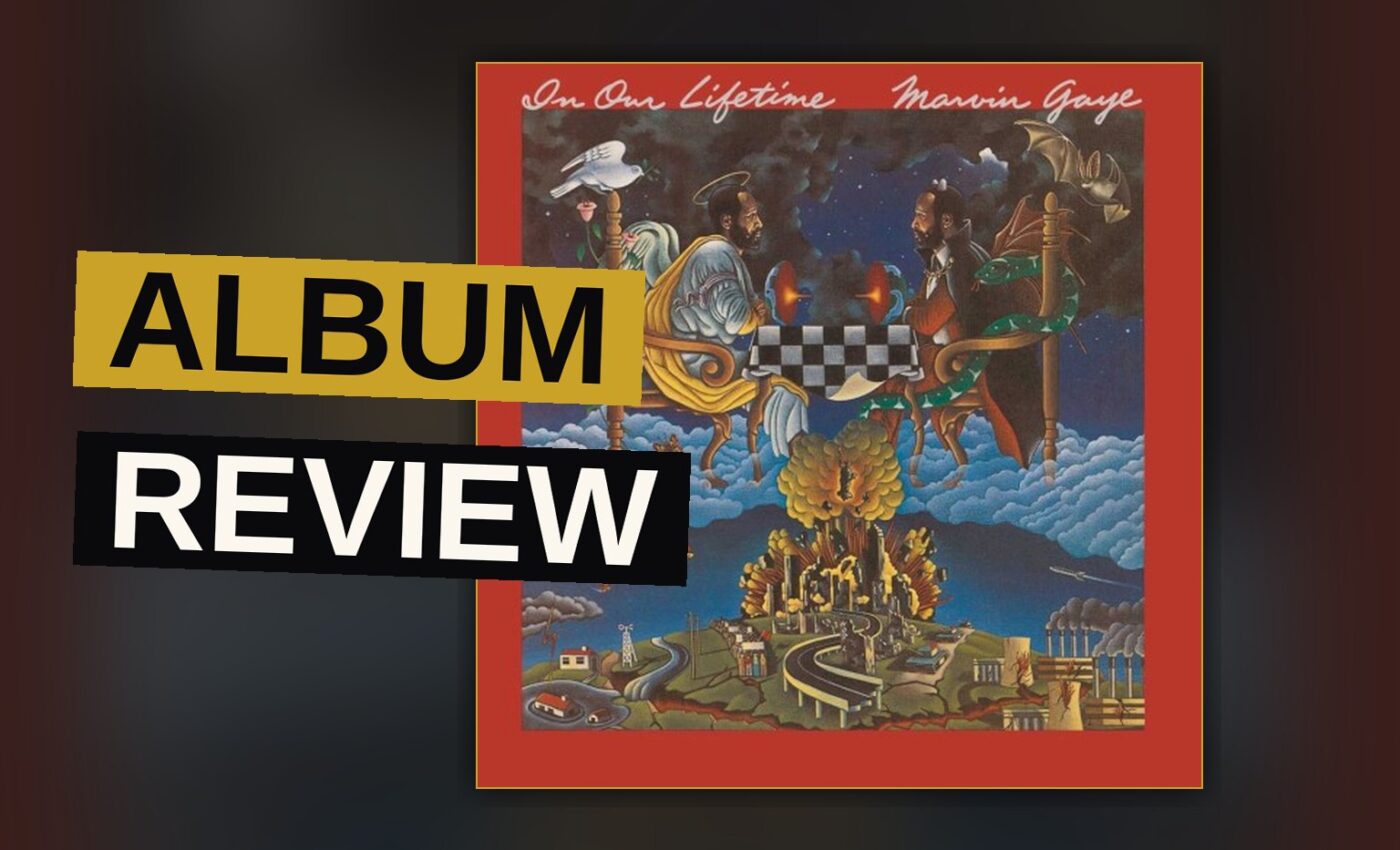
Marvin Gaye’s In Our Lifetime is not an easy listen, and it was never meant to be. Released in 1981, the album is a raw, often fractured portrait of an artist at war with himself, filtered through funk, gospel, and a deep, restless paranoia. It was born from a contentious production process with Motown, and that turmoil is baked into the grooves. This is Gaye’s confession booth, and the tape was rolling.
Praise Opens the Confession
The record opens with Praise, a four-and-a-half-minute gospel-tinged plea that sets the spiritual tone. It is less a song than a prayer set to a beat, with Gaye layering his own vocals into a choir of one. It works because he commits fully, no irony, no distance.
From there, Life Is for Learning shifts the mood into a slick, mid-tempo funk lecture. The message is simple, almost didactic, but the groove carries it. Gaye is teaching, and the classroom is a dance floor. It is a functional track, solid but not urgent.
Love Party and the Tension Beneath
Love Party arrives with a lighter touch, a four-on-the-floor jam that feels like the closest thing to a conventional Gaye single here. It is fun, but it is also a hint of the tension underneath. The party is happening, but the host is distracted. Like its predecessor, it works well enough but lacks the fire of what follows.
Funk Me and the Dare
Then comes Funk Me, the track that most directly captures the album’s internal conflict. It is five and a half minutes of raw, sexual funk, but the title is a dare, not a promise. There is a coiled aggression in the rhythm, a sense that Gaye is testing how far he could push before the label pushed back. He knew the title would cause trouble. He did it anyway.
Far Cry and the Political Hinge
Far Cry is the hinge of the record. It is the most explicitly political track, a weary look at a world coming apart. Gaye’s voice strains against the arrangement, and the effect is unsettling. He is not performing despair; he is reporting it.
Love Me Now or Love Me Later follows, a five-minute ballad that is less about romance than about ultimatums. The title is the entire thesis. Gaye is not asking for patience or understanding. He is demanding a decision, and the music reflects that impatience with a tight, insistent bassline.
Heavy Love Affair Stands Out
Heavy Love Affair is the track that critics have singled out, and it earns the attention. It is the most complete song on the album, a slow-burning soul number that lets Gaye’s voice do the heavy lifting. There is a weariness here that feels earned, a sense of a man who has loved too much and lost count. It is the sound of someone checking out, not with anger, but with a quiet, devastating finality.
The album closes with its title track, In Our Lifetime, a six-minute and fifty-six-second epic that ties the whole knot together. It is not a resolution. It is a question left hanging in the air.
When Gaye is engaged, he is untouchable. When he is coasting, you can hear the distance in his voice. That inconsistency is part of the record’s character. In Our Lifetime is not a polished artifact. It is a document of a man falling apart in real time.
David Ritz described it as a portrait of a man at personal war with himself, and that is exactly right. The war is audible in every transition, every abrupt key change, every moment where the funk drops out and leaves Gaye alone with his thoughts.
A Record Willing to Be Ugly
The album’s historical importance is real. Critics now regard it as a substantial work that captures Gaye’s inner turmoil, and they are right. But history alone does not make a record great. What makes In Our Lifetime great is that it is willing to be ugly. It refuses to smooth over the rough edges. It hands you the chaos and asks you to make sense of it.
| Track | Role in the Record |
|---|---|
| Praise | Spiritual opener, sets the confessional tone |
| Life Is for Learning | A lesser moment, mid-tempo funk lecture |
| Love Party | Light jam, hints at the tension beneath |
| Funk Me | Raw sexual funk, a deliberate provocation |
| Far Cry | Political hinge, the most unsettling track |
| Love Me Now or Love Me Later | Ballad of ultimatums, no patience offered |
| Heavy Love Affair | The standout, a quiet masterpiece |
| In Our Lifetime | Epic closer, leaves the question open |
There is no clean ending here. Gaye does not offer one. He offers a mirror, and it is cracked.
Key Numbers
- Artist: Marvin Gaye
- Album: In Our Lifetime (1981)
- Total running time: 39 minutes
- Tracks: 8
- Longest track: In Our Lifetime (6:56)
- Shortest track: Life Is for Learning (3:39)
The production battles with Motown are part of the legend, but the music stands on its own. This is a record that demands attention, not as background noise but as a statement. It is messy, confrontational, and brilliant — a 9 out of 10.
Get the Notebook.
The day's best stories and every fresh verdict, in plain English, in your inbox by seven. One email a day, no more.
- Praise4:49
- Life Is for Learning3:39
- Love Party4:55
- Funk Me5:32
- Far Cry4:26
- Love Me Now or Love Me Later5:00
- Heavy Love Affair3:46
- In Our Lifetime6:56