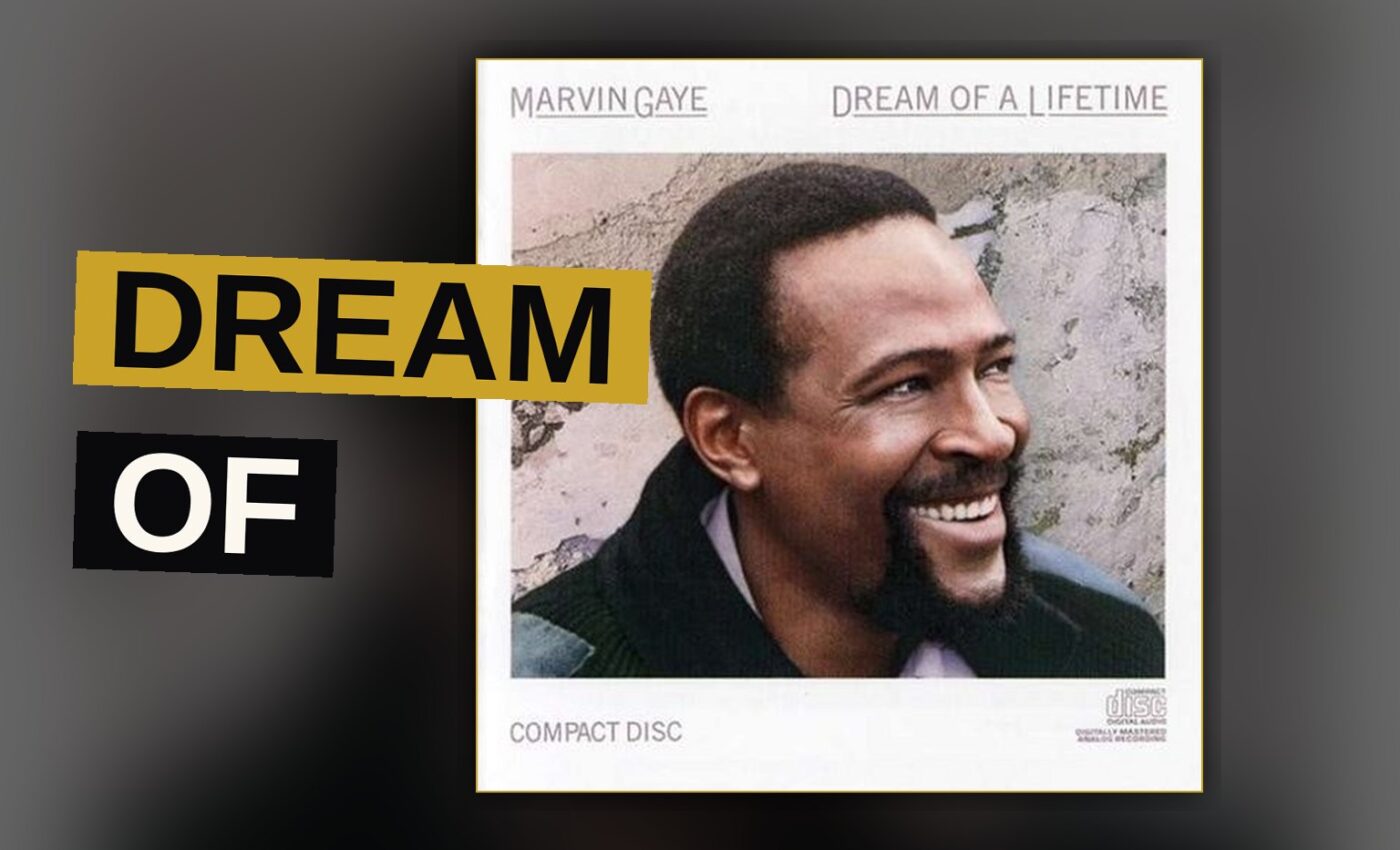
Marvin Gaye died in 1984, and his voice kept arriving. Dream of a Lifetime, released in 1985, is the second posthumous album to carry his name, a collection that stitches together late-period studio experiments with older Motown-era recordings. It is not a coherent statement. It is a drawer turned out, a mix of tender ballads and explicit funk tracks that Gaye recorded in the last years of his life, some of which had never been finished. The record tries to do two things at once: honor the silky soul singer of the 1970s and confront the raw, often uncomfortable sexuality of the man he became. It does neither cleanly.
The result is a document of a brilliant artist in fragments. The eight tracks run 36 minutes, and they sit uneasily next to one another. A song like “Ain’t It Funny (How Things Turn Around)” sounds like vintage Gaye — layered harmonies, a funky bass line, jazzy saxophone — while “Savage in the Sack” is a leering, synth-heavy joke that feels like an outtake from a different career. That clash is the album’s defining feature. It is also its problem.
Opening With “Sanctified Lady”
The album opens with “Sanctified Lady,” a track that Gaye had been working on before his death. It is a slow, grinding funk groove, built on a thick bassline and a spoken-sung vocal that hovers between prayer and seduction. The title suggests holiness; the lyrics suggest otherwise. It is not subtle. Gaye sings about physical desire with a directness that feels more like a dare than a come-on.
The production is dated — drum machines and synthesizers that scream mid-1980s — but Gaye’s voice cuts through it. He sounds engaged, even playful. It is the strongest of the explicit tracks, and the one that most clearly shows what he was reaching for: a fusion of church music and street funk, filtered through a man who was not shy about his appetites.
“Savage in the Sack” follows, and it is a step down. The title alone tells you what you are getting. It is a novelty song, a spoken-word monologue over a clunky beat, in which Gaye brags about his bedroom prowess. The humor is broad, the lyrics are crude, and the music is thin. It is hard to hear this as anything other than filler — a track that should have stayed in the vault. Gaye could be funny, and he could be frank, but this is neither sharp nor witty. It is just there, taking up space.
“Masochistic Beauty” is stranger still. It is a slow, moody piece with a whispered vocal and a dissonant chord progression. The subject matter is dark — the title is not a metaphor — and Gaye leans into the discomfort. It is not a good song, but it is not a throwaway either. It feels like a sketch, an idea that never got the arrangement it needed. The melody is shapeless, and the track drags. It is the kind of thing that only makes sense as a curiosity, a glimpse into a troubled mind. As music, it fails.
“It’s Madness” and the Motown-Era Shift
Then comes “It’s Madness,” and the album shifts. This is a proper song, with a verse-chorus structure and a melody that Gaye sings with real feeling. It sounds like it could have been recorded a decade earlier, and that is a compliment. The production is cleaner, the performance more focused. Gaye is not performing a persona here; he is singing. The track is short — just over three minutes — and it leaves you wanting more. It is a reminder that even in his later years, Gaye could deliver a straight-ahead soul ballad with ease.
“Ain’t It Funny (How Things Turn Around)” is the album’s centerpiece. It is a multitracked Gaye, his voice stacked in harmony over a funky bass line and punctuated by jazzy saxophone. The arrangement is bright, the groove is tight, and the lyrics are rueful — a meditation on how love changes, how people drift. It is the song that most closely resembles the Marvin Gaye of Let’s Get It On or I Want You. It has warmth and wit and a melody that sticks. If the album had been built around tracks like this, it would be a different record entirely. Instead, it is a high point surrounded by oddities.
“Symphony” is a short instrumental interlude, just under three minutes. It is pleasant enough, a light funk groove with some keyboard flourishes, but it does not go anywhere. It feels like a sketch, a transition piece that was never meant to stand alone. It does not hurt the album, but it does not help it either. It is the kind of track you skip without thinking.
“Life’s Opera” and the Title Track
“Life’s Opera” is the longest track on the record, at 7:42. It is an ambitious piece, a suite-like song that moves through several sections, with Gaye singing about the arc of a life — love, loss, regret, acceptance. The production is sparse, mostly piano and voice, and Gaye gives a committed performance. But the song overstays its welcome.
The sections do not cohere, and the length feels like indulgence rather than structure. There is a good five-minute song buried in here, but it is buried deep. It is the kind of track that rewards patience, but only barely.
The title track, “Dream of a Lifetime,” closes the album. It is a ballad, slow and reflective, with Gaye singing about hope and mortality. It is not a great song, but it is a fitting one. The title suggests a summing-up, a final statement, and Gaye delivers it with a quiet dignity. The melody is simple, the arrangement is spare, and the vocal is warm. It is a gentle ending to a messy record. It does not resolve the contradictions of the album, but it does soften them.
A Collection of Leftovers
The problem with Dream of a Lifetime is that it is not really an album. It is a collection of leftovers, some of which were never finished. The explicit tracks — “Sanctified Lady,” “Savage in the Sack,” “Masochistic Beauty” — were recorded in the early 1980s, when Gaye was experimenting with a more confrontational sound. The Motown-era tracks — “It’s Madness,” “Ain’t It Funny (How Things Turn Around),” “Symphony” — are older, smoother, more polished. They do not belong together. They were never meant to be together. The record company assembled them after Gaye’s death, and it shows.
That does not make the album worthless. The good tracks are genuinely good, and they justify the release. “Ain’t It Funny (How Things Turn Around)” is a lost gem, a song that deserves a place in Gaye’s catalog. “It’s Madness” is a solid ballad. “Sanctified Lady” is a fascinating artifact, a glimpse of where Gaye was heading. But the filler is hard to defend. “Savage in the Sack” is embarrassing, “Masochistic Beauty” is unfinished, and “Symphony” is a placeholder.
There are better posthumous collections in Gaye’s catalog. Vulnerable and You’re the Man are more coherent, more finished, more respectful of his legacy. Dream of a Lifetime is not in that class. It is a curiosity, a footnote. For completists, it is essential. For everyone else, it is a mixed bag.
The Final Verdict
Dream of a Lifetime is a record that cannot decide what it wants to be. It is half a great album and half a cautionary tale. The great half — “It’s Madness,” “Ain’t It Funny (How Things Turn Around),” “Life’s Opera,” the title track — shows Marvin Gaye at his best: melodic, soulful, emotionally direct. The other half — “Savage in the Sack,” “Masochistic Beauty,” “Symphony” — shows him at his most indulgent, with material that should have stayed in the vault.
The album is not a failure. It is a document. It shows a brilliant artist in decline, struggling with his demons, reaching for something new and not quite finding it. The tenderness is real, and so is the ugliness. That is what makes the record worth hearing, once. It is not what makes it worth revisiting.
The score reflects the split. The good tracks earn their keep. The bad ones drag the whole thing down. As a posthumous release, it is honest about its limitations, but honesty is not the same as quality. This is a record for fans who want the complete picture, not for listeners looking for a new favorite.
4 of 10.
Key Facts
- Album: Dream of a Lifetime — Marvin Gaye
- Release year: 1985 (posthumous)
- Tracks: 8
- Total running time: 36 minutes
- Longest track: “Life’s Opera” (7:42)
- Shortest track: “Symphony” (2:53)
- Score: 4 of 10
Get the Notebook.
The day's best stories and every fresh verdict, in plain English, in your inbox by seven. One email a day, no more.
- Sanctified Lady5:26
- Savage in the Sack3:21
- Masochistic Beauty4:42
- It’s Madness3:23
- Ain’t It Funny (How Things Turn Around)4:55
- Symphony2:53
- Life’s Opera7:42
- Dream of a Lifetime3:49