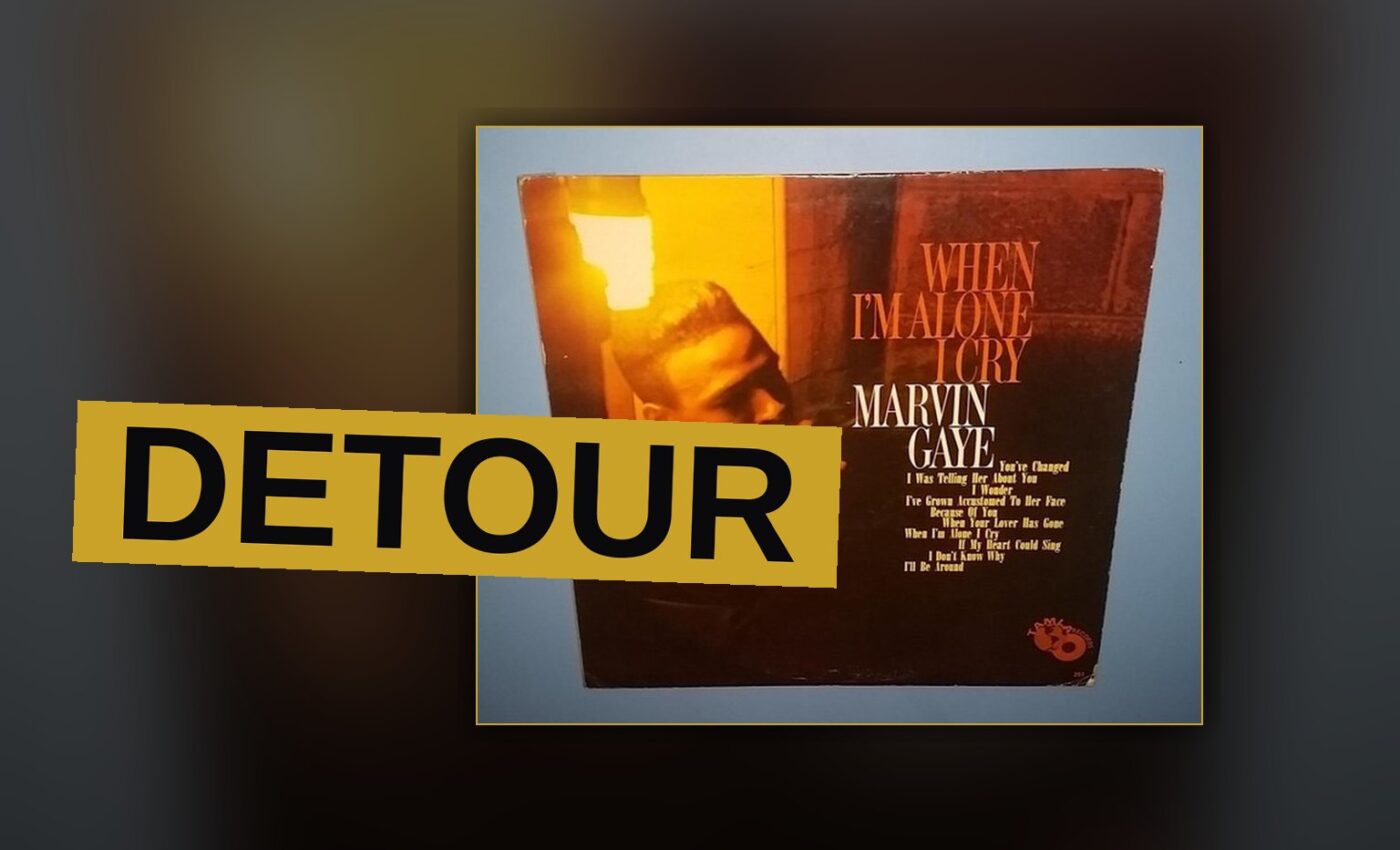
Marvin Gaye’s 1964 album When I’m Alone I Cry is a strange detour. It is a set of ten jazz and pop standards, recorded at the height of his early fame, and it tries to place him as a supper-club crooner in the mold of Nat King Cole. It is not a soul record. It is not a protest record.
The album is competently performed, but it lacks the fire that made Gaye’s later work essential. His voice is there, but it is held on a leash. The band is tight, the arrangements are polite, and the whole thing feels like a dress rehearsal for a career that never arrived.
Opening With “You’ve Changed”
The album opens with “You’ve Changed,” a slow-burning standard that sets the tone. Gaye sings it carefully, almost too carefully, and the restraint reads as stiffness rather than sophistication.
“I Was Telling Her About You” follows, and it is the first real stumble. The track runs past four minutes, but it feels longer. Gaye’s phrasing is deliberate to a fault, and the melody never catches. It is the sound of a singer trying to prove he can handle a ballad, rather than a singer who feels one.
“I Wonder” picks things up slightly. There is a lightness to the swing here, and Gaye sounds more at ease. It is still not a standout, but it is the first moment where the album’s ambition makes sense.
“I’ll Be Around” and the Middle Stretch
“I’ll Be Around” is where the record starts to breathe. The up-tempo arrangement suits Gaye, and for the first time he sounds like he is enjoying himself. The swing is natural, and his voice moves with the band rather than against it.
“Because of You” is a return to the ballads, and it is a step back. The track is pleasant, but it is also forgettable. Gaye’s delivery is polished, yet it lacks the ache that would define his best work.
“I Don’t Know Why” is the shortest track on the album at 2:48, and it is also one of the best. The tempo is brisk, and Gaye’s natural feel for jazz comes through. He swings effortlessly here, and the result is a track that sounds alive in a way the slower numbers do not.
“When I’m Alone I Cry” and the Final Tracks
“I’ve Grown Accustomed to Her Face” is a gentle, wistful number that suits Gaye’s lighter touch. It is not a revelation, but it is a solid performance.
“When Your Lover Has Gone” is a slow, melancholy piece that gives Gaye room to stretch. He handles it well, but the restraint that plagued the earlier ballads returns.
The title track, “When I’m Alone I Cry,” is the centerpiece, and it is a puzzle. Gaye sings it with a sincerity that is hard to dismiss, yet the performance is so controlled that the emotion never fully lands. It is the album in miniature: a capable singer holding back.
The closer, “If My Heart Could Sing,” ends the record on a quiet note. It is a gentle, unassuming track that does not push any boundaries. It is fine. That is the problem.
A Sub-Nat King Cole, Not His Own Man
The critical consensus on this album is harsh, and it is mostly right. AllMusic called it “competently done, but … supper-club fare, in which Gaye comes off as a sub-Nat King Cole rather than his own man.” That is the core issue. Gaye does not sound like himself here. He sounds like a man imitating a style that does not fit him.
David Ritz, Gaye’s biographer, put it more gently: “His ballad style remained self-conscious and restrained… The results were flat, though on the up-tempo numbers he swung effortlessly, demonstrating his natural feel for jazz.” Ritz is right about the up-tempo numbers. “I Don’t Know Why” and “I’ll Be Around” prove Gaye had a real feel for the genre. But the ballads dominate the record, and they drag it down.
The album’s running order does not help. The first four tracks are mostly sluggish, and it takes nearly fifteen minutes for the record to find any momentum. By the time “I’ll Be Around” arrives, many listeners will have already checked out. The back half is stronger, but it is not enough to rescue the whole.
What This Record Reveals
When I’m Alone I Cry is a historical curiosity more than a great album. It shows Gaye at a crossroads, trying to break free of the machine and prove he was more than a hit-maker. The attempt is admirable, but the execution is not.
The album also reveals why Gaye’s later work mattered. When he finally embraced his own voice on records like What’s Going On, the difference was night and day. Here, he is a guest in someone else’s world. There, he is the architect of his own.
That is not to say the record is worthless. The up-tempo tracks are genuinely enjoyable, and Gaye’s voice is always a pleasure to hear. But as a complete statement, the album is a misfire.
Ranking the Tracks
- “I Don’t Know Why” — the best track, with real swing.
- “I’ll Be Around” — lively and natural.
- “I Wonder” — light and at ease.
- “I’ve Grown Accustomed to Her Face” — solid but unremarkable.
- “If My Heart Could Sing” — gentle and fine.
- “When Your Lover Has Gone” — competent but flat.
- “You’ve Changed” — careful to a fault.
- “Because of You” — pleasant and forgettable.
- “When I’m Alone I Cry” — sincere but restrained.
- “I Was Telling Her About You” — the weakest track.
The Verdict
The album is not terrible. It is just unremarkable. It is the sound of a great singer wasting his time on material that does not suit him, and the result is a record that is easy to respect and hard to love.
It is a footnote in Gaye’s career, and that is where it should stay. If you are a completist, it is worth a listen. If you are looking for the real Marvin Gaye, you will not find him here.
4 of 10.
Get the Notebook.
The day's best stories and every fresh verdict, in plain English, in your inbox by seven. One email a day, no more.
- You’ve Changed3:35
- I Was Telling Her About You4:51
- I Wonder3:47
- I’ll Be Around4:11
- Because of You3:36
- I Don’t Know Why2:48
- I’ve Grown Accustomed to Her Face3:34
- When Your Lover Has Gone4:42
- When I’m Alone I Cry2:49
- If My Heart Could Sing3:31