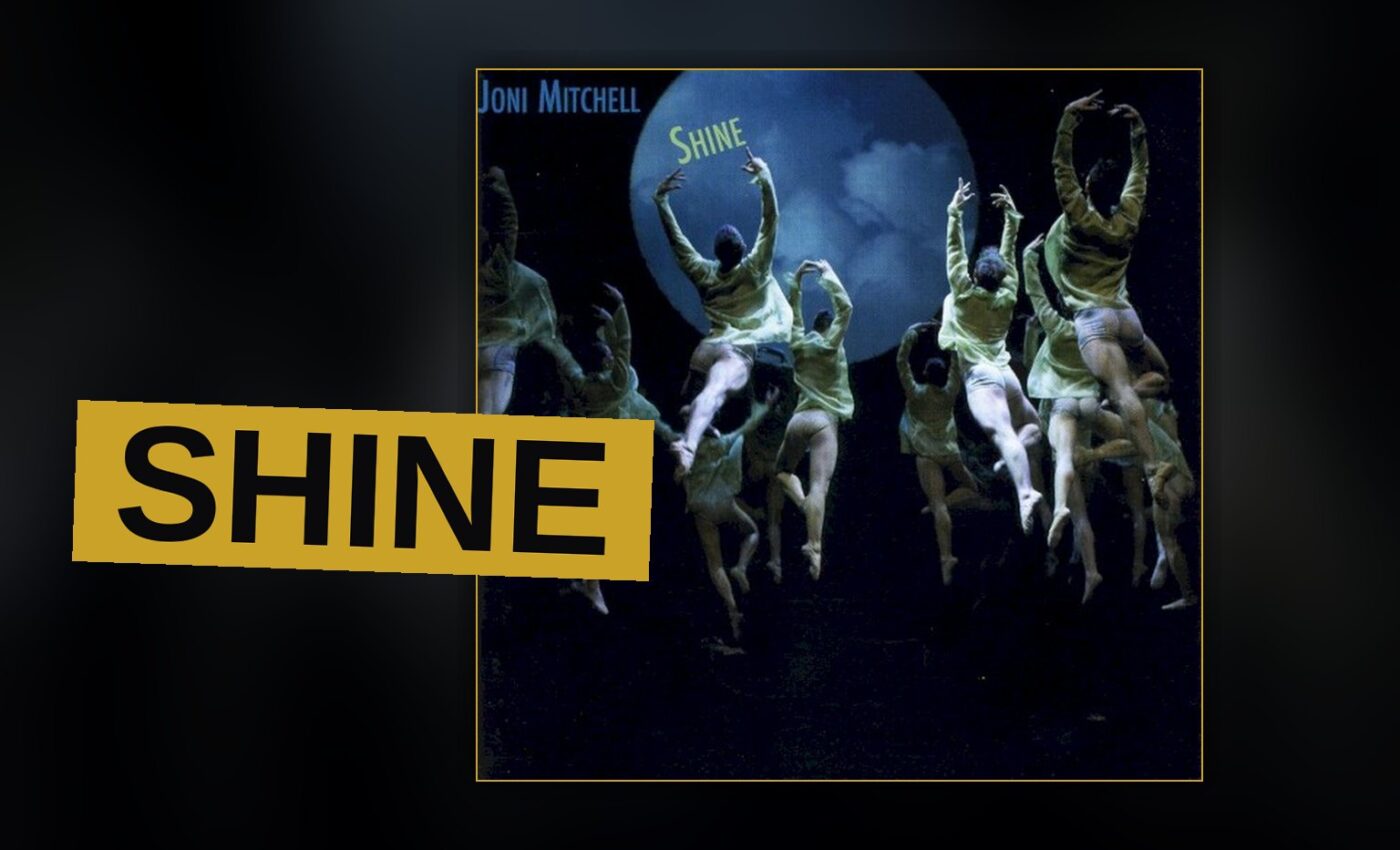
Joni Mitchell’s Shine is a record that knows exactly what it is: a late-career statement from a songwriter with nothing left to prove and a great deal left to say. Released in 2007, it is her first album of new material in nearly a decade, and it does not waste that time.
The record is serene but not sleepy, assured but not complacent. It revisits the folk-jazz textures that made her a legend while turning a steady, unblinking eye toward war, greed, and a planet in decline. These are not shouted protests. They are solemn premonitions, songs that feel less like arguments and more like weather reports from a future that has already arrived.
That tone gives Shine its particular power. Mitchell is not angry here, or at least not hot with anger. She is measured, almost oracular, singing about broken systems and broken landscapes with the calm of someone who saw it coming decades ago. The album does not beg for your attention. It assumes it. And it earns it.
Opening With Instrument
The record begins with “One Week Last Summer,” a five-minute instrumental that sets the temperature for everything that follows. It is unhurried, drifting through piano and guitar with a gentle, almost meditative pull. There is no vocal, no message, just texture and mood. It works as an overture, but it also works on its own terms, a piece of music that asks you to slow down before the words arrive.
“This Place” follows, and it is the first real song of the record. It is a quiet, searching number, the kind of track that feels like a memory being turned over in the hand. Mitchell’s voice has deepened with age, and she uses it differently now, leaning into its lower registers and letting the words settle rather than soar. The track is one of the album’s strongest, a reminder that her gift for melody never left, even as her concerns shifted toward the elegiac.
“If I Had a Heart” keeps the momentum going. It is a slower, more deliberate piece, built around a simple central question. The arrangement is sparse, leaving plenty of room for the lyrics to breathe. It is not a showstopper, but it does not need to be. It is the sound of a songwriter in full control, choosing restraint over flourish and trusting the material to carry the weight.
Hana and the Album’s Center
“Hana” is where the album starts to open up. It is a warm, rolling track, and it carries a sense of place that few songwriters can conjure. The guitars are soft, the rhythm is easy, and Mitchell sounds almost content. It is a brief respite before the darker material that follows, and it is all the more valuable for that.
“Bad Dreams” is the first real shadow on the record. It is a longer track, and it leans into the unease that has been simmering beneath the surface. The title is literal. The song is about the nightmares that come with living in a broken world, and Mitchell does not soften the edges. It is not a scream, but it is not a lullaby either. It sits in the middle of the album like a weight, reminding you that the serenity of the opening tracks was never the whole story.
Then comes “Big Yellow Taxi (2007),” the re-recording of her 1970 classic. This is the riskiest move on the record, and it mostly pays off. The new version strips away some of the brightness of the original and lets the song’s environmental message sit closer to the surface. It is not a radical reinterpretation, but it does not need to be. The song still works, and hearing it in Mitchell’s older voice adds a layer of ruefulness that the original, for all its charm, did not have.
Night of the Iguana and the Long Tracks
“Night of the Iguana” is a slow, atmospheric piece, the kind of track that rewards patience. It takes its time, building a mood rather than a melody, and it lands as one of the more distinctive songs on the record. It is not an easy listen, but it is a rewarding one, the sound of an artist still willing to experiment within her own vocabulary.
“Strong and Wrong” is shorter and more direct. It is a pointed song, the closest the album comes to a straightforward critique. The title says it all. Mitchell is not interested in nuance here, and the bluntness is refreshing after the album’s more meditative stretches.
The title track, “Shine,” is the penultimate song on the record, and it is a centerpiece that builds slowly. It is the album’s thesis statement, a song about the possibility of light in a dark time. It is not triumphant. It is not despairing either. It simply holds the two feelings together and lets them coexist. It is a long song, but it earns its length, building gradually to a conclusion that feels earned rather than forced.
The album ends with “If,” a short, quiet closer that sums up the record’s concerns without overstating them. It is not the strongest track here, but it does not need to be. It is a benediction.
Filler Tracks and Their Role
Not every song on Shine is essential. “If I Had a Heart” is solid, but it does not linger the way the album’s best moments do. It serves the record’s mood, filling out its emotional arc, but it is unlikely to be the track you return to. That is not a failure. A record like this needs connective tissue, and this song provides it without dragging the whole down.
That said, the track is not merely background. It is a deliberate, well-built piece that shows Mitchell’s restraint, and it holds up on its own terms even if it does not demand repeat listens. The tension between its craft and its modest impact is part of what makes the album work. It is a song that knows its place.
The re-recorded “Big Yellow Taxi” is also a slight question mark. It is good, but it is not necessary. The original still exists, and it still works. The new version adds context rather than improving on the source. It is a curio, a footnote, but a pleasant one.
An Aged Voice, A New Authority
The most striking thing about Shine is how Mitchell’s voice has aged. It is lower now, rougher at the edges, and it no longer has the soaring clarity of her 1970s work. But she has adapted. She sings within her range, letting the words do the work instead of the melody. It is a different instrument, but it is still a fine one, and it gives these songs a gravity they might not have had thirty years earlier.
That is the album’s real subject, in a way. Time. Time passing, time running out, time doing its slow damage to people and places alike. Mitchell is not fighting time here. She is acknowledging it, working with it, and the record is stronger for that acceptance.
The Verdict on Shine
Shine is a comeback in the truest sense. It is not a return to past glories, because Mitchell was never trying to replicate them. It is the sound of an artist picking up where she left off and finding that she still has something to say. The album is calm, confident, and often beautiful, and it stands as one of the strongest records of her later career.
It is not perfect. Some tracks are stronger than others, and the album’s overall pace is slow enough that it can test your patience. But that is a feature, not a bug. Shine asks you to slow down, to listen closely, to sit with what it is saying. It rewards that attention.
Critics have been generous in their praise. The BBC called it her best work since the 1970s, and Pitchfork heard a centered, premonitory tone throughout. The record’s strengths are clear on their own terms. It stands without comparison, a late-career statement from an artist who never stopped paying attention, who never stopped caring, and who still knows exactly how to turn a feeling into a song.
- Serene, assured songwriting that rewards close listening
- Strong center in “Hana” and “Bad Dreams”
- A re-recorded classic that adds context without replacing the original
- A voice that has aged into new authority
Shine is the sound of an artist at peace with her own legacy and still alert to the world around her. It is a quiet record, but it is not a small one. It is a warning, a comfort, and a reminder all at once.
Get the Notebook.
The day's best stories and every fresh verdict, in plain English, in your inbox by seven. One email a day, no more.
- One Week Last Summer5:00
- This Place3:55
- If I Had a Heart4:05
- Hana3:43
- Bad Dreams5:42
- Big Yellow Taxi (2007)2:47
- Night of the Iguana4:38
- Strong and Wrong4:04
- Shine7:30
- If5:33