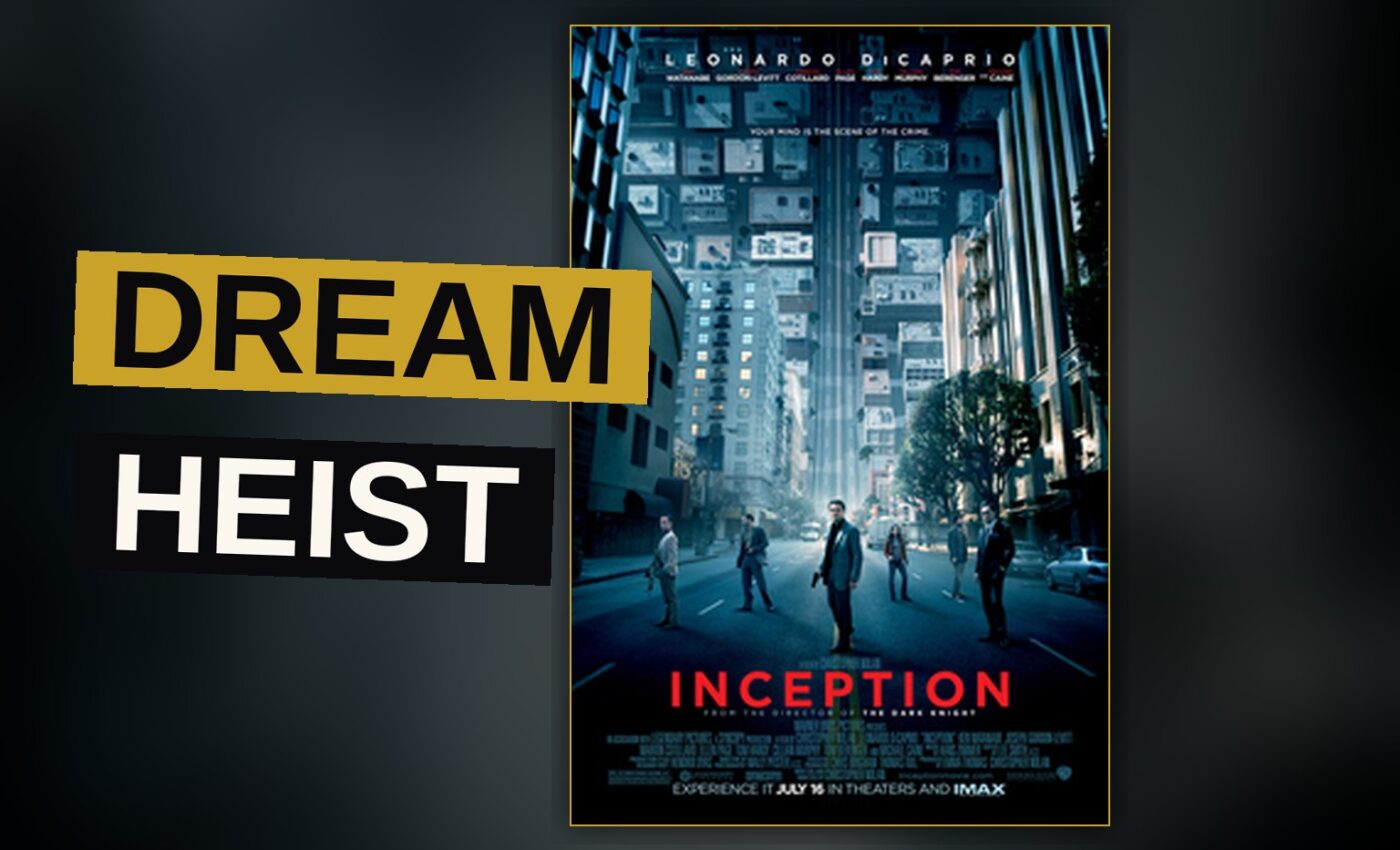
Christopher Nolan’s Inception is a heist movie that steals into your subconscious and refuses to leave. It is a film about dreams, but it is built with the precision of a Swiss watch. Leonardo DiCaprio leads a team of extractors who invade a target’s mind to plant an idea, and the result is a blockbuster that demands your full attention.
The plot is deceptively simple. Dom Cobb (DiCaprio) is a professional thief who steals secrets from deep within the dreaming mind. He is offered a chance to erase his criminal past if he can perform an inception — the reverse of extraction, planting an idea so the target believes it is his own. The job takes the team through multiple layers of dream-within-a-dream, each level bending time and reality in new ways.
Trailer, via Warner Bros..
Dream Layers Explained
Nolan gives the dream logic clear rules, and he sticks to them. A kick — a falling sensation — pulls you out of a dream. Death in a dream wakes you up, unless you are sedated. Time runs faster in deeper levels. The team’s plan involves three distinct layers, each with its own environment and challenge.
| Dream Level | Location | Time Dilation | Objective |
|---|---|---|---|
| Layer 1 | Rain-soaked city | 5 minutes = 1 hour | Kidnap Fischer |
| Layer 2 | Luxury hotel | ~10 hours = 1 week | Manipulate Fischer |
| Layer 3 | Snow fortress | ~6 months = 10 years | Plant the idea |
| Limbo | Endless cityscape | Infinite | Rescue Cobb |
Assembling the Crew
Nolan assembles a cast that sells the impossible with straight faces. DiCaprio carries the emotional weight as a man haunted by his dead wife, Mal (Marion Cotillard). Joseph Gordon-Levitt plays Arthur, the point man, with crisp professionalism. Tom Hardy’s Eames provides the wit, and Elliot Page’s Ariadne serves as the audience’s guide, learning the rules of dream architecture alongside us.
- Dom Cobb — Extractor, haunted by guilt
- Arthur — Point man, handles logistics
- Eames — Forger, impersonates in dreams
- Ariadne — Architect, builds the dreamscapes
- Saito — Businessman, funds the mission
Action Set Pieces
The action sequences are built around the dream rules. Gordon-Levitt’s zero-gravity fight in a hotel corridor is a marvel of practical effects and choreography. The van falling in slow motion while the team fights in the next level up is a masterstroke of cross-cutting. Nolan shows you the mechanics, and the tension comes from watching them work.
The snow fortress assault is a full-scale military operation, complete with avalanches and machine guns. Each set piece escalates the stakes, and the editing keeps all four layers legible.
Cobb’s Emotional Burden
The heist is the engine, but the heart is Cobb’s grief. Mal appears throughout the dreams, a projection of his guilt and his inability to let go. His journey is about accepting that he cannot control his memories. The film’s famous final shot — the spinning top — asks whether Cobb has truly returned to reality or is still dreaming.
That ambiguity is the point.
Sound and Score
Hans Zimmer’s score is a character in itself. The blaring horn motif that drives much of the soundtrack is now iconic, and the slowed-down version of Édith Piaf’s “Non, je ne regrette rien” is used as the kick signal within the film’s own logic. The sound design is immersive, from the thunder of the train to the quiet hum of the dream machine.
Flaws and Triumphs
Inception is a rare thing: a spectacle that rewards repeat viewing. The plot is intricate but never incoherent. The performances are grounded. The visuals are stunning. It is not a flawless film — the expository dialogue can feel heavy, and the second act drags slightly — but its ambition is undeniable.
The film asks big questions about reality, memory, and the stories we tell ourselves.
That it does so inside a genre framework is a triumph. Inception is a masterpiece of modern cinema.
Score
8.4/10 — matching the published TMDB audience score from 40,141 votes.