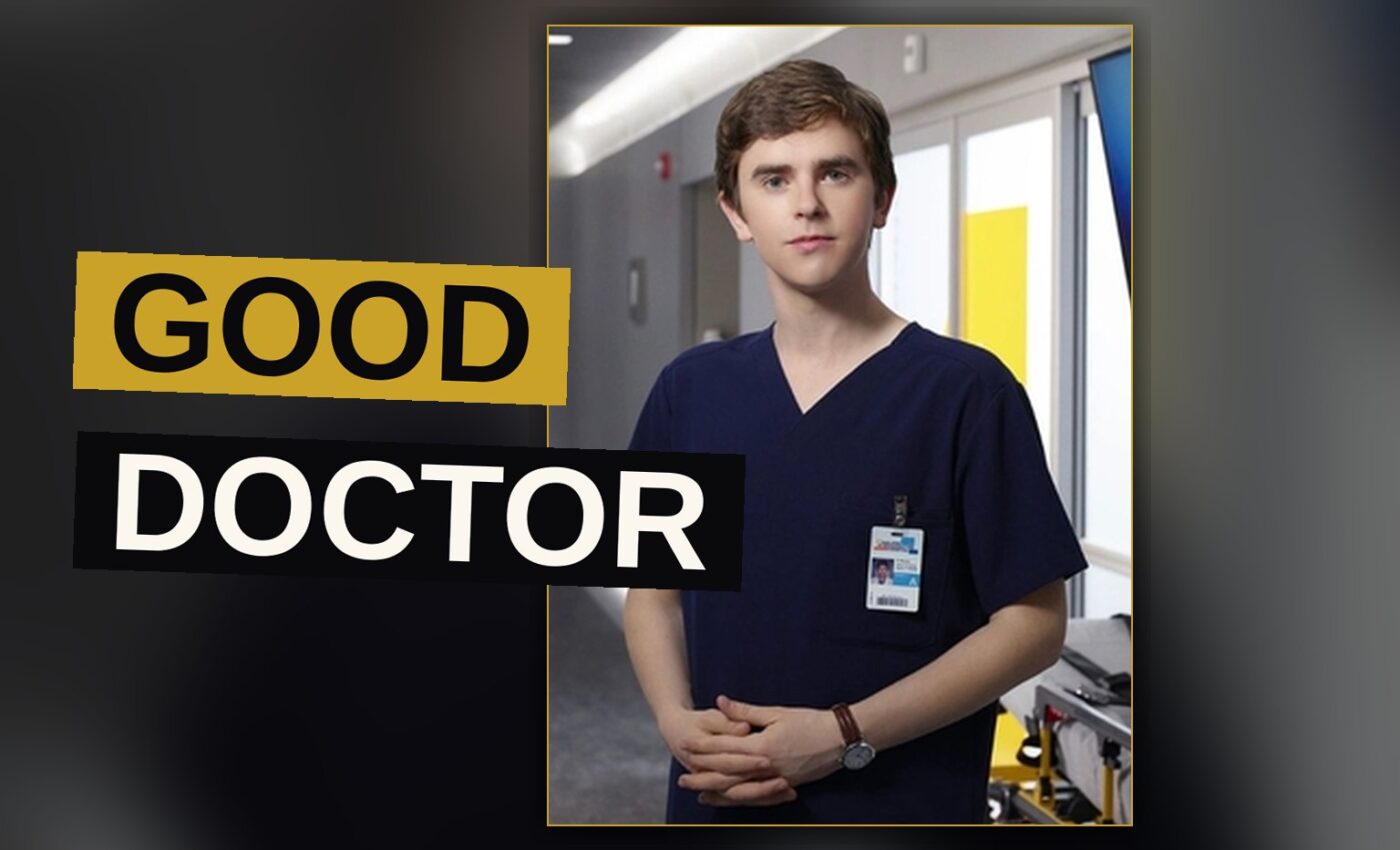
Dr. Shaun Murphy, played by Freddie Highmore, arrives at San Jose St. Bonaventure Hospital as a surgical resident with autism and savant syndrome. The premise of The Good Doctor is simple: a brilliant surgeon who sees the world differently, and whose gifts are both a gift and a curse. The execution, however, is far less simple.
The show premiered in September 2017 on ABC. It ran for six seasons, ending in May 2023. Its premise was built around Murphy’s struggle to fit into a system designed for neurotypical doctors. The hospital staff, led by Dr. Neil Melendez (Nicholas Gonzalez) and Dr. Jessica Preston (Nicole Kidman), tries to help him navigate the social and professional challenges of being a doctor while also relying on his extraordinary abilities.
Trailer, via Sony Pictures Entertainment.
Central Hook
The show’s central conceit is that Murphy can diagnose patients faster than anyone else because he processes information in a way that seems almost supernatural. He memorizes every patient’s chart, recalls every symptom, and connects dots that other doctors miss. That ability is the engine of the show’s procedural plots, and it is genuinely compelling in theory.
But the show often treats the savant syndrome as a superpower rather than a neurological condition. Murphy’s gifts are presented as a constant advantage, a tool that always works. There is little exploration of how his condition affects his personal life, his relationships, or his sense of self. The show leans on the trope of the disabled genius who is smarter than everyone else, which is a thin foundation for a six-season drama. The show wants to explore Murphy’s inner life, but it repeatedly returns to the same surface-level depiction of his gifts instead of delving into what they mean for him as a person.
Disability Portrayal
Murphy’s autism is another point of friction. The show frequently explains his behavior to other characters, as though they need to be told why he avoids eye contact or why he struggles with small talk. This can feel condescending, as if the audience is too stupid to understand autism without a lecture.
The show also tends to flatten Murphy’s identity into his condition. He is defined by his autism and his savant syndrome, and there is little room for him to be a fully realized person. His romantic relationships are handled awkwardly, and his friendships are often reduced to the function they serve in the plot. The show wants to celebrate him, but it keeps finding ways to make him a spectacle. Murphy is shown to be kind, intelligent, and skilled, but those traits are often overshadowed by the show’s tendency to treat his condition as a defining feature rather than one aspect of a whole person.
Medical Cases
The medical cases themselves are mostly standard TV fare. They involve rare diseases, complex surgeries, and ethical dilemmas that the show resolves with a speech about compassion. The science is occasionally accurate, but the show leans heavily on dramatic license. Patients are cured at the last minute, diagnoses are made moments before death, and everyone survives to deliver a monologue about hope.
The show’s best episodes are the ones that focus on the human cost of medicine. A case involving a young girl dying of cancer, or a patient whose surgery goes wrong, can land with real weight. But those moments are rare, buried under a season of formulaic plots and predictable twists. When the show shifts focus from the medical mystery to the emotional stakes, it can produce some of its most affecting scenes. But those scenes are few and far between.
Ensemble Cast
The ensemble cast is strong. Nicholas Gonzalez brings warmth to Melendez, the chief of surgery who becomes Murphy’s mentor. Nicole Kidman plays Preston, the head of pediatrics, with a sharp intelligence that anchors the show. Chukuwei Okunwa, as Dr. Marcus Andrews, and Richard Schiff, as Dr. Aaron Glassman, round out the senior staff with their own distinct personalities.
Freddie Highmore carries the show, and he does it well. He plays Murphy with a physical presence that communicates the character’s isolation, even when the dialogue fails him. His performance is the reason the show works at all, and it is worth watching for his work alone. Highmore’s portrayal gives Murphy a sense of humanity that the show’s writing sometimes fails to provide.
Criticism
The show has been criticized for its portrayal of disability, and the criticisms are fair. The savant syndrome is treated as a gift without cost, and Murphy’s autism is often used as a punchline. The show also relies on the “inspiration porn” trope, where Murphy is celebrated for being different rather than being treated as an equal.
These issues are not unique to The Good Doctor, but they are amplified here. The show wants to be progressive, but it keeps falling back on familiar tropes. It is a show about a doctor who sees things differently, but it rarely asks what that difference means for him as a person. The show’s intentions are good, but its execution consistently falls short.
Season Schedule
| Season | Episodes | Premiere Date | Final Date |
|---|---|---|---|
| 1 | 22 | Sep 25, 2017 | May 21, 2018 |
| 2 | 22 | Sep 24, 2018 | May 20, 2019 |
| 3 | 22 | Sep 23, 2019 | May 18, 2020 |
| 4 | 22 | Sep 21, 2020 | May 17, 2021 |
| 5 | 22 | Sep 20, 2021 | May 16, 2022 |
| 6 | 22 | Sep 26, 2022 | May 13, 2023 |
The show aired for six seasons, each with 22 episodes, and it maintained a consistent schedule across all of them. The final season ended in May 2023, bringing the series to a close after nearly six years on the air.
Legacy
The Good Doctor was a hit. It earned high audience ratings. But popularity is not the same as quality. The show had a strong premise and a capable lead actor, but it failed to build a lasting legacy beyond its initial success.
The show’s strengths are all in the execution. The writing is often shallow, the direction is competent but unremarkable, and the pacing drags in the middle seasons. The show relies on its emotional beats to carry it, and those beats become repetitive over time. The show’s emotional core is strong, but its storytelling structure weakens it.
The show’s weaknesses are structural. The savant syndrome and autism tropes are overused, and the show’s treatment of disability is problematic. These are not flaws that can be fixed with a better episode. They are flaws baked into the show’s DNA. The show’s foundation is flawed, and individual episodes cannot overcome that flaw.
The show is not a failure. It is a show that could have been much better. It has a great idea, a great actor, and a dedicated audience. But it chose to coast on its premise rather than push past it. The show had everything it needed to succeed, but it never quite reached its full potential.
Get the Notebook.
The day's best stories and every fresh verdict, in plain English, in your inbox by seven. One email a day, no more.