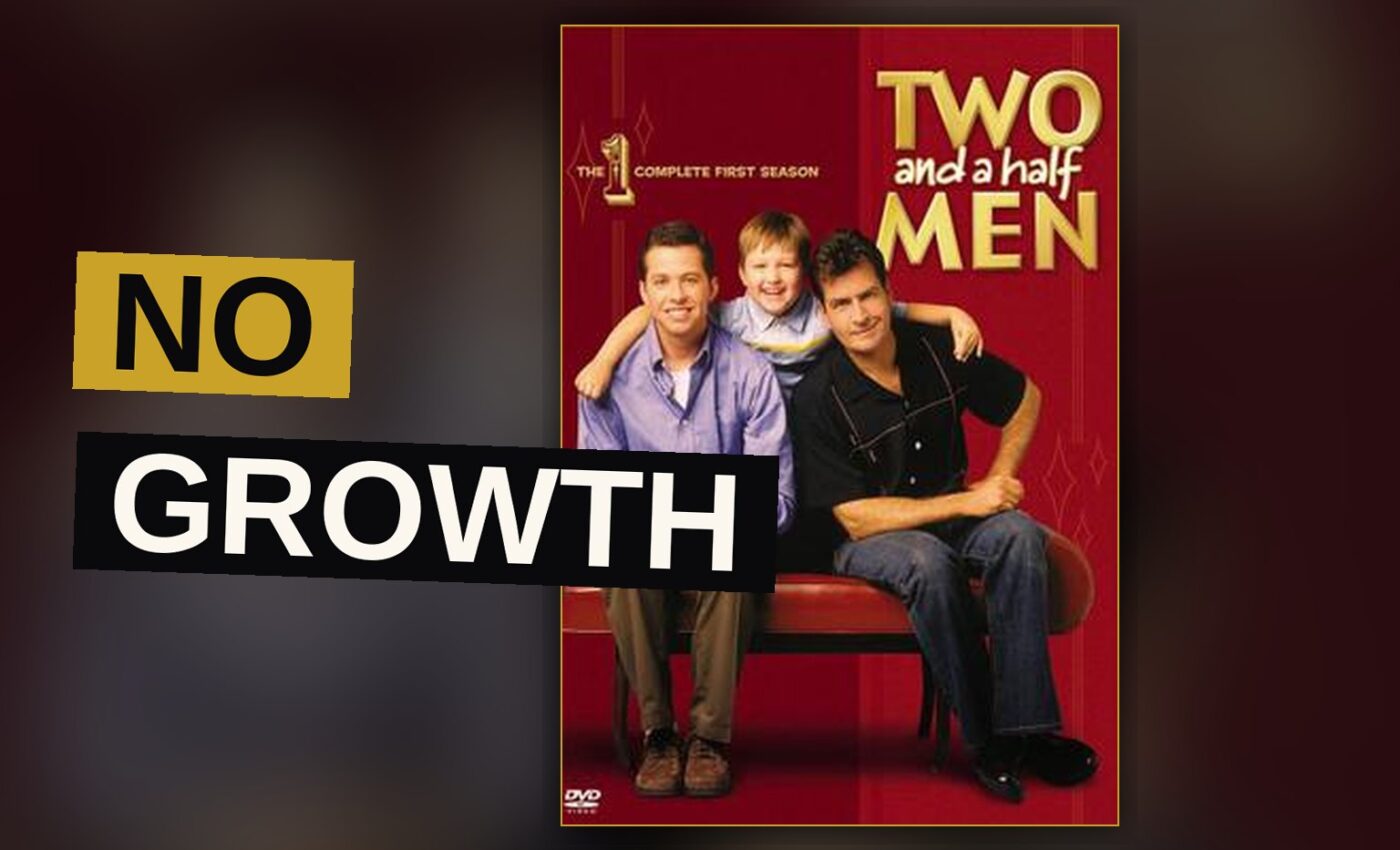
“Two and a Half Men” ran for twelve seasons, and it is still easy to explain why it never got better. The show was built on a simple idea: Charlie Harper, played by Charlie Sheen, is a wealthy bachelor who lives with his younger brother Alan and Alan’s son Jake. The setup promised satire. What it delivered was repetition.
Trailer, via Peacock.
Charlie Harper’s Problem
Charlie Sheen plays Charlie Harper as a man who never grew up. He spends his days watching sports, sleeping with women, and complaining about his neighbors. The joke is that he is rich and miserable. The problem is that the joke never changes. Each episode follows the same pattern: Charlie makes a bad decision, someone points out how stupid he is, and the episode ends with him getting what he deserves.
This structure worked in the early seasons. But after a while, the formula stopped being funny. Watching a character make the same mistake week after week stops feeling clever and starts feeling dull.
Alan Harper’s Problem
Alan, played by Jon Cryer, is supposed to be the opposite of Charlie. He is a divorced father who works in insurance and tries to be responsible. In theory, this contrast should drive the show’s humor. In practice, Alan rarely gets jokes that land. His scenes usually involve him being frustrated or embarrassed by Charlie’s behavior.
The show also leans heavily on Alan’s son Jake, played by Angus T. Jones. Jake is supposed to be a smart kid, but the writers often treat him as a plot device rather than a real person. He exists to make Alan look foolish or to give Charlie a reason to meddle.
The Writing Problem
The dialogue in “Two and a Half Men” is mostly terrible. Lines are delivered with a deadpan delivery that is meant to be sharp, but often just sounds lazy. Characters say things that no actual person would say. The show also relies on crude humor, especially jokes about sex, that feel more dated than funny.
The show’s tone is also inconsistent. Some episodes try to be serious, but the writing is so thin that even those attempts fall flat. Other episodes are pure slapstick, with characters getting hit or falling down for no reason. The mix of tones rarely works together.
The Long Run
Twelve seasons is a long time for any show. For “Two and a Half Men,” it was too long. The quality dropped sharply over time. Later seasons leaned harder on guest stars and plot twists that did nothing to improve the core comedy. The show became a parody of itself without realizing it.
The final season, in particular, featured some of the weakest writing in the series. Jokes about Charlie’s illness were handled poorly, and the show seemed more interested in ending than in saying anything worth remembering.
What Worked
It is not fair to say the show had no good moments. There are episodes where the writing clicks, and the cast delivers lines with genuine energy. The show also benefited from a strong supporting cast, including Constance McMillan as Charlie’s assistant and Marin Hinkle as Alan’s ex-wife.
But these bright spots are rare. They do not change the overall picture of a show that repeated the same jokes for years without learning from them.
Schedule Table
| Season | Years | Total Episodes |
|---|---|---|
| 1 | 2003–2004 | 24 |
| 2 | 2004–2005 | 24 |
| 3 | 2005–2006 | 24 |
| 4 | 2006–2007 | 24 |
| 5 | 2007–2008 | 24 |
| 6 | 2008–2009 | 24 |
| 7 | 2009–2010 | 24 |
| 8 | 2010–2011 | 24 |
| 9 | 2011–2012 | 24 |
| 10 | 2012–2013 | 24 |
| 11 | 2013–2014 | 24 |
| 12 | 2014–2015 | 24 |
That is a lot of episodes. Most of them feel interchangeable.
“Two and a Half Men” is not a terrible show. It is a show that could have been good and chose not to be. It is a show that ran past its welcome and kept running. It is a show that made jokes about maturity while refusing to grow up itself. The final score is 3.3 out of 10.
Get the Notebook.
The day's best stories and every fresh verdict, in plain English, in your inbox by seven. One email a day, no more.