
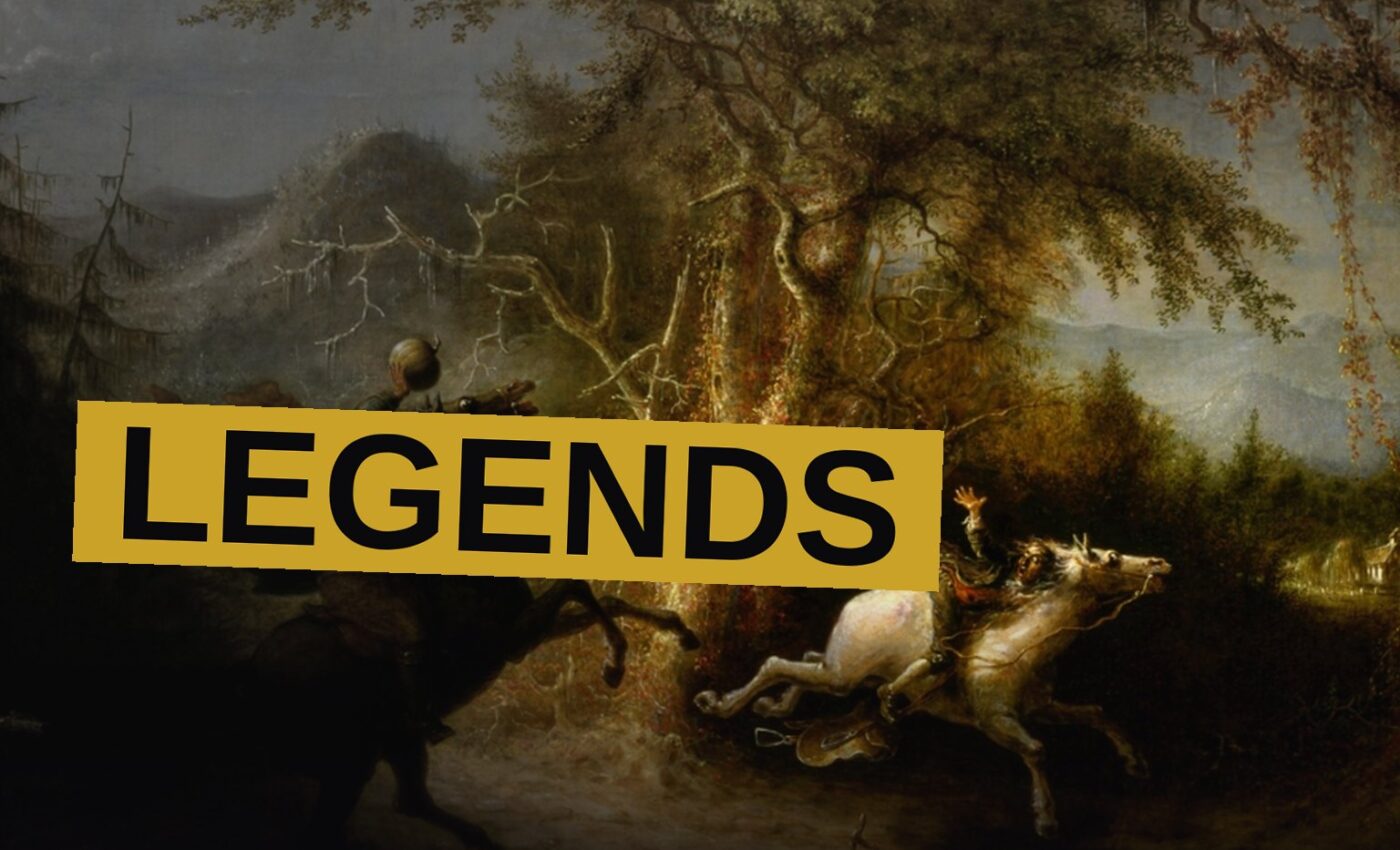
Washington Irving wrote two stories that shaped American literature, and both of them start with a man falling asleep in the woods. “Rip van Winkle” sends its title character into a twenty-year nap that ends with the American Revolution. “The Legend of Sleepy Hollow” follows Ichabod Crane, a schoolmaster who chases a headless horseman across a haunted valley. Both tales are collected in “The Sketch Book of Geoffrey Crayon, Gent.” Phillip Lopate, writing for the New Yorker, argues that the second story endures because of Irving’s storytelling craft, not just its plot.
Rip’s Long Nap
The story opens with Rip, a descendant of the Van Winkles who fought under Peter Stuyvesant, living in a village between the Hudson River and the Catskill Mountains. Rip is described as “a simple, good-natured man … a kind neighbor, and an obedient, hen-pecked husband.” He inherits a farm that falls into ruin while his children run around in rags. His wife, a “termagant,” torments him with constant scolding.
Rip’s escape is a walk in the woods with his dog Wolf. One day, after resting in the forest, he stumbles upon a group of men dressed in old Dutch garb, playing ninepins. They offer him liquor, and he drinks deeply. When he wakes, his dog is gone and his musket has rusted.
He returns to his village to find it changed. No one recognizes him, and his old friends have died. Twenty years have passed. The tavern sign, once bearing a portrait of King George III, now carries the image of George Washington. The disputatious “tavern politicians” ask him which side he voted for, “Federal or Democrat,” and he answers, “loyal subject of the king, God bless him!” They call him a Tory and a spy, but eventually accept his story that he has simply been asleep.
Rip learns that his wife has died, freeing him from her “petticoat government.” He becomes “one of the patriarchs of the village,” telling his story to anyone who will listen. The word “patriarch” appears again in Lopate’s essay, referencing Irving’s own history of New York, where Dutch patriarchs are “idle and quiescent.”
The Politics of Sleep
Steven Blakemore, in his paper “Family Resemblance: The Text and Contexts of ‘Rip Van Winkle,'” argues that the tale carries a political weight. The Dutch past, the Puritan English past, and the revolutionary era all merge in the story. The changes Rip finds suggest Irving’s own ambivalence about where the United States was heading.
Blakemore’s reading is not the whole story. Lopate admits that the political dimension exists, but it is not what draws him back to the tale. He is charmed by Irving’s fluency, his irony, and his ability to move between brisk action and leisurely description.
Ichabod’s Chase
“The Legend of Sleepy Hollow” is introduced as part of the papers left behind by the late Diedrich Knickerbocker. Irving describes the Tarrytown and Sleepy Hollow area near the Hudson River as a place where he might “steal from the world and its distractions, and dream quietly away the remnant of a troubled life.” He later built his house, Sunnyside, in that very spot.
The tale is set up as a Gothic story from the start. Irving writes that the place “still continues under the sway of some witching power. … The whole neighborhood abounds with local tales, haunted spots, and twilight superstitions.”
The hero is Ichabod Crane, a schoolmaster described as “a rather ridiculous-looking schoolmaster” who has set his cap for Katrina Van Tassel, the beautiful, coquettish daughter of a wealthy Dutch farmer. Ichabod’s favorite book is Cotton Mather’s History of New England Witchcraft, which shows him to be “an odd mixture of small shrewdness and simple credulity.” Irving himself had a thorough dislike of Puritanism.
Ichabod is also a glutton. He fixates on the feast at Katrina’s house, imagining “every roasting pig running about with a pudding in his belly, and an apple in his mouth; the pigeons were snugly put to bed in a comfortable pie.”
The Headless Horseman
The story builds toward its famous climax. The legend of the headless horseman waits for Ichabod along the road to Sleepy Hollow.
Lopate focuses on Irving’s prose style, comparing it to Charles Lamb’s method of comic elaboration. The prose reaches a high pitch in describing Ichabod’s appetite.
Why the Story Endures
Lopate’s argument is that Irving’s storytelling is the draw, not the plot. The story’s fame is a measure of American culture’s hunger for resistance to the heroic. The tale’s appeal comes from the writer’s control, his irony, and his ability to pause for fresh details of environment and identity.
The political reading is there, but it is secondary. Irving’s own dislike of Puritanism, his ambivalence about the revolution, and his nostalgia for the Dutch past all sit beneath the surface. But the surface is what Lopate returns to.
Key Facts Box
- “Rip van Winkle”: a man sleeps twenty years and wakes to find the American Revolution has ended
- “The Legend of Sleepy Hollow”: a schoolmaster chased by a headless horseman
- Both stories appear in “The Sketch Book of Geoffrey Crayon, Gent.”
- Diedrich Knickerbocker is the fictional editor who collects the papers
- Sunnyside: Irving’s house built in the Sleepy Hollow area
- Cotton Mather’s History of New England Witchcraft: Ichabod’s favorite book
The Two Tales Compared
- Rip van Winkle sleeps twenty years and wakes to find America has changed.
- Ichabod Crane chases a headless horseman.
- Both tales are set in the Hudson Valley.
- Both involve supernatural elements — Rip’s sleep, the haunted valley.
The two stories share a structure. A man leaves his village, returns, and finds everything altered. The difference is tone. Rip’s return is a comedy of confusion. Ichabod’s is a nightmare.
Lopate’s essay suggests that Irving’s skill with language is the lasting draw. The politics are interesting, but the writing is what endures. Irving’s ability to balance humor and horror, to pause and elaborate, is what makes “The Legend of Sleepy Hollow” a classic.
The headless horseman is a memorable image, but the story’s real power comes from the prose that brings him to life. Irving’s gift, Lopate argues, is his fluency and his irony, his ability to hold two speeds at once — brisk and relaxed, urgent and unhurried. That is the legacy of “The Legend of Sleepy Hollow.”
Source: lithub.com
Get the Notebook.
The day's best stories and every fresh verdict, in plain English, in your inbox by seven. One email a day, no more.