
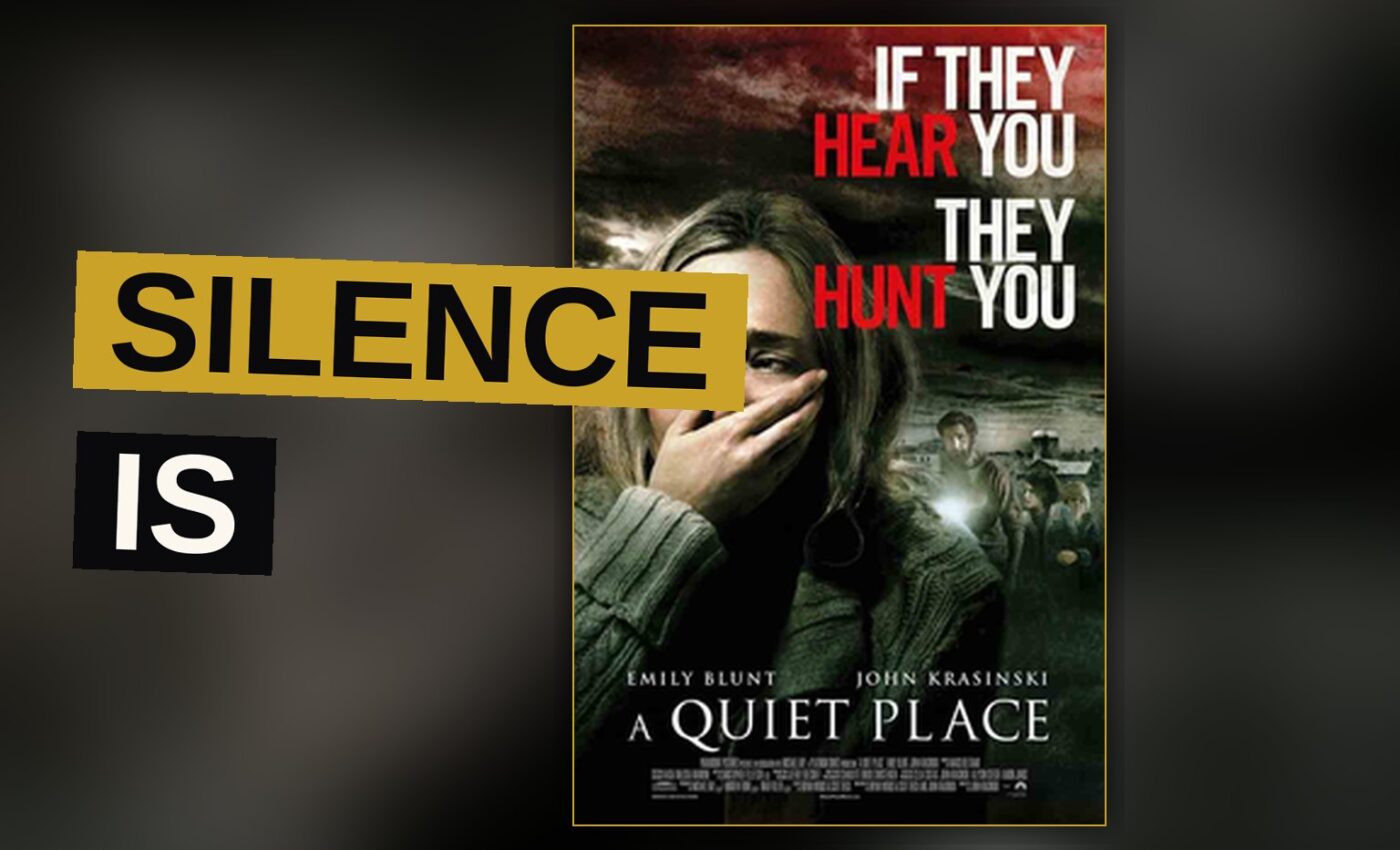
John Krasinski’s A Quiet Place runs 91 minutes and spends most of them telling you to shut up. That is the whole engine of the thing: a family on an isolated farm in Millbrook, New York, surviving not by fighting the creatures that took the planet but by never making a sound they can hear.
Trailer, via Paramount Pictures.
The Sand Paths and the Sign Language
The premise is laid out without a word of exposition. Sightless aliens with sharp hearing and armored skin have killed most of the human population. The Abbott family — father Lee, mother Evelyn, deaf daughter Regan, sons Marcus and Beau — have stayed alive through precautions: sand paths laid to avoid crunching leaves, American Sign Language instead of speech.
It is a horror film that treats silence as a physical substance. Every floorboard is a threat. Every object that could fall is a loaded gun.
Beau and the Toy Space Shuttle
The opening act turns on a toy. In town for supplies, Beau finds a Space Shuttle. Lee pulls the batteries and makes him leave it, because a powered toy makes noise. Regan returns it to him without the batteries. Beau takes the batteries anyway, and nobody sees.
On the walk home he switches it on. The alien reaches him before Lee can. A four-year-old dies in the first fifteen minutes, and the film never lets the family — or the audience — put it down.
Regan carries the guilt and hides it from her parents. Marcus knows. That buried fault line is what the rest of A Quiet Place is built on.
Evelyn, the Nail, and the Red Lights
More than a year later, Evelyn is pregnant. Lee is trying to build Regan a working hearing aid and cannot master the electronics; the attempt throws a high-pitched noise but does not restore her hearing. Marcus goes fishing with his father. Regan, angry she cannot go, visits Beau’s grave.
Evelyn goes into labor alone. Heading for the basement, she steps on an upright nail and drops a photo frame. The noise brings an alien into the house. In pain and fighting to stay silent, she flips a switch that turns the lights around the house red.
It is the best sequence in the film, and it works because the film has spent an hour teaching you what a dropped frame costs.
Millicent Simmonds and the Hearing Aid
Krasinski cast Millicent Simmonds, a deaf actress, as Regan. His reasoning, as he put it, was that he did not want a non-deaf actress pretending to be deaf, and that a deaf actress would help his understanding of the situations tenfold. He wanted someone who lives it and could teach him about it on set.
That decision is the film’s spine. Regan’s deafness is not decoration and not a plot device bolted on for tension. It shapes how the family communicates, how the camera frames a room, and where the sound design puts its emphasis. The hearing aid Lee keeps failing to finish becomes the mechanism the climax turns on.
Emily Blunt plays Evelyn as a woman holding a household together by force of will. Krasinski plays Lee as a survivalist who has narrowed his whole life to getting his family through one more day. Noah Jupe’s Marcus is the child who understands too much and says too little.
Krasinski also provided the motion-capture for the creatures. He directed, co-wrote, and starred — a combination that usually produces a mess. Here it produced one of the most controlled genre films of its year.
What the Silence Costs
A Quiet Place premiered at South by Southwest on March 9, 2018, and Paramount released it in the United States on April 6, 2018. It grossed more than $340 million worldwide and drew critical acclaim. The National Board of Review and the American Film Institute both named it one of the top ten films of 2018.
The awards run tells you where the craft landed:
| Honor | Category | Result |
|---|---|---|
| Academy Awards | Best Sound Editing | Nominated |
| Golden Globe Awards | Best Original Score | Nominated |
| Writers Guild of America | Best Original Screenplay | Nominated |
| Screen Actors Guild | Outstanding Performance by a Female Actor | Won (Blunt) |
| National Board of Review | Top Ten Films of 2018 | Named |
Beck and Woods conceived the story in college and started the script in January 2016. They told Platinum Dunes they wanted Blunt for the mother. Krasinski read the script in July 2016, and by March 2017 he was announced as director, co-writer, and co-star. Shooting ran in upstate New York from May to November 2017.
Where the Film Tightens and Where It Slips
The tagline is “If they hear you, they hunt you,” and the film means it literally. That is a constraint, and constraints are where horror gets good. The sand paths, the sign language, the stripped batteries — these are rules, and the movie obeys them.
The rules also expose the seams. A film built on near-total silence has to keep finding reasons for noise, and by the third act the reasons get thinner. The creatures are terrifying in the dark and less so once the film shows you how they work. Beck and Woods built a machine; Krasinski runs it hard for 91 minutes, and 91 minutes is the right length because the machine has maybe 91 minutes in it.
What holds it together is Regan. The guilt she carries over Beau is the only interior life the film gives you, and Simmonds plays it without a line of dialogue to lean on. When the hearing aid finally matters, it matters because the film made you watch a father fail to build it, over and over, for a daughter who could not hear him anyway.
The Verdict on A Quiet Place
A Quiet Place is a gimmick executed at a level most gimmicks never reach. The premise is one sentence long, and the film never pretends otherwise. What elevates it is the casting of Simmonds and the decision to let deafness shape the film’s grammar rather than serve as a scare tactic. Blunt carries the middle act alone, largely without speech, and it is the strongest stretch of the movie.
The weaknesses are real. The creatures lose menace as they gain definition, and the script’s rules start bending where the set pieces need them to. But this is a film that understands something most horror films forget: the scariest thing in the room is usually the thing you cannot do.
The tagline promises that if they hear you, they hunt you. The film’s better idea is that the family has already stopped being able to hear each other long before the aliens arrived.
Get the Notebook.
The day's best stories and every fresh verdict, in plain English, in your inbox by seven. One email a day, no more.


