
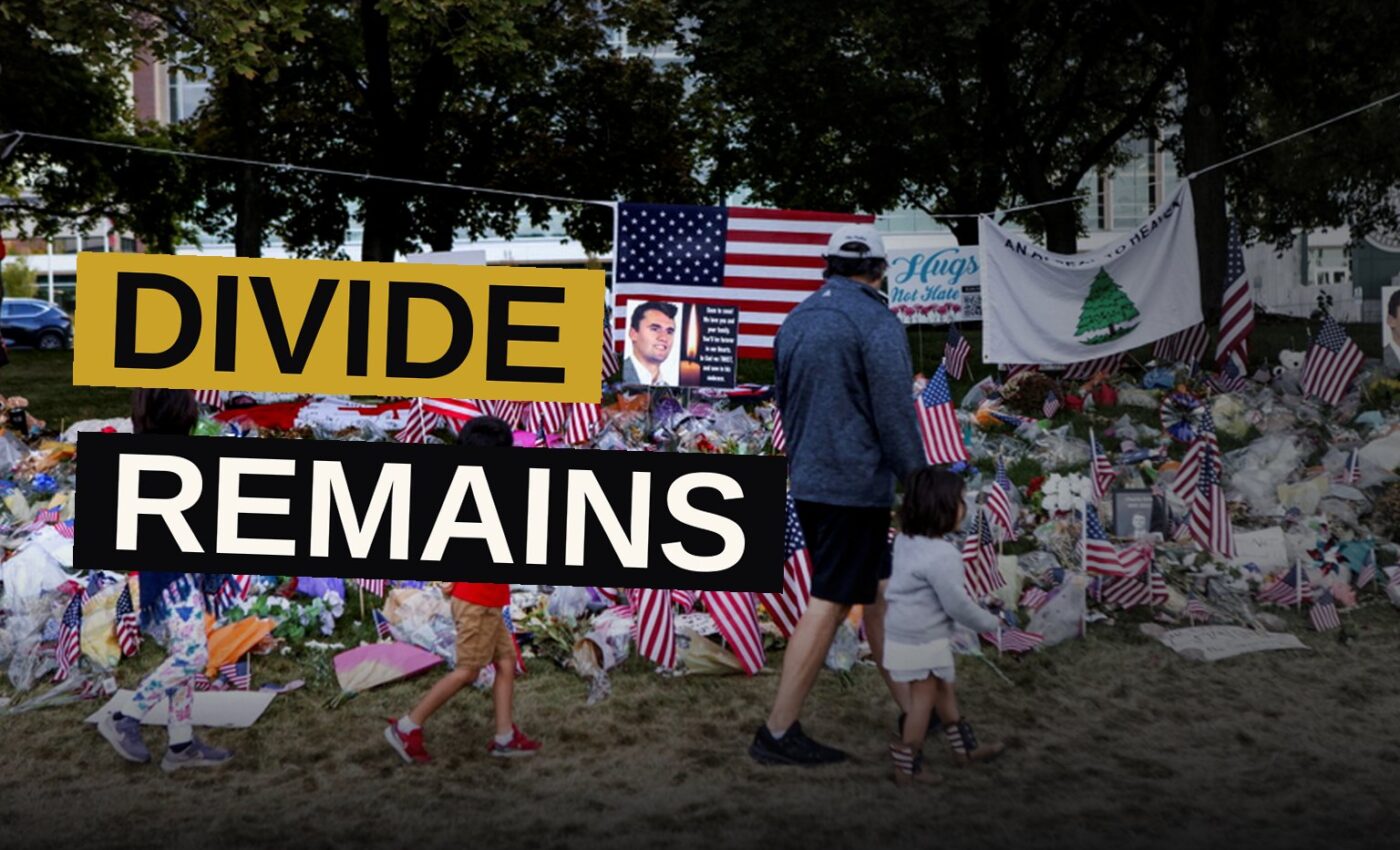
A week into fall semester at Utah Valley University in Orem, Utah, the campus’s grassy, terraced courtyard sits quiet. Collin Grannis, who graduated over the summer, remembers it differently. “It used to be very lively. People doing homework, people taking their food to eat outside, people to hang out. I remember people taking naps on the grass, like right in that area,” he recalled. “And it’s been fully cleared out because people have that association with it.”
A hard-right activist and co-founder of Turning Point USA died on stage last year during a debate with a student who holds progressive political views, in full view of thousands of spectators. The aftermath saw an unprecedented wave of intimidation, harassment and threats that appeared to touch nearly every part of the country.
The Quiet Courtyard
The courtyard’s emptiness now speaks for itself. Grannis described the space as a gathering spot where students stopped to chat and unwind. The fountain’s trickling water once drew people in. Now the grass sits empty, cleared out because of what happened there.
A generation has not seen a conservative youth movement leader as influential as Kirk, and his passing altered the way people behave toward one another online.
Doxing Spreads Through Trusted Circles
Releasing a person’s private identifying details without their permission constitutes doxing. The practice has been employed by both the political right and left in the U.S., though it has changed shape over time.
Shauna Dillavou, who leads Brightlines, a company focused on stopping doxing, traced the practice’s rise through three stages. It began inside gaming subcultures before spreading to violent extremist groups and eventually reaching high-reach social media accounts. According to Dillavou and other experts, Kirk’s death erased what remained of the remaining limits on the practice.
“That creates terrible impacts for people,” Dillavou said. “It’s job losses. It’s career losses. People have to move. They get death threats, and lawsuits. And … those impacts are lasting.”
The Website That Targeted Critics
A website called “Expose Charlie’s Murderers”, which presented itself as “the largest firing operation in history”, opened up for lead submissions just hours after Kirk’s death. The site hinted that those who posted speech showing no sympathy toward Kirk or his death would be treated as “supporting political violence online.”.
Kat Green, who runs the doxing mitigation nonprofit Endora, described it as one of several websites aiming to “out”. The sites displayed names, photographs, employers, social media handles and additional details about numerous individuals who almost certainly never expected their online postings to be waved before a furious crowd.
“It’s a limited pool of people who help with that right now, and everybody was slammed,” said Green. “So we all started working together to see what we could learn about the sites and who was behind them.”
A National Leader’s Call to Arms
The phenomenon of using technology to corral negative attention to crowdsourced targets was not new. For years, Kirk’s organization, TPUSA, featured a “Professor Watchlist” that encouraged college students to report professors teaching “leftist propaganda.”
The request to join came from the very top. On the Monday following Kirk’s death, Vice President Vance took over as host of Kirk’s podcast and personally urged listeners to “get involved.”.
“So when you see someone celebrating Charlie’s murder, call them out – and, hell, call their employer,” Vance said. “We don’t believe in political violence, but we do believe in civility. And there is no civility in the celebration of political assassination.”
“There is just a very different speed and power dynamic around the post-Charlie Kirk assassination, where you have the vice president essentially endorsing some of this,” said Shannon Hiller, executive director of the Bridging Divides Initiative at Princeton University.
Doxing As Incitement
Dillavou saw the tech-enabled outing of Kirk’s critics as incitement to violence rather than a call to civility.
“Doxing is stochastic terrorism,” she said, referring to a phenomenon in which an influential voice’s call to violence increases the likelihood that a random “lone wolf” will act on it. “The idea with doxing is not that the information about you – your personal information, your home address, your phone number – exists online. It does. It’s that … that someone takes up the mantle to come after that person.”
What Happens Next
The “Expose Charlie’s Murderers” website eventually came down.
Jobs were lost, people relocated, and some even received death threats and faced lawsuits. The harm had already occurred.
Whether the split endures is the real issue now. The nation must determine if it can bounce back from a time when a national leader openly backed attacking opponents, turning once-trusted neighbors and friends into rivals instead.
Here is how the sequence of events unfolded:
- Kirk was killed in front of thousands while debating a student with progressive political views.
- Within hours, “Expose Charlie’s Murderers” launched, inviting the public to submit leads on critics.
- On the Monday after the killing, Vance appeared on Kirk’s podcast and told listeners to “get involved.”
- Mirrors of the website emerged even as the original site came down.
| Event | Date |
|---|---|
| Charlie Kirk killed | Last year |
| “Expose Charlie’s Murderers” launched | Hours after the killing |
| Vance’s podcast call to action | Monday after the killing |
| Website taken down | Eventually |
The change has been described in terms of how fast it happened and how widespread it became. The “Expose Charlie’s Murderers” website and other similar platforms reached everyday users whose postings were gathered, distributed and spread through closed groups and trusted circles. It is this distribution of targeting that sets this moment apart from earlier instances of online harassment.
What’s happening here goes beyond ordinary political disagreement. Instead, it marks a change in how people behave toward one another online, turning ordinary Americans into targets merely for expressing their views.
What has been lost is a matter of debate, but the quiet courtyard in Orem stands as a symbol of it.
Get the Notebook.
The day's best stories and every fresh verdict, in plain English, in your inbox by seven. One email a day, no more.