
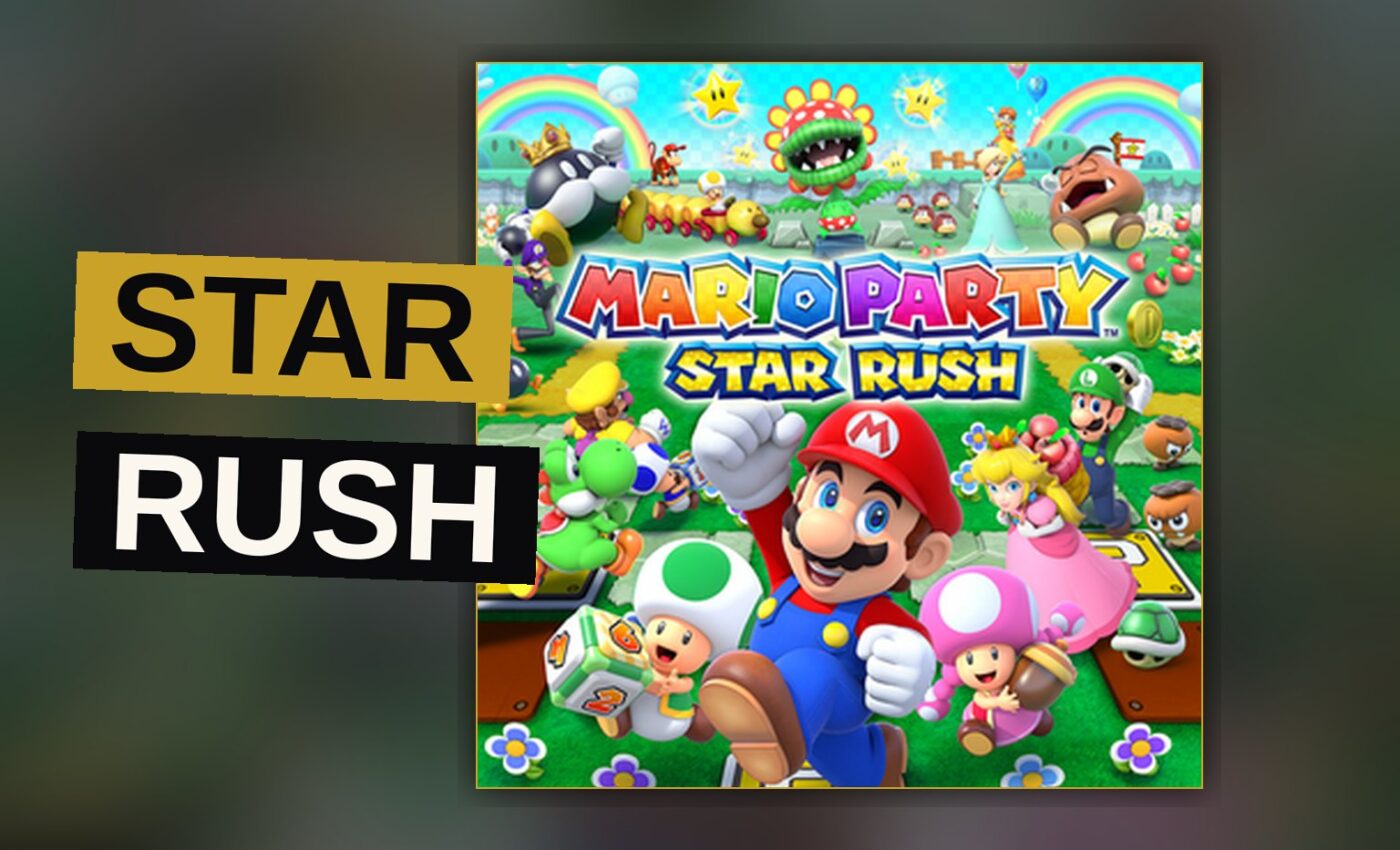
Mario Party: Star Rush arrived on the Nintendo 3DS in 2016 with a problem to solve. The series had spent two entries — Mario Party 9 in 2012 and Mario Party 10 in 2015 — moving every player around a shared car, a design that stripped out the free movement fans had built the franchise on. Star Rush’s answer was to stop taking turns altogether.
Trailer, via Nintendo of America.
Everyone Rolls at Once
Developer NDcube built Star Rush around simultaneous play. Up to four characters roll dice and move across non-linear, grid-like boards at the same time, rather than waiting their turn. Nintendo’s stated goal was faster matches better suited to a handheld you play in short bursts.
It is the fourth handheld entry in the Mario Party series and the second built for the 3DS. Nintendo published it in Europe, Australia and Japan in October 2016, then North America in November.
The roster runs twelve deep:
- Mario, Luigi, Princess Peach, Princess Daisy and Rosalina
- Yoshi, Toad and Toadette
- Donkey Kong, Wario, Waluigi and Diddy Kong
Each is controlled by a human or by AI, and the AI comes in Normal, Hard and Very Hard. A “Party Level” rises as you earn points on performance, unlocking extra characters and modes along the way.
Toad Scramble and the Ally System
The main mode is Toad Scramble. All four players are different-colored Toads. Other Mario characters appear on the boards and can be recruited as AI allies, letting you roll extra dice and get help in boss battles. Each player can hold up to four allies at once.
Items turn up during board games too, used to boost your score or trip up a rival. There are five worlds and fifteen boards, most unlocked gradually. The package holds 53 minigames, 12 of them exclusive to the Coinathlon mode.
Most minigames lean on skill. A couple lean on luck — Haunted Hallways sends players racing to a hidden goal across a map full of Boos and doors.
| Feature | Traditional Mario Party | Mario Party: Star Rush |
|---|---|---|
| Movement | Turn-based | Simultaneous |
| Board style | Linear | Non-linear, grid-like |
| Car mechanic | Present in Mario Party 9 and 10 | Removed |
| Platforms | Varied | Nintendo 3DS |
The Case Against the Boards
The simultaneous turn is the right fix. Waiting through three other players’ dice rolls was the worst part of handheld Mario Party, and Star Rush kills it cleanly. Local multiplayer even lets several people play from a single copy of the game, which matters on a system where everyone in the room may not own the cartridge.
The cost shows up elsewhere. Fifteen boards sounds generous until you learn most are locked behind progression, and the criticism that landed hardest on this game was repetition — modes that wear thin, a thin spread of boards and minigames once you have seen them. Star Rush sold more than 88,000 copies. That is a modest figure, and it reads as a verdict of its own.
The ally system is the most interesting thing here, and it is also the most underused. Recruiting characters to roll extra dice and fight bosses for you gives Toad Scramble a light tactical layer the rest of the game never develops. Four allies per player is a real decision. Few modes ask you to make one.
Compare the two directions the series has now tried. Mario Party 9 and 10 forced everyone into one car and drew complaints that players had lost control of their own turns. Star Rush hands that control back but spreads its content thin. Neither answer is complete on its own.
What Comes After
Nintendo followed Star Rush with Mario Party: The Top 100 in 2017, a minigame compilation for the 3DS. That is a telling move. When the boards are the weak part, you ship the minigames and leave the boards behind.
Star Rush is a course correction that stops short. The simultaneous movement is the series’ best structural idea in years, and the ally recruitment deserves a fuller game than this one. What holds it back is volume — or the lack of it. Fifteen boards, most locked. Fifty-three minigames, a chunk of them confined to a single mode. The framework is sound; the house built on it is small.
Buy it for Toad Scramble and the local play, which work. Do not expect the depth the grid suggests.
Get the Notebook.
The day's best stories and every fresh verdict, in plain English, in your inbox by seven. One email a day, no more.


