
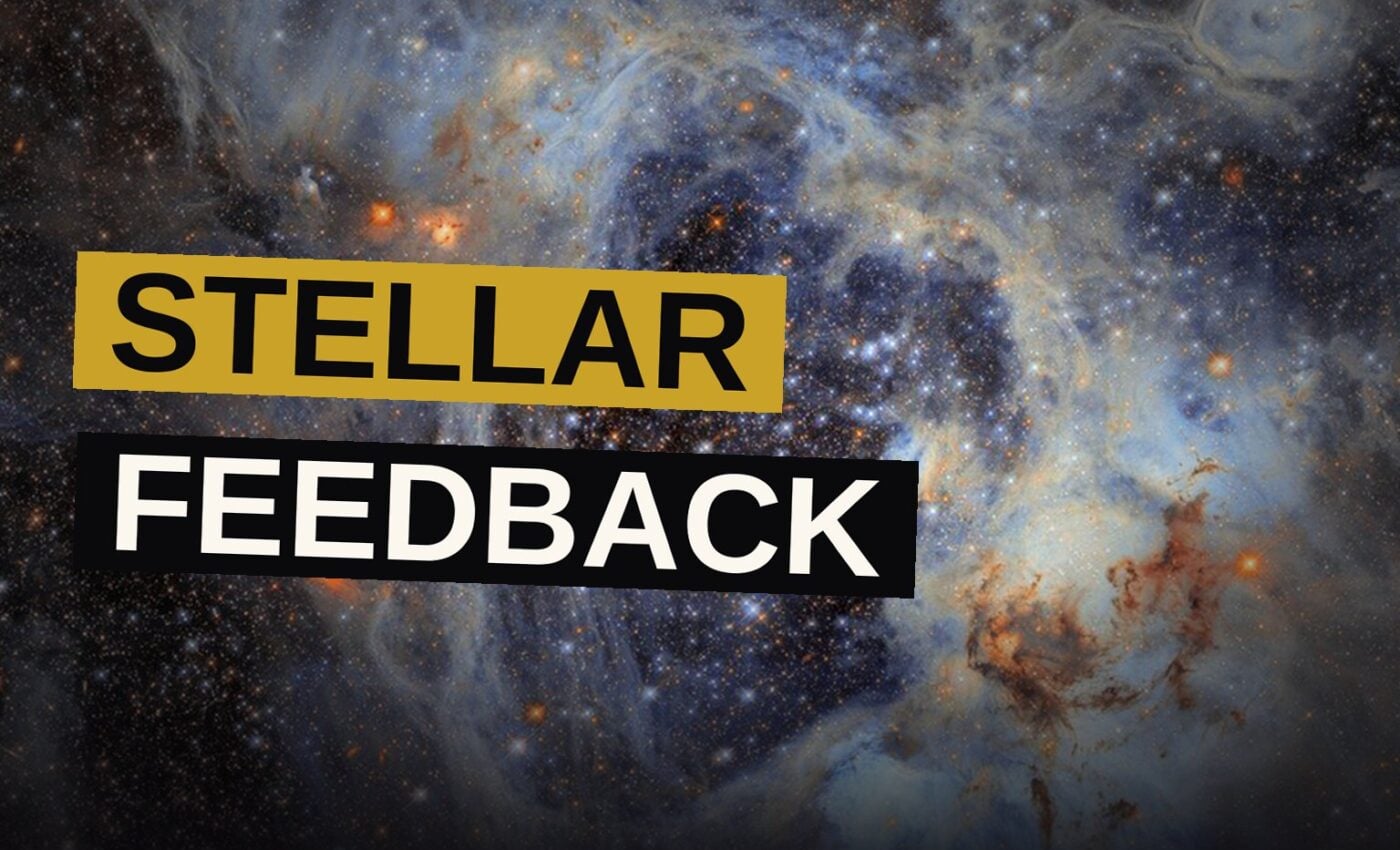
The Hubble Space Telescope has captured a picture of a great empty space within a cloud of gas, yet this is no ruin wrought by calamity. It is a cradle, and it still brings forth life. Nebula LHA 120-N44, also known as N44, rests some 160,000 light-years distant in the Large Magellanic Cloud, a small galaxy that circles our own. Upon Earth, it can be seen in the constellation Dorado.
Released Sept. 3, 2026, the image shows nearly 30,000 infant stars clustered around a vast hollow scooped out of a stellar nursery. The hollow stretches roughly 210 by 140 light-years across, appearing as if a hole has been punched through a cloud. For scale, the nearest star system to our own, Alpha Centauri, sits just 4.4 light-years away.
The Stars That Made the Hole
N44 is known as a superbubble, a cavity that has been hollowed out by a cluster of hot, massive stars located at its center. These stars are intent on destruction. Just like our sun’s solar wind, which creates auroras on Earth and defines the extent of the solar system, these stars’, they send out powerful winds that blast material into space.
These massive stars ultimately blow up as supernovas, which push even more material outward. Combined with the light from both ancient and youthful stars, this energy cuts through the nebula to form a huge hollow space. A layer of gas and dust then forms around the entire shape.
What Happened to the Expelled Gas
The majority of the expelled material has been forced outward and squeezed into a dense ring of gas and dust around the superbubble. Inside that ring, fresh stars are taking shape. In other words, the very massive stars that tear apart the gas cloud that gave them birth are also aiding in the creation of their successors.
This phenomenon is referred to as “stellar feedback.”. It happens when massive stars heat up, ionize and spread apart the gas and dust surrounding them, making star formation impossible in their immediate area. At the same time, their winds can compress nearby gas clouds until they become dense enough to collapse under their own gravity, thereby giving rise to new stars.
Counting the Stars
Almost half a million stars fill this Hubble picture of N44, with some sitting within the nebula itself and others appearing against the same line of sight. Roughly 30,000 of these are still young stars that have not yet begun fusing hydrogen in their cores — the very process that keeps stars like our sun burning.
Given the number of youthful protostars still too cool and too thin to qualify as true main-sequence stars, the cluster N44 offers scientists a rare chance to try answering a question that appears straightforward on its surface: how much time does it take to build a star?
The Cycle of Destruction and Creation
The picture shows a repeating pattern of ruin and renewal in space. A single set of stars breaks up its own starting point even as it aids the rise of another set. Those very stars that produced the gap are also the ones nourishing the outer layer where fresh stars take shape.
“This is known as ‘stellar feedback’ — when massive stars heat, ionize and disperse the gas and dust around them, making star formation impossible in their vicinity.”
Those stars which shape the bubble are also its very source of sustenance.
The Data Set
This picture captures a dramatic moment in a developing system, with nearly half a million stars contributing to what researchers call a rich data set for those who study how stars come into being.
The image was shared Sept. 3, 2026.
Again and again the process repeats itself: the very winds that drive gas outward compress it somewhere else, while the explosions that disperse gas set the stage for fresh stars to come into being.
This picture captures a moment within a repeating sequence, a pattern that keeps returning to itself. It stands as proof that the cosmos runs on recurring motions: ruin giving way to new building, disorder yielding to arrangement, the end of existence making room for renewal.
The marvel of it lies in the image itself. It depicts a superbubble wherein stars consume their own natal cloud even as they give rise to fresh stars within the thrown-off shell. This single scene captures the entire cycle of stellar feedback, a simple picture that holds a complex truth.
Anyone who takes the time to look at the picture receives a present from it. Inside, the universe is shown carrying out its natural process of creating fresh stars out of older ones. That cycle keeps going, and the stars keep appearing.