
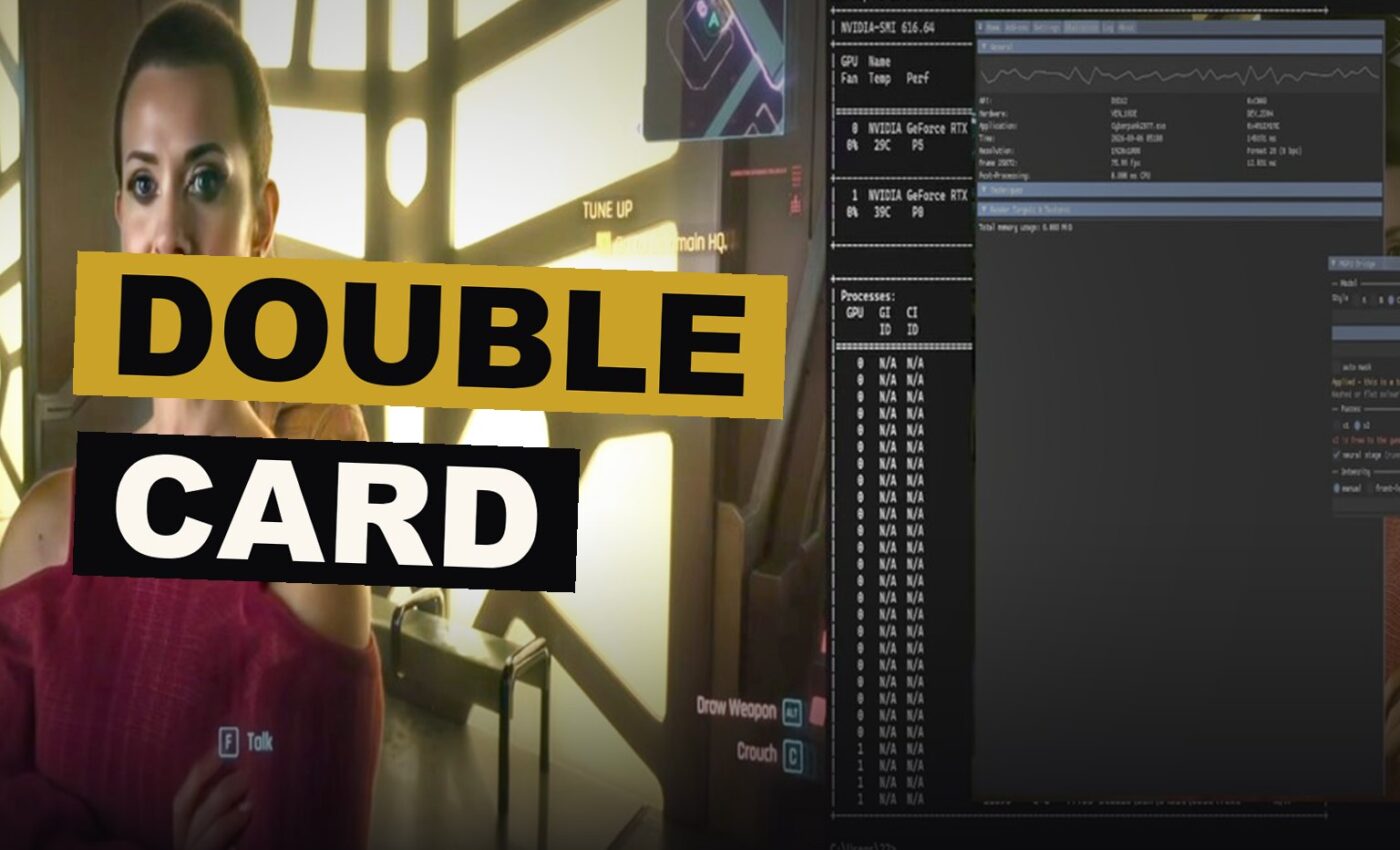
A new mod lets DLSS 5’s Neural Rendering feature run on a second graphics card, cutting the heavy performance cost that has followed the AI effect since Nvidia first showed it off.
The mod, made by Marcelo Guibout for ReShade, the app modders use to add different effects to the picture in PC games, sends part of the work to a second GPU. It sits on Github now, free to download, and is meant to work with games that already have DLSS 5 support added through modding.
The Performance Problem DLSS NR Creates
Nvidia has said DLSS Neural Rendering can cut frame rates by 50-60% as a general figure, no matter the game or how much AI work is being done. NBA 2K27 was checked ahead of launch, and the cost was found to run even higher than that. The cost is worse still on AMD GPUs, where DLSS NR has been shown to run worse than that figure, and the same heavy cost has shown up when running the feature through ReShade.
Guibout’s fix is simple to explain: instead of making one GPU render the frame and also run the neural rendering pass, split the work between two cards. A second card — in Guibout’s case, an RTX 5060 Ti 16 GB — takes the finished frame and runs the neural rendering pass on its own, then shows the result on its own screen. The frame never has to travel back to the first card, which removes an added source of lost time and delay.
Guibout explains the reason for this plainly: neural processing after the frame is drawn uses up all the power of whatever card runs it. Run it on the same card doing the rendering, and lowering the render size only frees up room that the neural step fills right back up — so the change in size stops paying for itself. Move that neural step to a second card, and the first card is left free to do its own work.
How It Was Made
Guibout did not make this alone. The project started with a local AI model, Qwen3.8-27B, running on LM Studio on the same pair of RTX 5060 Ti 16 GB cards used later. That gave Guibout a starting base for the mod. From there, Anthropic’s Claude wrote most of the C++ core, though Guibout says Claude also gave a number of confident, wrong answers along the way.
This lines up with what Nvidia’s Jen-Hsun showed at GDC and GTC in the spring, when the earliest DLSS 5 shows were already running on two graphics cards.
What It Costs
None of this comes free.
Guibout tested the mod using a pair of RTX 5060 Ti 16 GB cards, which sit in the fifth tier of Nvidia’s RTX Blackwell lineup. Each card runs about $800, meaning the full arrangement needs around $1,600 in graphics cards just to get the mod running as meant.
A second screen is needed, not something extra. Guibout notes that the neural result is shown by the card that made it, and running without a second screen works but runs less well.
There’s also a limit worth noting. This ReShade version only works after the final frame has already been drawn, with none of the depth and motion data that Nvidia’s own official version uses. That means a second card here is not tied as closely into the rendering steps as older systems that used two cards together, like SLI or CrossFire — though it will likely still need some part before the final image work is done.
Comparing The Two Methods
| Single-GPU DLSS NR | Two-GPU Mod | |
|---|---|---|
| Performance cost | 50-60%, sometimes higher (per Nvidia, NBA 2K27 checks) | Cut down greatly, per Guibout |
| Hardware needed | One GPU | Two GPUs (tested on RTX 5060 Ti 16 GB x2) |
| Screen arrangement | One screen | Second screen needed |
| Depth/motion data | Used in Nvidia’s official version | Not used — works only after the frame is drawn |
| Current state | Nvidia’s official version | Tested on one machine, three games, per Guibout |
Not Ready For Wide Use
Guibout is clear that this mod is not ready for wide use. The notes on Github say it is meant mainly for study and further change, and it has been tested on exactly one machine across three games. Guibout asks anyone interested to read the code before running it.
There’s a wider hardware problem too. SLI and CrossFire are gone, and most current motherboards do not come with several open PCIe x16 openings for a second card any longer — especially once NVMe SSDs are already using up open PCIe paths.
Still, there’s a clear gain for anyone who upgrades cards often: an old card does not have to sit idle. It could instead take on the neural rendering work for whatever card comes next. There’s a business reason too — if Nvidia ever made a feature like this part of its own hardware, it would give buyers another reason to stay inside the GeForce line rather than switch brands.
Work on DLSS 5 and Neural Rendering mods is moving fast now that it sits with the modding community rather than Nvidia alone. Mods like this ReShade version give a close look at how Neural Rendering works, and where its limits still are.
Source: pcgamer.com
Get the Notebook.
The day's best stories and every fresh verdict, in plain English, in your inbox by seven. One email a day, no more.