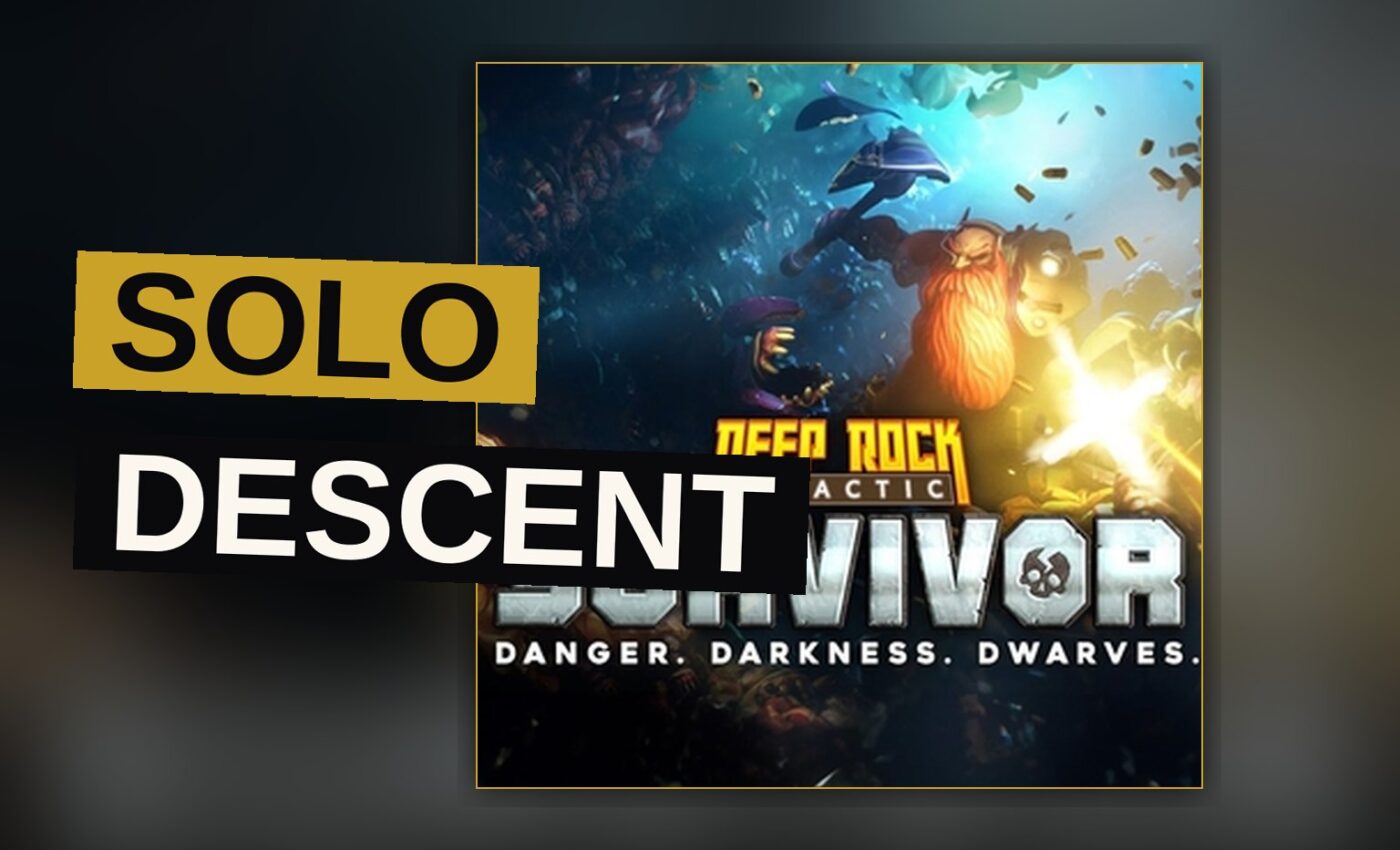
Miners drop into caves again, and this time the mission is staying alive, not just mining. Deep Rock Galactic: Survivor takes the team-based shooter that made its name and turns it into a solo, top-down fight against endless swarms. It works far better than that shift has any right to.
Trailer, via Ghost Ship Games.
Alone in the Dark
The setup is simple. A miner is dropped into a cave built new each time, told to dig, and left to survive waves of bugs that arrive faster and meaner as the clock runs down. There is no team here. Deep Rock Galactic: Survivor strips away the four-player heart of its parent game and replaces it with a single miner against the swarm.
That change could have ruined what made Deep Rock Galactic feel alive. It does not. The tunnels still give way under pick and blast. The bugs still pour out of the dark in numbers that feel impossible to survive until a build finally comes together.
The first few runs test patience more than skill. New players will die often, learn slowly, and start to see the shape of what works only after several failed attempts. That slow start pays off once the pieces of a build begin working as one. The game asks for time before it gives anything back, and that trade feels honest.
Digging as a shield
Movement is the game’s real weapon. Digging through rock opens new paths, funnels enemies into a narrow point, and buys space when the swarm gets close. Deep Rock Galactic: Survivor rewards players who think about the ground beneath them as much as the weapons in their hands.
Weapons and upgrades pile up fast. A run might start with a simple pistol and end with a wild mix of turrets, thrown charges, and passive buffs that turn one miner into a full demolition team. The pace of growth is quick enough that a run never feels stuck, even when the early minutes drag.
Some of the strongest moments come from combinations the game never tells players to expect directly:
- A fire-spraying weapon paired with a tunnel-collapse upgrade that traps enemies in flame
- Turret drones added one after another until the screen fills with crossing lines of fire
- Digging upgrades that double as crowd control by opening new escape routes mid-fight
Finding these combinations by accident is part of the pleasure. Deep Rock Galactic: Survivor does not explain its best synergies. It lets players find them. That discovery loop keeps runs feeling fresh long after the basic shape of the game becomes clear.
Four Roles, Four Feels
Deep Rock Galactic: Survivor keeps the four classes from its source game, and each one changes how a run feels. The digging-focused class moves fast underground and fights close. The heavy-weapons class holds a line and grinds down anything in front of it. The fast, light-footed class moves quickly and lights up dark corners most others avoid. The support-focused class leans on turrets and traps instead of raw force.
Each class carries its own upgrade pool, so a run with one feels nothing like a run with another. That range keeps repeated missions from feeling like the same fight with bigger numbers attached. The classes are not just skins with different stats. They ask for different habits, different paths through a cave, and different judgments about when to dig and when to fight.
This variety also changes how players approach the same cave twice. A path that works well for the heavy-weapons class might fail completely for the digging-focused one, forcing new decisions rather than repeating an old plan. The same map can play as a slow push or a fast scramble depending on who is holding the pick.
The Rising Swarm
The difficulty curve is steep by design. Early minutes feel manageable, almost slow. Then the swarm grows dense, and a player who has not built real synergy into their upgrades will die fast. The jump from calm to chaos is sudden, but the game gives clear signs before it happens.
That difficulty still feels fair. Deep Rock Galactic: Survivor gives enough warning before each wave grows heavier that failure feels earned, not cheap or sudden. A new sound, a shift in the dark, a thicker line of bugs on the edge of the screen. These signals tell a player to move, to dig, or to check their build before the pressure arrives.
Losing a run rarely feels like the game cheated. It feels like a build that needed one more piece to hold together. That distinction matters, and it is part of why failed runs still feel worth trying again. The lesson from each loss is usually clear, and the next run can put it to use right away.
Progress Between Runs
Progress outside a run matters as much as the run itself. Currency earned underground buys lasting upgrades back at the base between missions. Those upgrades open new gear, new classes, and new depths to mine. The sense of building toward something carries over even when a run ends early.
That loop is familiar to anyone who has played this kind of endurance game before. Deep Rock Galactic: Survivor does not remake that structure from nothing. It executes it cleanly, with enough new gear appearing between runs to keep the grind from feeling flat or dull. Each purchase changes the next run in a small but real way.
The upgrades are not just number increases. Some add new tools, some change how a class plays, and some open paths that were closed before. The result is a progress system that feels tied to actual play rather than a meter filling in the background.
The Base Between Missions
The base is small but well suited to its job. It is where a player checks new gear, picks a class, and heads back down. The space is tight, with no wasted corners or long walks between stations.
There is no filler talk, no long chain of menus. A run can start again within seconds of the last one ending. That speed matters in a game built around repeated attempts. The time between runs is short enough that a loss does not break the rhythm.
The base also holds the record of progress. New gear sits on display, unlocked classes wait in a row, and the next depth is visible on a map. It turns the space between missions into a quick check of how far a player has come and what is still left to reach.
Tone and Presentation
Deep Rock Galactic: Survivor carries over the tone of its source game almost perfectly. The miners still shout their familiar lines. The humor is still broad and physical. That tone keeps runs feeling light even when the swarm on screen turns into chaos. The game never takes itself too seriously, and that choice fits the action well.
The presentation supports that tone well. Caves glow with mineral light, blasts light up tunnels, and the swarm’s movements stay readable even when the screen fills with enemies. On PC and Xbox Series X/S, performance holds steady even when hundreds of bugs crowd a single space. The chaos stays clear, and the player can always see what is coming.
The sound design does its part too. Picks strike rock with a heavy thud, bugs skitter in from every side, and the miner’s voice cuts through the noise with a warning or a joke. The audio keeps the player oriented even when the screen is at its busiest.
A Loop That Holds
Deep Rock Galactic: Survivor earns its score honestly. It takes a beloved team-based shooter, strips it down to one miner and a swarm of bugs, and builds something that stands on its own. The digging, the rising chaos, and the progress carried between runs all come together into a loop that is hard to put down.
The game knows what it is. It does not try to stretch beyond its shape or pad its length with empty content. Every part of the loop supports the rest, and the result is a game that respects the player’s time.
The failures sting, but they teach. The successes feel earned, not given. And the next run is always one button away.
Get the Notebook.
The day's best stories and every fresh verdict, in plain English, in your inbox by seven. One email a day, no more.