
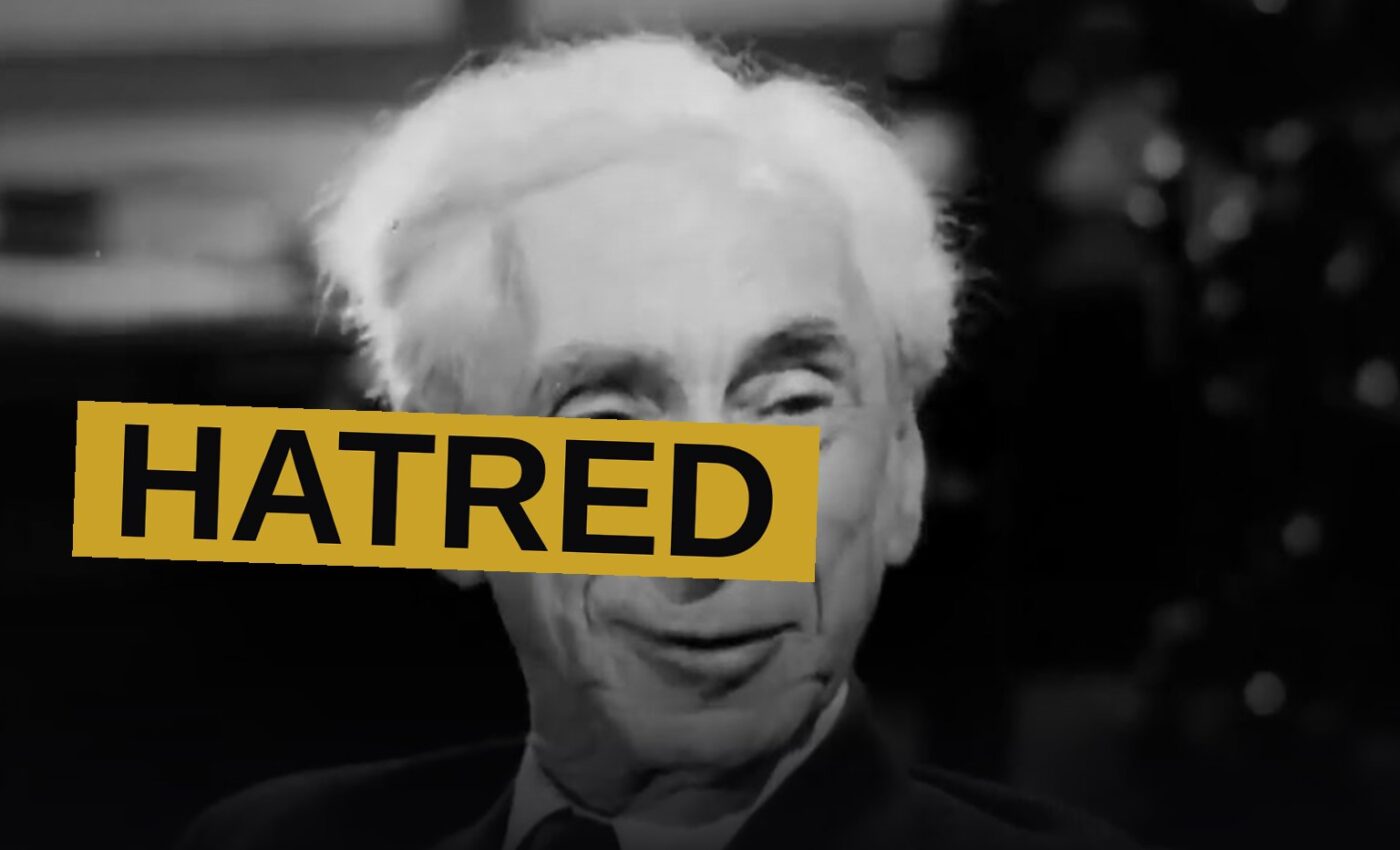
In 1952, Bertrand Russell appeared on a TV episode called A Conversation with Bertrand Russell. In it, he explained why he rejected communism — and why he blamed the philosophy of Karl Marx himself for the disaster he saw in its results.
Russell’s critique was not just about the Soviet Union or the Communist parties of his day. He went after the ideas at the root. In his 1954 essay “Why I Am Not a Communist,” collected in Portraits from Memory, he made two charges against Marx: “one, that he was muddle-headed; and the other, that his thinking was almost entirely inspired by hatred.”
Russell’s Two Charges Against Marx
Russell argued that Marx was intellectually dishonest. He said Marx accepted Thomas Malthus’ dire prediction about population growth when it was useful, and rejected it at other times. Russell also claimed Marx applied David Ricardo’s theory of value — which treats value as embodied labor — to wages but not to the prices of manufactured goods.
The result, Russell said, was not a search for truth. “He is entirely satisfied with the result, not because it is in accordance with the facts or because it is logically coherent, but because it is calculated to rouse fury in wage-earners.”
The Hatred at the Core
Russell saw Marx’s view of history as built on emotion, not evidence. He said Marx predicted a workers’ uprising as inevitable, based on an “extension to world history of certain features prominent in England and France a hundred years ago.” Marx also believed in “a cosmic force called Dialectical Materialism which governs human history independently of human volitions.”
Russell dismissed that worldview as “mere mythology.” He connected it directly to his better-known attack on religion, the 1927 lecture “Why I Am Not a Christian.”
Doubt Over Dogma
Russell’s problem with Marx was part of a larger problem with certainty. “I think one of the troubles of the world has been the habit of dogmatically believing something or other,” he said in the clip. “I think we ought always to entertain our opinions with some measure of doubt.”
That doubt was central to his thinking.
Kindly Feeling and Its Absence
Russell offered a standard for what a good philosophy should do. “If a philosophy is to bring happiness, it should be inspired by kindly feeling,” he said. Marx failed that test. “Marx pretended that he wanted the happiness of the proletariat, but he really wanted is the unhappiness of the bourgeois. And it was because of that negative element, because of that hate element that his philosophy produced disaster.”
That is the core of his argument. The disaster was not an accident or a misreading. Russell traced it to the hatred inside the doctrine itself.
A Debate That Remains Open
There are, perhaps, arguments to be made that communism, as practiced in the Soviet Union, took the form it did precisely because it departed from Marxist lines. Whether that departure made things better or worse is a matter no philosopher can settle.
The clip comes from the 1952 TV episode. It remains a sharp statement of one philosopher’s case against another.
Key Facts Box
- 1952: Year of the TV episode A Conversation with Bertrand Russell
- 1954: Year of Russell’s essay “Why I Am Not a Communist”
- 1927: Year of Russell’s lecture “Why I Am Not a Christian”
- 2: Number of charges Russell makes against Marx
Russell’s argument stands as a reminder that ideas have consequences.
Source: openculture.com
Get the Notebook.
The day's best stories and every fresh verdict, in plain English, in your inbox by seven. One email a day, no more.