
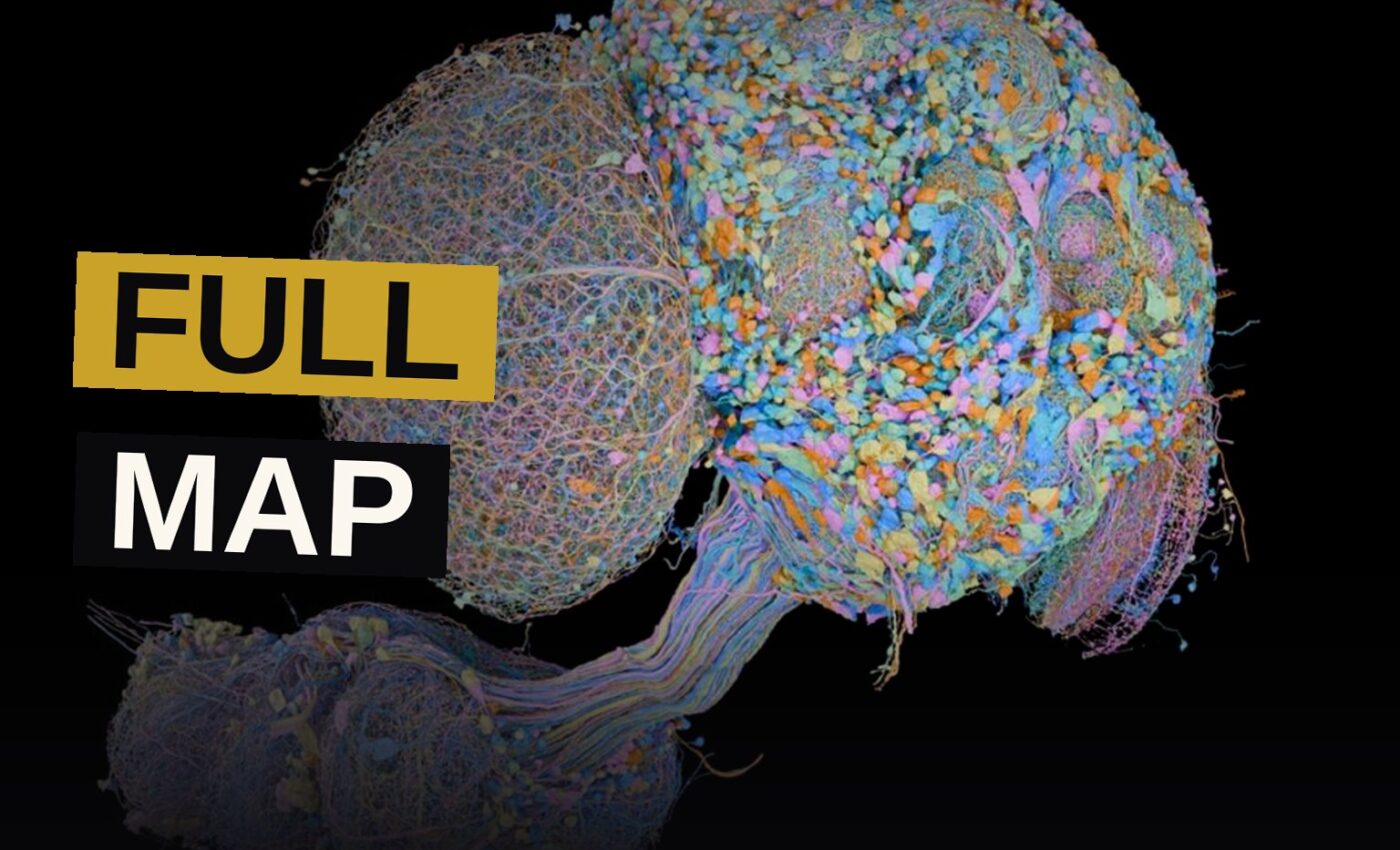
Researchers announced on Friday that they have completed a map of every nerve cell in the brain of a male fruit fly. The work follows the completion of a female Drosophila map earlier this year, giving science the second complete map of a fruit fly brain.
The project was a collaboration between the Howard Hughes Medical Institute’s Janelia Research Campus and Google. Both teams acknowledged that neither could have done the project without the other.
The full wiring plan — showing how every nerve cell links to every other — offers a tool that could speed up brain research. It also stands on its own as a scientific achievement, tracing hundreds of millions of connections.
What the map covers
The brain of a fruit fly is small, but it is not simple. It holds a dense web of nerve cells, each one linked to others.
To build the map, the team imaged an entire brain at a resolution fine enough to see individual contact points between cells. That imaging requires a specific set of skills. Interpreting what the images mean requires another set. And assembling a complete picture of the hundreds of millions of connections is a task that no human could finish in a reasonable amount of time.
That is where Google came in. The company’s computer specialists built the tools needed to stitch the images together into a single, complete model.
The researchers described the partnership as one where neither side could have done the work alone.
How the brain sends signals
Our contact with the world begins with what we take in through the senses. Nerve cells register sound, light, touch, and more. From there, most brain activity involves nerve cells passing messages to each other.
That communication changes the raw signals into forms the rest of the brain can use. It routes information to the right processing areas. It often produces an action, from forming a memory to moving a muscle.
The map shows the full path of that traffic. It records every nerve cell and every connection, so researchers can trace how a signal moves from a sense cell to a muscle cell.
This is not a rough sketch. It is a complete list. Every nerve cell is accounted for, and every connection is marked.
The male and female maps
The new map covers a male Drosophila. The earlier map, completed this year, covered a female.
Having both gives researchers a direct way to compare the two. The connectome of the female was completed earlier this year, and the new work provides an opportunity to do some science on its own.
The team behind the work noted that the two maps together offer more than a single map would. A single map tells you how one brain is built. Two maps open up new lines of study.
The long game
The people behind the effort expect the work to pay off over time. The map could give brain researchers a valuable tool for understanding how the brain works, they said.
That understanding does not come fast. A map is a starting point, not an answer. But it is a starting point that did not exist before.
With a complete map, a researcher can look at a specific nerve cell and see exactly what it connects to. They can trace a circuit from the start to the end. They can test ideas about how the brain handles information.
Without a map, those questions are much harder to ask. You can study single nerve cells, but you cannot see how they fit into the whole system.
The division of labor
The Janelia team handled the science. They prepared the brain for imaging. They captured the images at the necessary resolution.
The Google team handled the computation. They built the software that turned the images into a single clear model. They developed the methods that could follow nerve cells and mark each connection.
Neither side could have done the other’s job. The preparation of an entire brain for imaging at the necessary resolution requires a distinct set of skills, as does interpreting what those images indicate.
The collaboration worked because each team brought skills the other lacked.
A tool for faster research
The map is not just a finished thing. It is also a tool.
Researchers can use it to plan tests. Instead of guessing which nerve cells might be involved in a behavior, they can look at the map and find the right circuits.
That could speed up brain research.
The team behind the work said the map could give brain researchers a valuable tool for understanding how the brain works.
Improving the tools
The project also pushed the technology forward. The work gave the team a chance to improve tools that are likely to be applied to ever-more complex nervous systems, including those of animals with spines.
That is a big step. An animal with a spine has a brain far larger than a fruit fly brain. It has far more nerve cells and far more connections. The tools that worked for the fly will need to be scaled up.
But the core approach — image the brain, stitch the images, build the map — is the same. The team behind the fly map said the work provided an opportunity to improve those tools.
Building a complete picture
The male fly map is done. The female fly map is done. The next question is what researchers do with them.
The team behind the effort expects the work to be worth it in the long term. The map gives brain researchers a tool for understanding how the brain works.
That is the promise of the project. A complete map of a brain is not the end of the science. It is the beginning.
Key facts box
- Second complete fruit fly brain map, following a female Drosophila map completed earlier this year
- New map covers a male fruit fly
- Collaboration between Howard Hughes Medical Institute’s Janelia Research Campus and Google
- Map includes every nerve cell and hundreds of millions of connections
The two maps now sit side by side. The male fly map was built by a partnership of biologists and computer scientists. That partnership, the teams said, is the reason the new map exists at all.
Source: arstechnica.com
Get the Notebook.
The day's best stories and every fresh verdict, in plain English, in your inbox by seven. One email a day, no more.