
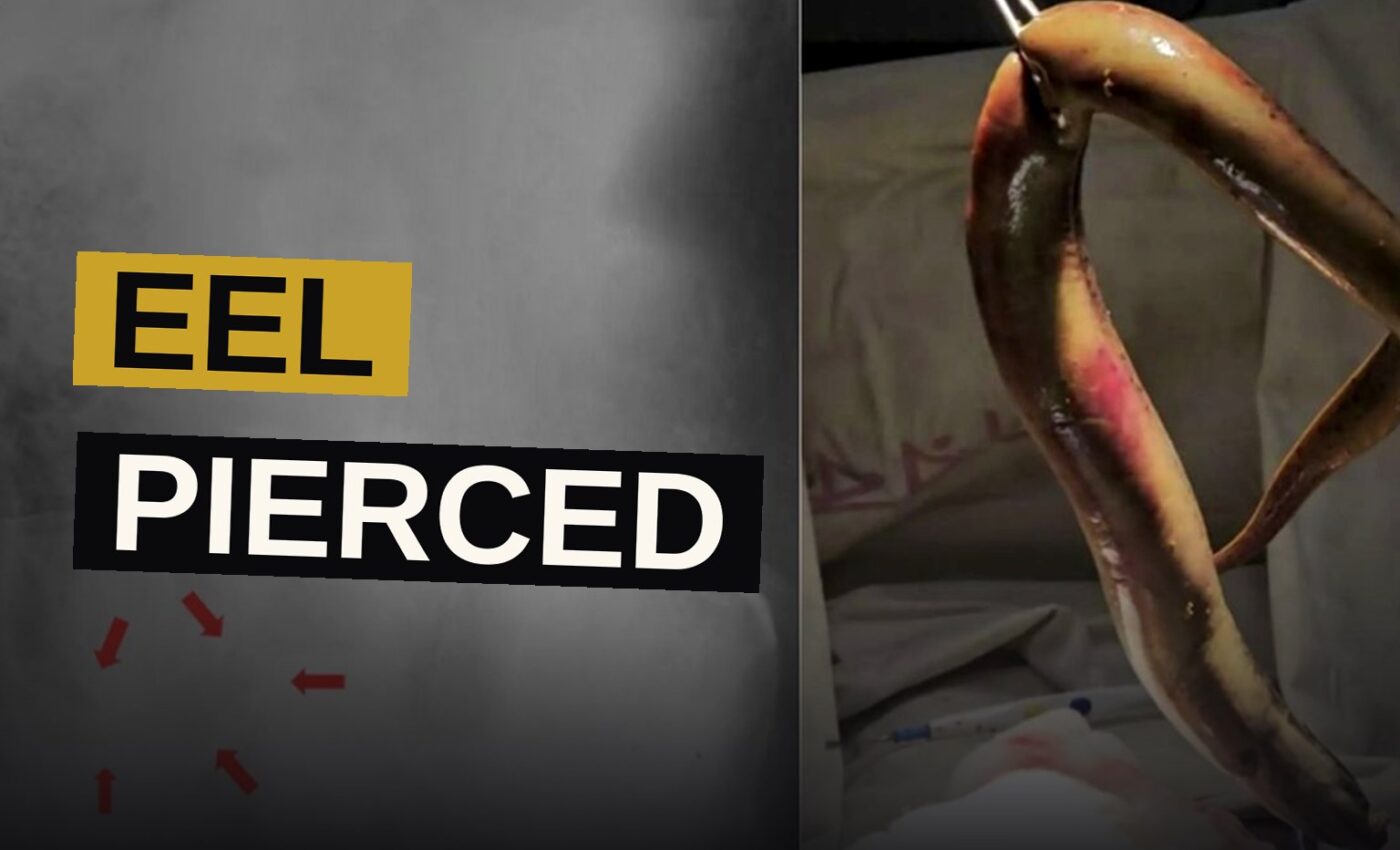
A 55-year-old man in Bangladesh went to the emergency room with severe pain in his belly that had started five hours earlier. Doctors found the cause: a live eel had entered his rectum and punctured his colon.
The case is documented in a report published in the International Journal of Surgery Case Reports by Mokbul, Roy, Roy, Shrestha, and Nawys. The authors describe the event as “exceedingly rare.”
The Eel’s Path
The man told doctors that one day before his hospital visit, an eel had “entered through his rectum accidentally.” He was wearing a lungi, a long skirt common among Bangladeshi men. The eel slipped through the opening at the bottom of the garment and wriggled into his anal canal.
He did not seek medical attention right away. He hoped the fish would exit on its own.
When doctors examined him, his temperature and blood pressure were normal. His heartbeat was slightly elevated at 110 beats per minute. A typical resting heart rate for adults is 60 to 100 bpm.
The man’s belly was rigid and tender when pressed. An X-ray revealed a dark, eel-shaped shadow on the right side of his belly. The image also showed a crescent-shaped gas shadow under the right part of his diaphragm, hinting at peritonitis.
Surgery and Recovery
Peritonitis is swelling of the peritoneum, the membrane that covers the belly organs. It is usually caused by bacterial or fungal infection but can also develop when fluids from other organs leak into the area. Without quick treatment, it can lead to a life-threatening infection that spreads rapidly.
Doctors gave the patient IV antibiotics, fluids, and anti-ulcer medications. They determined he was at risk of septicemia, or “blood poisoning,” where pathogens invade the bloodstream. They decided to operate immediately.
Surgeons performed a laparotomy, creating an opening in the belly wall. They made an incision in the man’s sigmoid colon, the S-shaped section of the large intestine next to the rectum. From there, they extracted the eel from the peritoneal cavity.
The eel measured nearly 2.2 feet (0.6 meters) long. It was still alive.
The doctors hypothesized the eel kept breathing by punching through the colon wall and squeezing into the peritoneal cavity. That cavity contains a pale-yellow fluid that reduces friction between organs. The fluid is mostly water but also holds glucose, electrolytes, proteins, enzymes, white blood cells, and urea.
The surgeons then performed a sigmoid colostomy, creating an opening in the belly as an exit point for the large intestine’s contents. This bypassed the damaged section to prevent fecal leakage and further infection.
Four days later, the man was symptom-free and discharged. The report did not document any follow-up visits.
Comparing Two Eel Cases
The doctors noted one previous case in scientific literature involving a live fish penetrating the colon. That case took place in Hong Kong.
| Detail | Bangladesh case | Hong Kong case |
|---|---|---|
| Patient age | 55 years old | 50 years old |
| Eel length | Nearly 2.2 feet (0.6 m) | More than 1.6 feet (0.5 m) |
| How eel entered | Accidentally, through clothing | Knowingly inserted |
| Reported reason | Not stated | Attempt to relieve constipation |
| Eel alive at removal | Yes | Not stated in the report |
The Hong Kong man deliberately inserted the eel into his rectum, allegedly to relieve constipation. The Bangladesh man said the entry was accidental.
Why This Case Matters
Traumatic perforation of the intestine by foreign objects is uncommon. Cases involving live animals are “exceedingly rare,” the authors wrote.
Foreign objects often enter the body through accidental ingestion or deliberate insertion into the rectum. Some objects, like vibrators, are designed for that purpose. Others are not. The report lists chicken bones, light bulbs, metal rods, glass bottles, and kitchen whisks among the items found.
Penetration of the colon by a live fish is an “unusual and scarcely documented event,” the doctors added.
This article is for informational purposes only and is not meant to offer medical advice. The full study appears in International Journal of Surgery Case Reports, volume 124(C), published in 2024.
The case was covered by Mindy Weisberger, a science journalist and author of “Rise of the Zombie Bugs: The Surprising Science of Parasitic Mind-Control,” published by Hopkins Press. Weisberger formerly edited for Scholastic and was a channel editor and senior writer for Live Science. She studied film at Columbia University and previously produced, wrote, and directed media for the American Museum of Natural History in NYC. Her work has appeared in Scientific American, The Washington Post, How It Works Magazine, and CNN, and has earned awards including the CINE Golden Eagle and the Communicator Award of Excellence.
The man left the hospital free of symptoms.
Source: livescience.com
Get the Notebook.
The day's best stories and every fresh verdict, in plain English, in your inbox by seven. One email a day, no more.