
For more than ten years, Inpatient Press has treated books as strange objects, and the indie publisher has released novels, collections, zines and games that bend form to suit that vision. Publisher Mitch Anzuoni studied both computer science and creative writing in college, and his stated aim is “to publish what others do not.”. The press was founded in 2013.
Inpatient’s distributor, MIT Press, received a statement from Anzuoni that “the most important, and perhaps defining, characteristic of my publishing is the treatment of the book as a substantial object on its own, not some ready-made crucible for text and image to be poured into.”. This method has led to unusual projects. A run of publications was made available through a newspaper machine. Among them was Armageddon News, a grouping of pamphlets and small publications produced by the FBI to go after student activists, along with the bureau’s own records on that undertaking.
In addition to its ongoing book publishing, Inpatient has issued work by Samuel R. Delaney and Copi. The company has also produced archival projects, such as a complete reprint of the legendary SF punk zine Search & Destroy.
The Games Start With Small Press Tycoon
The studio’s games are aimed at fiction fans rather than traditional gamers, with the very first title being Small Press Tycoon. That game is described as “the original DIY publishing adventure sim.”, where players take on the role of running a small publisher and chase metrics such as “hipness” and “quality.”. The game allows players to “print chapbooks and zines, hold readings, discover new and exciting authors, sign distribution deals, and even win industry awards!”.
What follows is a game built on irony, self-reference and mockery. It mixes humor, satire and the strange to establish its tone from the very start.
Mezzanine Looks Back at the Tech Age
Mezzanine places you inside the role of an HR administrator working for Zentropy, a fabricated multimedia start-up rooted in the Y2K era. The game’s design mirrors the look of turn-of-the-millennium graphics. The company’s offices are smooth and shiny, leaning into a swollen chrome uncanniness.
The tale revolves around a company that is “the lost potential of multimedia and how our current societal psychosis may have always been by design.”, and its satirical take on the direction tech was headed. You find yourself wandering through an abandoned tech office after dark, and the game’s sordid secrets emerge from there. The narrative plays out as a knowingly prescient commentary on where technology was going, with the description itself framing the story in those terms.
A review of Mezzanine described the game’s effect. The player “Eyes of pheasant sold at market” reported: “You are so lucky that I read alot of books and know what the ♥♥♥♥ lacunae are.”
Ex Libris Takes the Literary Turn Further
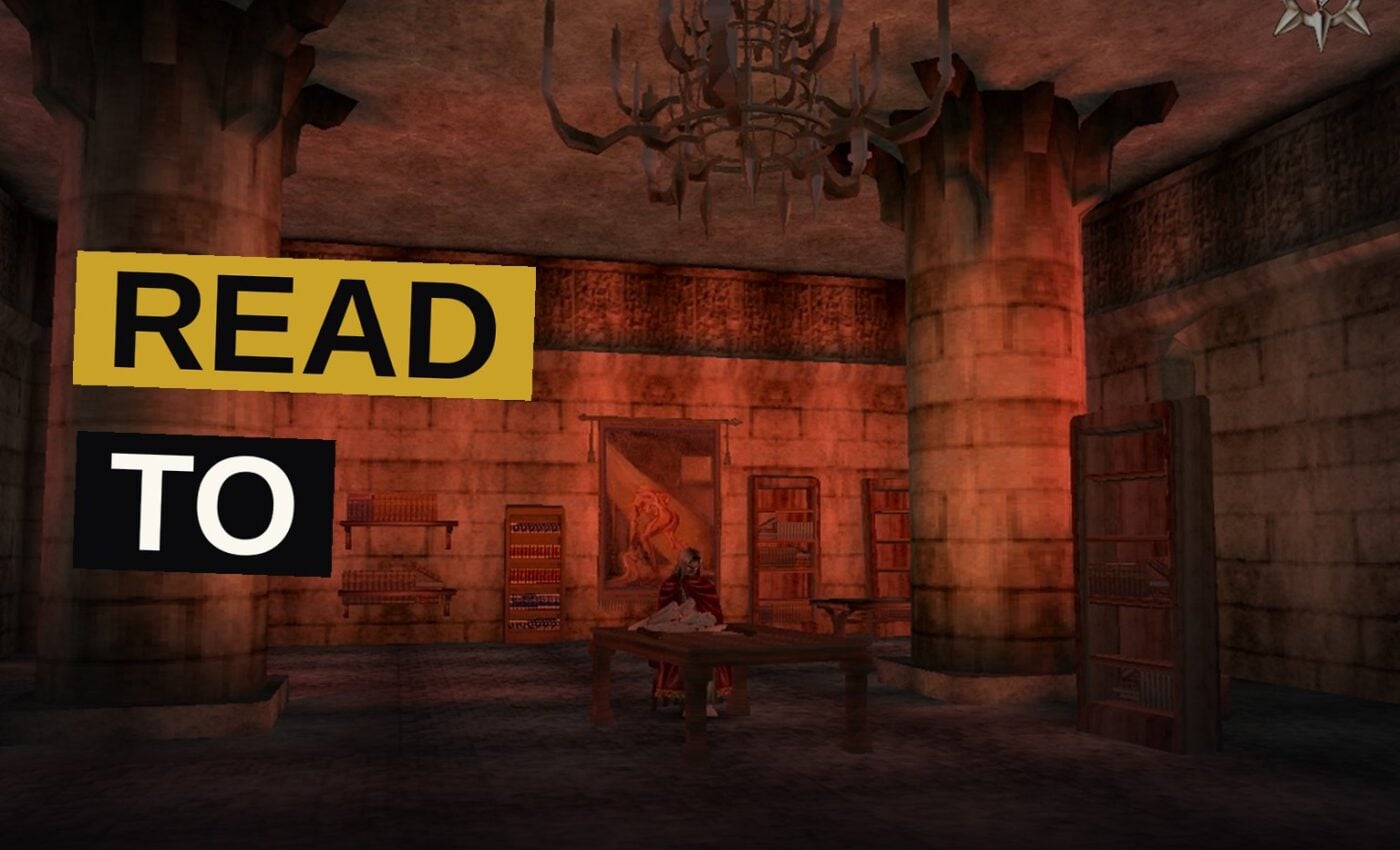
Ex Libris, the newest game from Inpatient, was released in April, and it might just be the most literary entry in their catalog so far. The story begins at the Abbey of Theleme, a sunken, dark monastery situated within a mythical version of medieval Europe.
Orange firelight falls upon lo-res ivy and stone as you wander through courtyards and chambers, meeting travelers and locals along the way. A drunken bookseller, drilling soldiers, a fortune teller, and a companion who will not speak all cross your path. Books and scrolls are plentiful, and as you “learn” the languages they are written in, translations start to appear.
The polygonal characters and the brooding soundtrack carry an almost hieroglyphic quality. The writing blends English with ancient tongues and made-up languages.
The whole game is eerie and mystical.
Reading as a Game Mechanic
The exploration rewards you, and the game starts to feel less like a game and more like literature. You raise a “logos” stat. As you “understand” more writing and dialogue, the game’s text forms a coherence.
The writing is quite good. It is accurately described as an “amalgamation drawing from Umberto Eco, Francois Rabelais, Clark Ashton Smith, Marguerite Porete, and countless other sources to create an interconnected hypercathedral.” The reviewer, James Folta, said he is not deep enough into the game to say what that hypercathedral looks like. But themes about authorship and memory are emerging, echoed in the mechanic of discovering hidden archives and unlocking translations.
Folta likened the act of wandering through the Abbey and reading its contents to a hypertext novel such as The Castle of Crossed Destinies or Pale Fire. As you skip from one passage to another, the sense of being disconnected falls away. The separate pieces of text come together into a larger pattern. Consider Ex Libris as though Borges or Cortazar had crafted it for an old LucasArts point-and-click adventure game.
No Puzzles, No Winning
There is no puzzle-chase in Ex Libris. The writing does not serve as mere background texture tacked onto unrelated game mechanics. The enjoyment comes from something else entirely, not from a competitive push to win or finish the experience.
These works do not present themselves as hills to be overcome through speed or competition. Instead, they invite you to study them according to the narrative, aesthetic, and critical decisions made by the author and the object itself. Just as you would read a book, you move through them slowly and thoughtfully. “I won Helen DeWitt’s latest novel by conquering the various challenges and trials it presented me.” There is no clear victory waiting at the summit of an Inpatient game.
The audience defines the direction in which the games move, skipping through their sequence at will. Giving readers control over the pace, if you will, of a book stands out as one of the distinctive pleasures that separates reading from other art forms.
The Publisher’s Broader Mission
Everything Inpatient does is driven by its interest in the conditions of publication. Its publisher looks into strange slippages and exceptions in how work gets to readers. The newsbox zines and the games share the same project.
The games occupy a space where computer science and creative writing meet, and Anzuoni’s education supports that position, since she holds qualifications in both subjects.
Here is the order in which the games were released:
- Small Press Tycoon — the original DIY publishing adventure sim.
- Mezzanine — the Y2K-era office satire.
- Ex Libris — the monastery crawl that came out in April.
These tests favor careful reading over quick reactions. They require you to take your time.
Points in Case’s managing editor James Folta also co-writes the weekly Newsletter of Humorous Writing. His review of Inpatient’s games can be found on the site where this article came from.
When you encounter a book in a vending machine or a game demanding you master ancient and invented tongues before granting access to a scroll, you’ll recognize the creator behind it.
Source: lithub.com
Get the Notebook.
The day's best stories and every fresh verdict, in plain English, in your inbox by seven. One email a day, no more.