
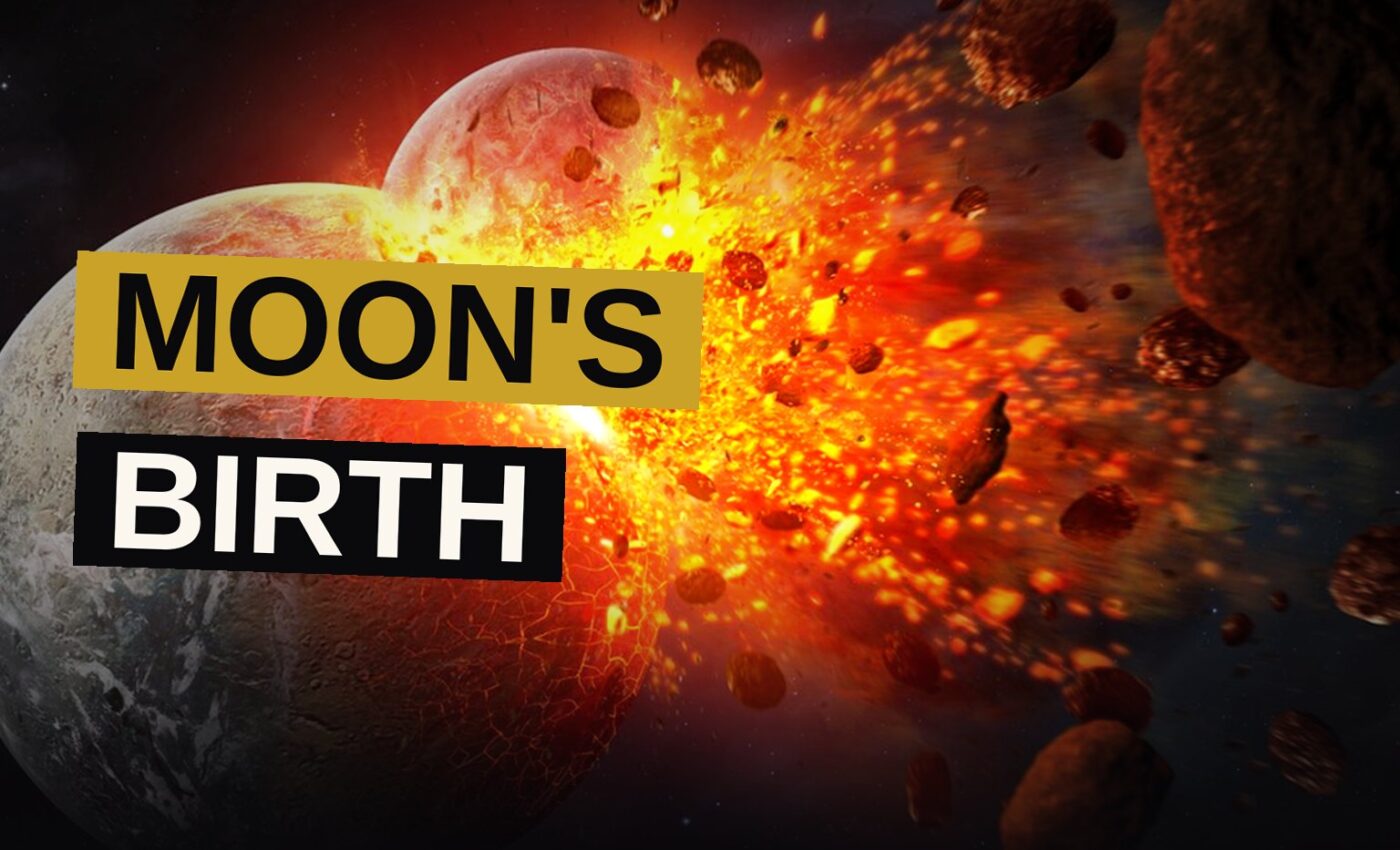
The moon may have formed in just 5 hours, new simulations suggest. The finding comes from a fresh look at the ancient collision between Earth and a Mars-size protoplanet called Theia.
Scientists have long suspected that the moon was born when Theia smashed into early Earth. That impact likely turned both worlds into spinning clumps of molten rock. Those clumps cooled into the Earth and moon we see today.
The New Simulations
Researchers ran a series of simulations that focused on the geological properties of both Earth and Theia before their collision. Previous models mostly looked at the masses of the two bodies. The new work also considered their material strength — particularly the hardness of their exteriors.
The study appeared Sept. 1 in The Astrophysical Journal Letters. Its authors are Adeene Denton, Erik Asphaug, Namya Baijal, and Robert E. Melikyan.
“We weren’t sure if it would matter for the moon or not,” said Denton, a geologist and planetary scientist at the Southwest Research Institute in Boulder, Colorado. “When we did the simulations, we found it actually matters quite a bit.”
Temperature Matters
The main factor in the strength of colliding bodies is temperature. Both Earth and Theia were very young when they hit, so they were still hot with soft or molten surfaces. Those properties cushioned the collision and let the debris stay largely intact.
That allowed the moon to form quickly. Under the most extreme scenario — where the pair were at their hottest — the moon could have formed in just five hours.
But this is only one possible outcome. There is no way of knowing exactly how hot Earth and Theia really were at impact.
What This Changes
The giant impact hypothesis was first proposed in 2001. Scientists then thought the collision happened much later, when the bodies had cooled and become brittle. That would have created a larger field of rocky debris that took longer to coalesce.
Lunar rocks from NASA’s Apollo missions back the theory and date the moon to around 4.5 billion years old. That puts the collision roughly 100 million years after the sun was born.
The new simulations highlight material strength in planetary impact modeling. That could change what we know about other ancient collisions, like the one that knocked Jupiter’s moon Ganymede off its axis or the one that birthed Saturn’s moon Titan.
The findings could also affect the search for exomoons — hypothetical moons around distant exoplanets. Astronomers have hunted for them by looking for debris fields around exoplanets. If the moon is any guide, those debris fields may be short-lived and hard to spot.
What Happened Next
When the moon first formed, it was covered in a magma ocean that took hundreds of millions of years to solidify. It was likely a volcanic hellscape. Over time it moved away from Earth, cooled further, and is now assumed to be geologically dead.
The moon is still slowly moving away from us. It could eventually escape Earth’s gravity entirely — if the dying sun doesn’t destroy it and us first in around 5 billion years.
| Factor | Old assumption | New simulation |
|---|---|---|
| Collision timing | Later, cooler bodies | Early, hot bodies |
| Surface state | Brittle | Soft or molten |
| Debris field | Large, slow to coalesce | Compact, quick to form |
| Moon formation time | Much longer | As little as 5 hours |
The results show that a simple change in assumptions can reshape a fundamental story about our solar system.
Source: livescience.com
Get the Notebook.
The day's best stories and every fresh verdict, in plain English, in your inbox by seven. One email a day, no more.