
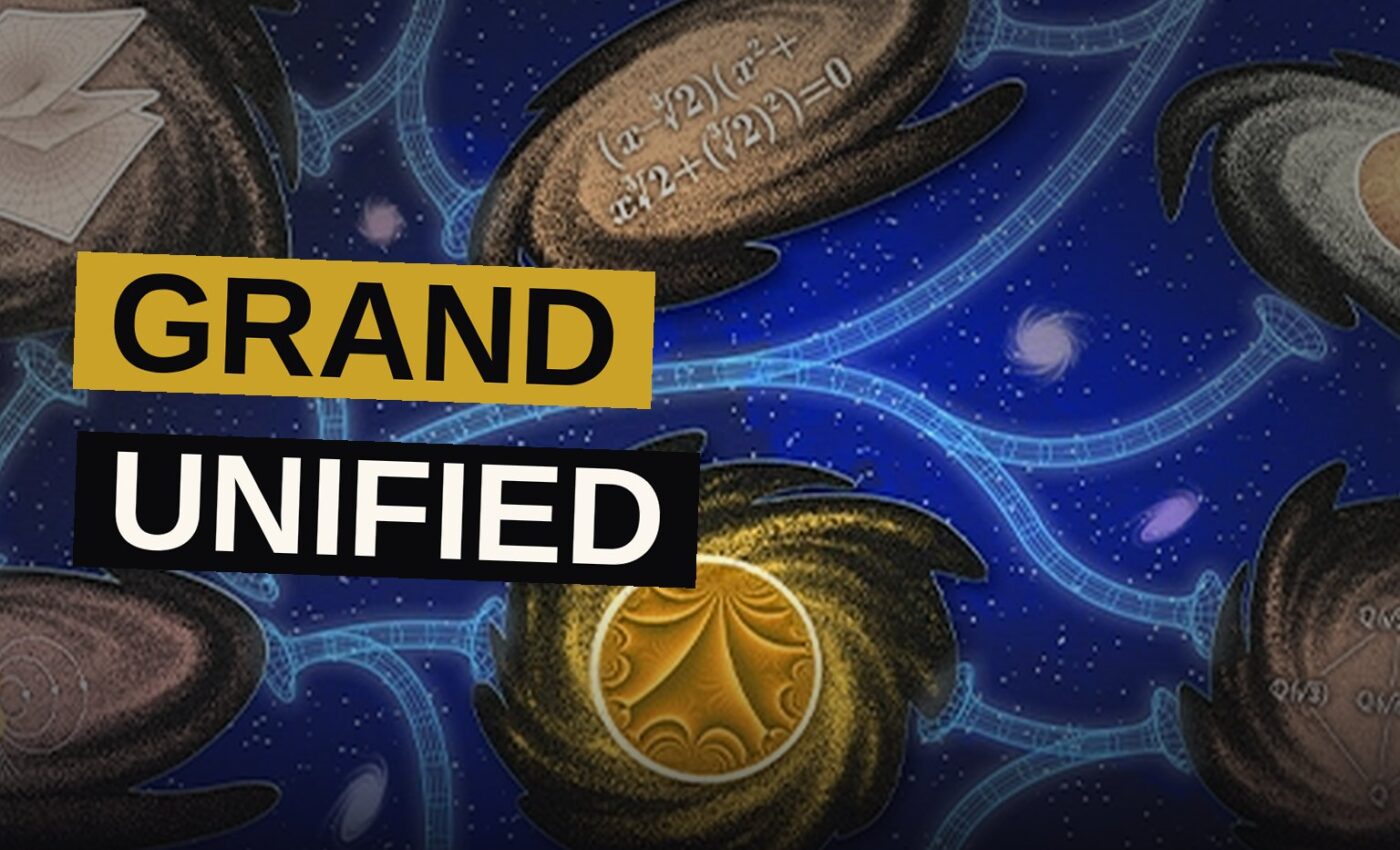
The Langlands program is often called a “grand unified theory of mathematics,” but even most mathematicians admit they don’t fully understand it. The decades-long effort, launched by Canadian mathematician Robert Langlands in 1967, connects distant realms of math like wormholes linking separate galaxies. Yet when experts try to explain it, their descriptions sound nothing alike.
“Everyone will have heard of it, certainly,” said David Ben-Zvi, a mathematician at the University of Texas, Austin who studies the geometric Langlands correspondence. But when asked whether the average attendee at a recent International Congress of Mathematicians would have a decent understanding of what the program is, or would have no idea, he replied: “I would think more the latter than the former.” The program has so many aspects and consequences that even specialists describe it in wildly different terms — unexpected symmetries, bridges between areas, or the best vision of Fourier theory.
Here’s what the program actually is, where it came from, and why mathematicians think it might describe both the mathematical universe and the physical one.
Robert Langlands and the 1967 Letter
Langlands, now in his 80s, occupies Albert Einstein’s former office at the Institute for Advanced Study in Princeton, New Jersey. In 1967, he wrote a letter to a colleague proposing a connection between two seemingly unrelated areas: number theory and harmonic analysis, the study of signals and waves.
From that letter, Langlands conjectured the existence of a family of correspondences between objects, symmetries, and properties across different mathematical domains. The idea was that a bridge could link a problem in one field to a problem in another.
The effort to extend and exploit these correspondences became the Langlands program, pursued by hundreds of mathematicians over the past half-century. The program suggests an underlying unity to the universe of mathematical truths, which is why it has been called a “grand unified theory of mathematics.”
But the correspondences themselves are excruciatingly specific and esoteric, which makes the program hard to interpret.
The Number Field at the Start
To understand the original Langlands wormhole, start with the rational numbers, denoted Q. These are numbers expressible as fractions — 1, 5/16, or −5.3277. They form a special set called a number field, because adding, subtracting, multiplying, or dividing rationals (except by zero) always yields another rational.
Things change when you introduce a polynomial equation such as x² − 2 = 0. The equation features only rational numbers, but its solutions — the values of x that make it true — lie outside Q. The solutions are x = √2 and x = −√2, both irrational. Their digits begin 1.41421… and continue forever without repeating.
Mathematicians use these solutions to extend Q into a new field, written Q(√2). This field contains √2 and −√2, plus all numbers you can get by combining them with other rationals. Any number of the form a + b√2, where a and b are rationals, belongs to the field. Examples include 5 + 3√2 or −√2/7.
If you picture a as a horizontal number line and b as a vertical one, the field Q(√2) spans the whole plane.
Galois and the Symmetry of Equations
The field Q(√2) has a symmetry: a transformation that preserves all its elements. You can replace every √2 with the equation’s other solution, −√2, and vice versa. The field remains intact. Every a + b√2 becomes a − b√2, which was already in the field, sitting on the opposite side of the horizontal axis. The transformation is like reflecting the field in a mirror.
The collection of such symmetries is called the Galois group, after Évariste Galois, a mathematician who studied them in 1832. Galois came up with his big insight at age 20, just weeks before he was killed in a duel.
His discovery: these symmetry groups reveal a great deal about equations and their solutions, even for equations too hard to solve directly.
For x² − 2 = 0, the Galois group consists of two symmetries: the one that swaps √2 and −√2, and the one that does nothing.
The Bridge Between Number Theory and Waves
Langlands’ 1967 insight was to connect these Galois groups to harmonic analysis, the study of signals and waves.
One expert described the program as “the best vision we have to understand non-abelian versions of Fourier theory.” That statement might be the deepest explanation available so far.
The correspondences act as a link between the symmetries of number fields, captured by Galois groups, and the structures of harmonic analysis.
The program extends far beyond the single example of Q(√2), covering an enormous range of equations, fields, and symmetries.
Why Experts Disagree on What It Means
Ask mathematicians what the Langlands program is about, and you get different answers. One said it’s all about “unexpected symmetries.” Another defined it as “bridges between two areas of mathematics.” Someone else called it the best vision of Fourier theory. References were made to the parable of the blind men and the elephant — each expert grasps one part of the program and describes it differently.
Part of the difficulty is that mathematicians shy away from interpretation by nature, since anything they say will be unproven. The full program remains conjectural, a vast landscape of connections that mathematicians are still mapping.
Another challenge is the sheer specificity of the mathematics. The program is sweeping and unifying, but the correspondences are excruciatingly precise. Each one links particular objects with particular properties.
The program has grown organically since Langlands’ letter.
The Physical Universe Connection
Mathematicians have yet to mine the deepest meaning of the Langlands program. The obscure message at its core seemingly pertains not only to the mathematical universe, but also to the physical one.
This is speculative — researchers are still working out what the program means for the physical world.
For now, the Langlands program remains a mathematical project with no precedent. It spans centuries of mathematics, from Galois’ duel to Einstein’s old office, and it connects ideas that once seemed completely separate.
The Long Road Ahead
The Langlands program is not a single theorem but a research agenda, a way of organizing mathematical work across many fields. Hundreds of mathematicians have contributed to it over the decades.
Ben-Zvi’s assessment of how well mathematicians understand the program is telling. Most have heard of it, certainly. But a working understanding of what it is and why it matters is rarer. The program’s size and complexity make it hard to grasp even for specialists, who tend to focus on one corner of the elephant.
The correspondences themselves are like wormholes. They connect distant regions of the mathematical universe, and traveling through them can reveal connections between domains that once seemed completely separate. That’s the promise of the Langlands program — a unified view of mathematics, and possibly of physics, that no one has fully seen yet.
Key Facts Box
- 1967: Robert Langlands writes the letter launching the program
- 1832: Évariste Galois studies symmetry groups, later killed in a duel at age 20
- Q: The set of rational numbers, expressible as fractions
- x² − 2 = 0: The example equation with irrational solutions √2 and −√2
- Q(√2): The extended number field containing a + b√2 for rational a and b
- 2: The number of symmetries in the Galois group of x² − 2 = 0
Comparing the Domains
| Domain | Key Objects | Example | What It Studies |
|---|---|---|---|
| Number theory | Number fields like Q(√2) | x² − 2 = 0 | Rational numbers and equations |
| Harmonic analysis | Signals and waves | — | The study of signals and waves |
| Galois theory | Galois groups | The symmetry that swaps √2 and −√2 | Symmetries of equations |
The program is still unfolding. Each new correspondence adds to the structure that Langlands first glimpsed in 1967.
What the program ultimately means — for mathematics, for physics, for our understanding of the universe — is still an open question. The experts agree on that much, even if they describe the elephant differently. The Langlands program is a grand unified theory in the making, and no one yet knows where it leads.
Source: quantamagazine.org
Get the Notebook.
The day's best stories and every fresh verdict, in plain English, in your inbox by seven. One email a day, no more.