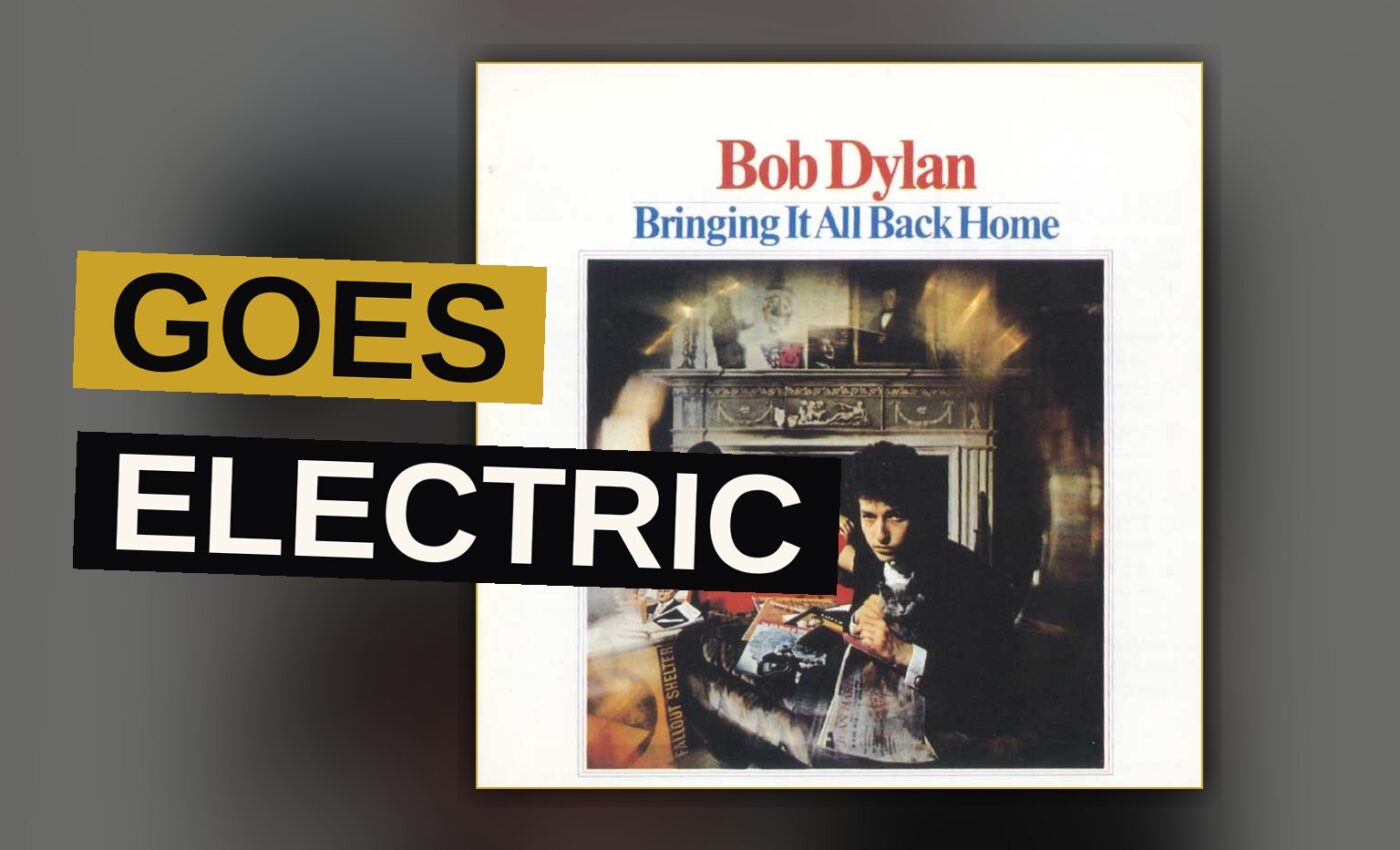
Bob Dylan’s fifth album, Bringing It All Back Home, is the sound of an artist blowing up his own frame. Released in 1965, it is the record where Dylan stops being the acoustic folk prophet who wrote protest anthems and becomes something stranger, louder and more permanent.
It is a full pivot, executed in public. The album is trying to do two things at once: to bury his old reputation as a political singer, and to build a new kind of songwriting that is surreal, funny, caustic and deeply personal. It succeeds at both, and in doing so changes what a pop record can contain.
The record is split down the middle. Side one is electric, four-piece rock and roll with a snare drum you can feel in your teeth. Side two is acoustic, but the acoustic songs are not a retreat. They are just as strange, just as dense, just as confrontational. The whole thing runs 47 minutes across 11 tracks, and it opens with one of the most important singles in rock history.
Subterranean Homesick Blues Opens the Attack
“Subterranean Homesick Blues” starts the record with a two-and-a-half-minute burst of compressed, rhyming paranoia. It is not a protest song in any traditional sense, but it is a protest against everything — against authority, against language, against the idea that a song has to mean one thing. The words tumble out in rapid couplets, dense with images of basements, medicine and running from the law. The track is built on a rolling blues riff that Dylan practically spits over, and it introduced a generation to the idea that rock lyrics could be as fast and as dense as poetry.
“She Belongs to Me” slows the pulse but sharpens the portrait. It is a love song, sort of, about a woman who has a kind of power over light and dark, who carries herself with total confidence. The guitar work is clean, almost delicate, and Dylan’s vocal is confident, even amused. It is one of the few tracks on the record that feels like it could have been written by anyone else, but the imagery is pure Dylan.
Maggie’s Farm Makes the Break
“Maggie’s Farm” is the record’s clearest statement of intent. It is a three-and-a-half-minute dismissal of an employer, or a system, or a scene — the song works on all levels. Dylan sings about refusing to work for a boss and her family, and the band behind him plays with a sneer. It is a breakup song aimed at the folk movement that had tried to claim him as its own. The track is built on a single, relentless riff, and it does not let up. It is not subtle, and it is not meant to be.
“Love Minus Zero/No Limit” is the quietest moment on the electric side, a ballad that sounds almost traditional until you listen to the words. It is a love song that refuses to make its subject easy to grasp, describing a woman who is compared to a raven at a window. It is tender, but it is also slippery. The song’s title reads like a mathematical equation, and the lyrics never quite resolve into a simple answer.
“Outlaw Blues” is a short, sharp joke. It is three minutes of blues posturing, with Dylan bragging about his outlaw ways, his woman and his motorcycle. It is the least serious song on the record, and it is better for it. The band is tight, the guitar solo is brief, and the whole thing feels like a palate cleanser before the side’s big finale.
“On the Road Again” closes the electric side with a comic nightmare. It is a song about staying with a woman whose family is impossible — her mother makes him nervous, her father is a deadbeat, her brother has a curly mop. It is funny, fast and throwaway in the best sense. It does not try to be important, and that is its charm.
Bob Dylan’s 115th Dream Goes Long
“Bob Dylan’s 115th Dream” is one of the longest tracks on the record, at six and a half minutes, and it is a shaggy-dog story about discovering America. It opens with a false start — Dylan laughs, and the band stops, and they start again. The song is a surreal travelogue that touches on a naked girl, a cop, a bank robbery and a yellow cat. It is the closest Dylan ever came to pure comedy on a record, and it works because the band keeps it moving.
“Mr. Tambourine Man” is the record’s centerpiece, and one of the most covered songs in popular music. It is a plea to be carried away by music, by a figure who is part musician, part dealer, part spirit. The acoustic guitar dances underneath Dylan’s vocal, and the song becomes a doorway — it is not about anything literal, and that is the point. It is about the feeling of wanting to be lifted out of yourself. Dylan’s own version, with its long, winding verses, remains the definitive one.
“Gates of Eden” is the most impenetrable song on the album. It is five and a half minutes of dense, surreal imagery, with no chorus and no obvious hook. It is a song about a world that is not the world, where a lamppost stands with folded arms. It is the kind of track that rewards close listening, but it is also the one that casual fans are most likely to skip. It is not a failure, but it is a test.
It’s Alright, Ma Delivers the Moral Center
“It’s Alright, Ma (I’m Only Bleeding)” is the record’s moral center, and its most quoted song. It is seven and a half minutes of acoustic guitar and harmonica, with Dylan delivering a torrent of lines that have become part of the language. The song is a catalogue of modern complaints — advertising, war, religion, family, money — and it is as angry as anything on the electric side, even without a band behind it. It is the song that proves Dylan did not need electricity to be revolutionary.
“It’s All Over Now, Baby Blue” closes the record with a farewell. It is addressed to an unnamed “Baby Blue,” but it reads as a goodbye to his old self, his old audience, his old style. The song tells its subject to leave, to take what is needed, and it drifts off on a harmonica solo that feels like a door closing. It is a perfect ending, and one of the most moving songs in his catalog.
A Record That Changed the Rules
Bringing It All Back Home is not a perfect record. “Gates of Eden” is a slog on first listen, and “Outlaw Blues” and “On the Road Again” are minor entries. But the album’s highs are so high, and its ambition is so total, that those dips barely register. The record is a statement of artistic independence, made at the exact moment Dylan had the power to make it stick.
The album’s influence is difficult to overstate. It is the record that taught a generation that rock lyrics could be literary, that a pop song could be surreal, that a folk singer could plug in and still be taken seriously. Critics and retrospectives near-universally treat it as a groundbreaking, essential album that marked Dylan’s pivotal shift from acoustic folk protest music toward electric folk-rock and surreal, poetic songwriting.
What makes the record still work, decades on, is not its historical importance. It is the songs. “Mr. Tambourine Man” remains a doorway into another state of mind. “It’s Alright, Ma” remains a moral challenge. “Subterranean Homesick Blues” remains a rocket. The record does not feel like a museum piece, because the writing is too alive.
The Electric Divide
The decision to split the album between electric and acoustic sides was a commercial risk and an artistic masterstroke. It let Dylan have it both ways: the rock fans got their noise, and the folk fans got their poetry. But the split also tells a story. The electric side is the future, loud and messy and full of jokes. The acoustic side is the past, but the past as Dylan wanted to remember it — not as protest, but as prophecy.
The record’s title is a joke and a mission statement. Dylan is bringing it all back home — the blues, the folk, the surrealism, the noise — and he is bringing it to a popular audience that had never heard anything like it. He is also bringing it back to himself, away from the movement that had tried to claim him.
The Lasting Weight
Bringing It All Back Home is a landmark. It is the sound of an artist at the peak of his powers, taking the biggest risk of his career and landing it. It is funny, angry, tender, weird and unforgettable. It is not the easiest entry point into Dylan’s catalog — the density of the lyrics and the roughness of the electric band take some getting used to — but it is the most essential.
The record earns every bit of its reputation. It is one of the most important albums in popular music, and it remains as vital today as it was in 1965.
9 of 10.
Key Facts Box
- Artist: Bob Dylan
- Album: Bringing It All Back Home
- Release year: 1965
- Total running time: 47 minutes
- Track count: 11
- Key tracks: “Subterranean Homesick Blues,” “Mr. Tambourine Man,” “Maggie’s Farm,” “It’s Alright, Ma (I’m Only Bleeding),” “It’s All Over Now, Baby Blue”
- Score: 9 of 10
Get the Notebook.
The day's best stories and every fresh verdict, in plain English, in your inbox by seven. One email a day, no more.
- Subterranean Homesick Blues2:25
- She Belongs to Me2:50
- Maggie's Farm3:58
- Love Minus Zero/No Limit2:54
- Outlaw Blues3:07
- On the Road Again2:38
- Bob Dylan's 115th Dream6:33
- Mr. Tambourine Man5:34
- Gates of Eden5:43
- It's Alright, Ma (I'm Only Bleeding)7:32
- It's All Over Now, Baby Blue4:14