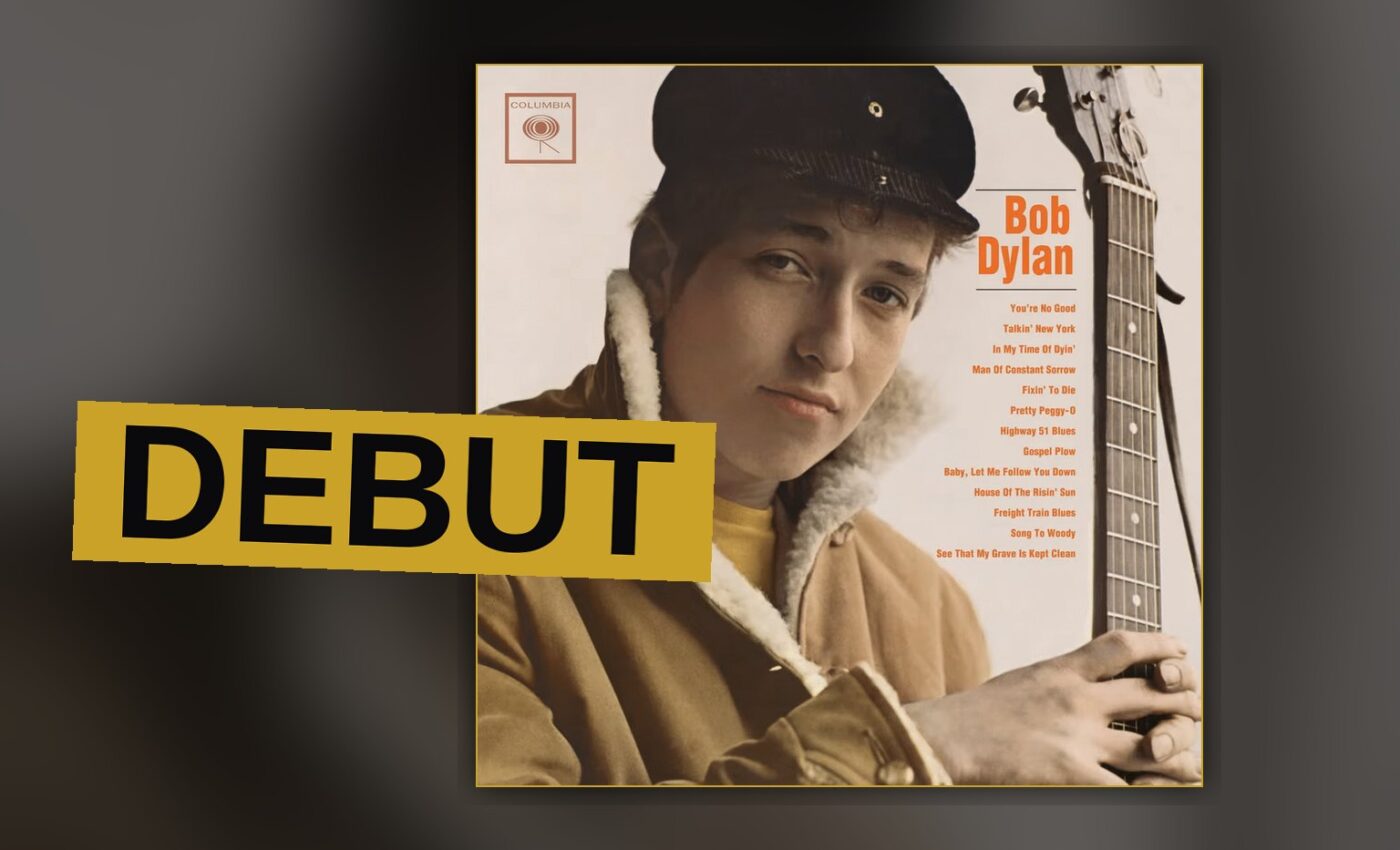
Bob Dylan’s self-titled debut is a 36-minute bolt of raw folk and blues. It is not the Dylan of electric guitars or surrealist poetry. It is a young man with an acoustic guitar, a harmonica rack, and a voice that sounds older than he was.
The record is built almost entirely on other people’s songs. Thirteen tracks, and only two are Dylan originals. The rest are traditional folk numbers and blues standards. The intent is clear: this is a singer finding his footing, not a songwriter announcing himself. It is a debut that looks backward to tradition before it can look forward to reinvention.
Covers That Carry the Record
The album opens with “You’re No Good,” a 1:40 burst of fingerpicked scorn. Dylan tears through it with a sneer, and the brevity works in its favor. “Talkin’ New York” follows, and it is one of the two originals. It is a talking blues, Dylan’s wry account of arriving in the city broke and unknown. The humor lands: he sings about being turned away from clubs and sleeping in subways, but the tone is amused rather than bitter.
“In My Time of Dyin’” slows things down. It is a traditional gospel-blues number, and Dylan plays it with a heavy, deliberate crawl. The slide guitar and his gravelly delivery give it real weight. “Man of Constant Sorrow” is next, and it is one of the record’s best moments. The song was already famous, but Dylan’s version is unhurried and mournful, his voice cracking just enough to sell the hardship.
“Fixin’ to Die” keeps the grim streak going. The harmonica is ragged, the rhythm is urgent, and the fatalism feels earned. “Pretty Peggy-O” is lighter, a Scottish ballad turned folk standard. Dylan’s take is jaunty, almost playful, and it gives the record a needed breath.
“Highway 51” is a blues, and Dylan plays it with a jump in his step. It is not a deep cut, but it moves. “Gospel Plow” is the shortest track after the opener, a 1:46 field holler with a driving strum. It is simple and functional, a warm-up rather than a statement.
The Long Middle and the Originals
“Baby, Let Me Follow You Down” is a 2:35 blues. It is loose and conversational, with Dylan talking a little before the song starts, and that intimacy is part of the charm. Then comes the centerpiece: “House of the Risin’ Sun,” the traditional ballad that Dylan stretches to 5:18. It is the longest track on the record, and it earns every second. His arrangement is sparse — just voice, guitar, and harmonica — but the slow build is hypnotic. It is a dirge of quiet menace, and it remains the definitive acoustic version.
“Freight Train Blues” is a throwaway. Dylan plays it competently but without much spark. It is the kind of track that fills out a running time rather than defines it.
The album’s real payoff comes at track 12: “Song to Woody.” It is the second Dylan original, and it is a tribute. The lyrics are simple and direct, but the sincerity is overwhelming. It is the first moment on the record where Dylan sounds like he has something of his own to say, not just something to interpret.
The closer, “See That My Grave Is Kept Clean,” is a blues about death. Dylan returns to the subject with a matter-of-fact calm. It is a fitting end: a young man singing about mortality with the confidence of someone who has not yet lived enough to earn it.
What the Debut Proves
The record’s weaknesses are obvious. Several tracks — “Gospel Plow,” “Freight Train Blues,” “Highway 51” — are competent but forgettable. Dylan’s voice is an acquired taste, and on a few cuts his harmonica playing is more enthusiastic than precise. The album is also short, and it lacks the thematic coherence of his later work. It is a collection, not a statement.
But the strengths are real. “House of the Risin’ Sun” and “Song to Woody” are essential Dylan. “Man of Constant Sorrow” and “In My Time of Dyin’” show a young interpreter with real instinct for the emotional core of a song. And the record as a whole captures a specific moment: the last time Dylan was just a folk singer, before he became the most important songwriter of his generation.
- “House of the Risin’ Sun” (5:18) is the standout track
- “Song to Woody” is the first great Dylan original
- Only two of 13 tracks are Dylan compositions
- AllMusic rates it 4/5
Key facts:
- Album: Bob Dylan (1962)
- 13 tracks, 36 minutes total
- Released on Columbia Records
- Our score: 8.0/10
The debut is a promise, not a payoff. It is a sterling effort that outclasses most of what came before it in the folk genre, but it was immediately eclipsed by Dylan’s own subsequent albums. The great talent scout who signed Dylan to his first record contract heard genius waiting here — and he was right, though it took another record or two to fully arrive.
For what it is — a young artist’s first statement, rooted in tradition rather than invention — it succeeds almost completely. It is not the album that changed music. But it is the album that made the change possible.
8 of 10.
Get the Notebook.
The day's best stories and every fresh verdict, in plain English, in your inbox by seven. One email a day, no more.
- You’re No Good1:40
- Talkin’ New York3:19
- In My Time of Dyin’2:39
- Man of Constant Sorrow3:08
- Fixin’ to Die2:21
- Pretty Peggy‐O3:23
- Highway 512:53
- Gospel Plow1:46
- Baby, Let Me Follow You Down2:35
- House of the Risin’ Sun5:18
- Freight Train Blues2:19
- Song to Woody2:42
- See That My Grave Is Kept Clean2:43