
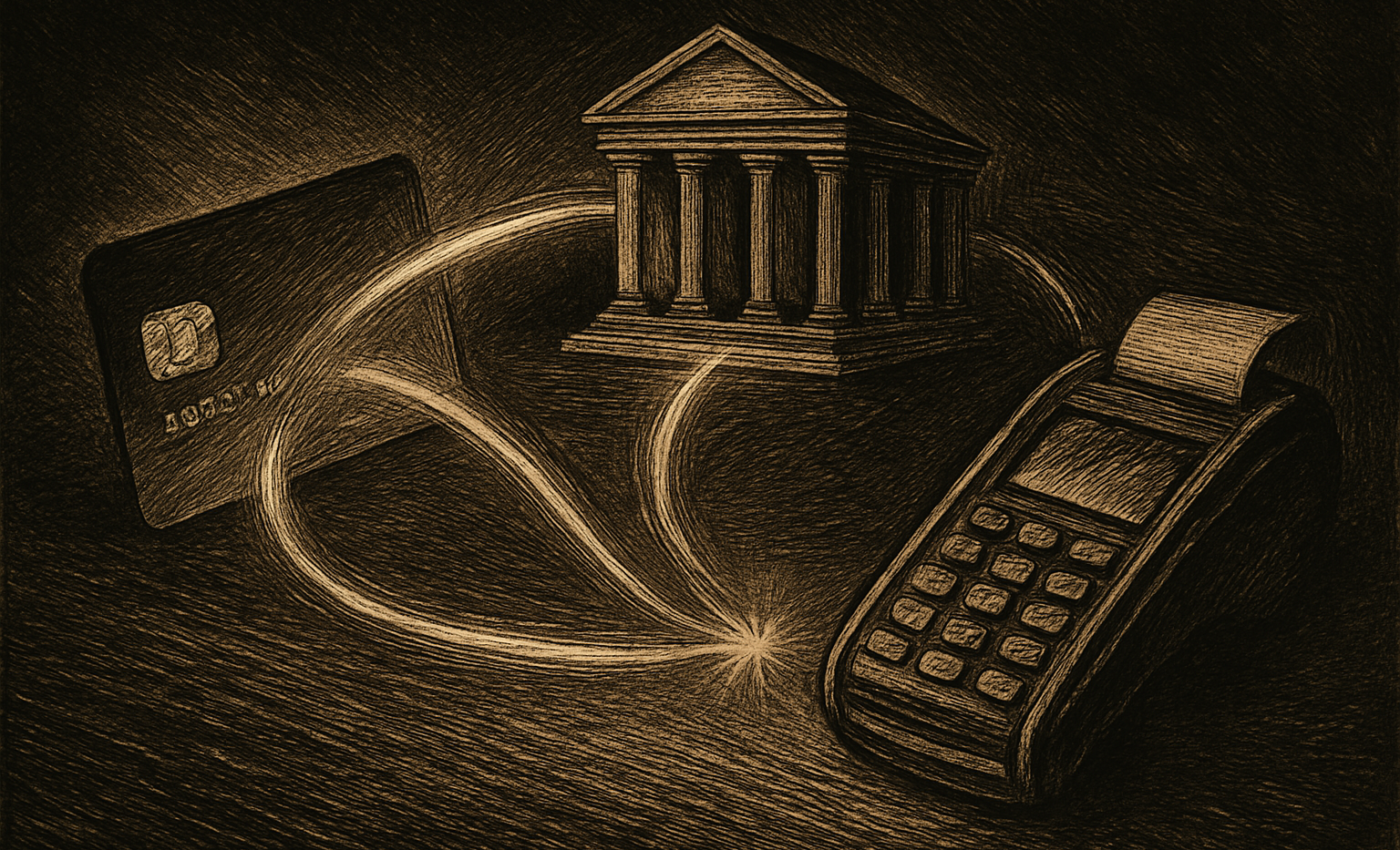
A Visa or Mastercard transaction happens in seconds. The card is tapped, the payment goes through, and you walk away. But behind that moment sits a company you never see, doing a job most people can’t name.
The two brands are not banks. They do not issue your card, print it, or underwrite the stores that accept it. They are card networks, and their job is to connect the people and institutions on both sides of every transaction. A blog post titled “What do Visa and Mastercard do? An intro to card networks” broke down exactly how that works.
The Four Jobs of a Card Network
Visa and Mastercard sit in the middle of a two-sided market. On one side are cardholders and the banks that issue their cards. On the other are merchants and the banks that process their payments. The network’s job is to make sure both sides can talk to each other and move money.
That work comes down to four responsibilities, according to the post:
- Run the telecommunications network to route transaction messages.
- Coordinate the banking network to move money and settle transactions.
- Set the incentives to encourage use of the network.
- Set and enforce rules of the network, including a mechanism for disputes.
The post focuses on Visa, which the author knows from years in the payment industry. Mastercard does the same work, just with different names for things.
The Data Center With a Moat
The first job is purely technical. Card networks are telecommunications networks, not unlike the Internet. Visa maintains data centers and leases fiber optic cables to connect issuers and acquirers electronically. At the most basic level, Visa forwards transaction messages between participants. Mastercard calls this activity “switching,” treating itself as a network switch.
Visa takes its data centers seriously. The post quotes a 2013 Network Computing article about the company’s flagship facility, called Operations Center East, or OCE. It is a 140,000-square-foot building that Visa will only say is located “somewhere along the Eastern seaboard.”
The facility is designed to withstand earthquakes and winds up to 170 miles per hour. The roads in have hydraulic bollards that can stop a vehicle traveling 50 miles per hour. Visitors pass a security gate, get cleared by roving security teams, and then face a biometric scan.
A 2012 USA Today headline put it plainly: “Top secret Visa data center banks on security, even has moat.”
The top secret location turned out to be Ashburn, Virginia, conveniently near a Topgolf and a Trader Joe’s.
How a Transaction Actually Moves
When you use a card, the network routes a request called an authorization from the merchant to the issuer. The issuer approves or declines it. Card numbers, also known as Primary Account Numbers, or PANs, work like IP addresses. The first 6 to 8 digits identify the issuer and are called the Bank Identification Number, or BIN.
An approved authorization places a temporary hold on the account for the transaction amount. Later, the merchant submits the final amount — adding a tip or voiding a transaction — to start the transfer of money. That step is called clearing.
Before computers did this work, people did it by phone and mail.
The Banking Network Behind the Payments
The second job is financial. Visa runs a network of banks, and after a transaction is finalized, money must move on both ends to complete it. That step is called settlement.
Visa routes that money by holding financial relationships with each party. It can collect from one and transfer to another. To stay efficient, Visa does net settlement: each participant’s debits and credits are totalled daily, and the net amount moves once daily.
Domestic transactions are relatively straightforward, thanks to central banks. Visa also settles internationally and handles currency conversion. It acts as an adapter between banking systems, using its global relationships. Without Visa, each participant would need its own international banking arrangements.
That scale carries risk. Visa faces non-payment risk and must hold a significant balance to cover payouts while waiting to receive settlement payments. The post cites Visa’s 2024 annual SEC report: most U.S. dollar settlements clear the same day, while settlements in other currencies generally remain outstanding for one to two business days. As of September 30, 2024, Visa held $11.2 billion of its total available liquidity.
Shuffling this amount of money around and timing everything right is no easy feat.
What Visa and Mastercard Do Not Do
The post is careful to list what the networks are not responsible for. The list clarifies common confusion about the payment industry.
- They are not the card issuers. That is the bank that gives you the card.
- They are not banks, though your card is probably issued by one — Chase, Capital One, BofA, and others.
- They do not distribute point of sale systems or online checkouts. Payment processors do that.
- They do not onboard or underwrite merchants. That is merchant acquiring, done by banks offering merchant accounts, and increasingly by processors like Stripe, Square, and Adyen.
- They do not manufacture or print cards.
- They do not build point of sale hardware.
The networks only connect the parties. That connection is the product.
Why the Network Model Works
The value of a card network grows with participation. More merchants mean more reason for cardholders to use the card. More cardholders mean more reason for merchants to accept it. Visa and Mastercard’s job includes growing both sides of that market.
The incentives matter. The networks set incentives to encourage use of the network. They also set and enforce the rules, including the dispute mechanism that decides who wins when a transaction goes wrong.
For international payments, the network’s value is especially clear. A merchant in one country can accept a card from another without building its own banking relationships across borders. The network handles that complexity.
The system is not simple, and the post does not pretend it is. Moving money across continents and keeping everything timed correctly is a hard problem. But the design is elegant in one sense: the consumer never sees any of it.
A tap on a terminal is the only visible part of a system that spans data centers, banks, and settlement ledgers. The rest happens in the space between the card and the receipt, run by companies whose names appear on the card itself.
The blog post made that invisible system visible.
Source: tautology.town
Get the Notebook.
The day's best stories and every fresh verdict, in plain English, in your inbox by seven. One email a day, no more.