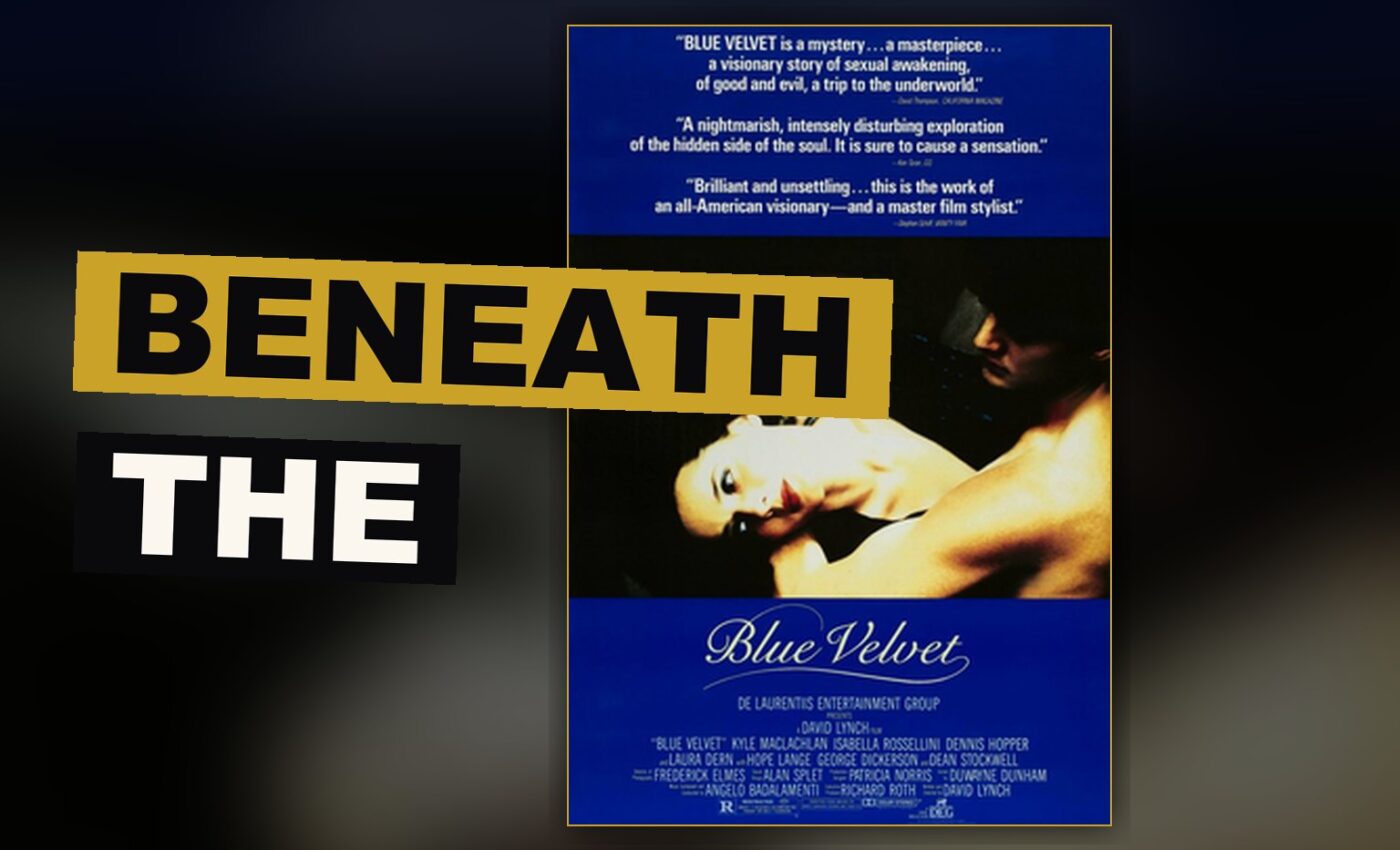
David Lynch’s Blue Velvet opens on a picket fence, a fire truck, and a man collapsing in his garden. What follows is a college student’s summer homecoming that turns into a criminal investigation, a sadomasochistic affair, and a film that split critics when it arrived in 1986.
Lynch wrote and directed the movie. It runs 120 minutes and carries the genres mystery, thriller and crime. The tagline asks the question the film never quite answers: “It’s a strange world, isn’t it?”
An Ear in the Vacant Lot
Jeffrey Beaumont (Kyle MacLachlan) returns to Lumberton, North Carolina, after his father Tom suffers a near-fatal stroke. Walking home from the hospital, he cuts through a vacant lot and finds a severed human ear. He brings it to police detective John Williams.
Williams’s daughter Sandy (Laura Dern) tells Jeffrey the ear relates to a lounge singer named Dorothy Vallens. Intrigued, Jeffrey enters Dorothy’s apartment by posing as a pest exterminator. He steals a spare key while she is distracted by a man in a yellow sport coat — the “Yellow Man.”
Isabella Rossellini and the Knife
Isabella Rossellini plays Dorothy. Lynch met her at a restaurant and offered her the part. Helen Mirren had been his first choice.
Rossellini had exposure before the film for her Lancôme ads and for being the daughter of Ingrid Bergman and Roberto Rossellini. After test screenings, her agency ICM Partners dropped her as a client. The nuns at her old school in Rome called to say they were praying for her.
That reaction tells you what the film does to people.
Frank Booth Wants a Heineken
Jeffrey and Sandy attend Dorothy’s nightclub act, where she sings “Blue Velvet.” They leave early so Jeffrey can break into her apartment. Dorothy returns, undresses, finds Jeffrey in the closet, and forces him to strip at knifepoint.
Then Frank Booth arrives. Dennis Hopper plays him. Frank beats and rapes Dorothy while inhaling gas from a canister, moving between sobbing and rage. Jeffrey sneaks away after Frank leaves and seeks comfort from Sandy.
The cast around Hopper was a mix of unknowns and Lynch regulars:
- Kyle MacLachlan, who had starred in Lynch’s Dune
- Isabella Rossellini, in the role that got her dropped by her agency
- Dennis Hopper, the best-known actor in the film
- Laura Dern, then 18, cast after several established actresses turned the part down
- Dean Stockwell and Brad Dourif, both rejoining Lynch from Dune
Val Kilmer was offered a role and turned it down, calling the film too “graphic.” He later regretted it. Harry Dean Stanton and Steven Berkoff both refused the role of Frank over the violent content. Michael Ironside has said Frank was written with him in mind. Hopper accepted, reportedly exclaiming, “I’ve got to play Frank! I am Frank!”
Molly Ringwald was among the actresses who passed on Sandy before Dern took it.
The Ear, the Husband, the Child
Jeffrey works out that Frank has abducted Dorothy’s husband Don and her son Donnie to force her into sexual slavery. He suspects Frank cut off Don’s ear to keep her in line.
While still seeing Sandy, Jeffrey begins a sadomasochistic relationship with Dorothy in which she encourages him to hit her. He sees Frank at Dorothy’s show, then watches him sell drugs and meet the Yellow Man. The Yellow Man later meets a “well-dressed man.” When Frank catches Jeffrey leaving Dorothy’s apartment, he abducts him and Dorothy and drives them away.
The screenplay had circulated in the late 1970s and early 1980s. Several major studios passed on it over its sexual and violent content. After Dune failed in 1984, Lynch tried to make something more personal, closer to the surrealism of his first film, Eraserhead (1977). De Laurentiis Entertainment Group, then owned by Italian producer Dino De Laurentiis, agreed to finance and produce it.
What Hopper Does to a Room
Hopper is the reason to watch Blue Velvet, and he is also the reason some viewers never finish it. Frank Booth is not a villain with a plan. He is a man with a gas canister and a mood that swings without warning. Hopper plays the swings straight, and the effect is that every scene he enters becomes unsafe.
Lynch casts against type everywhere else too. MacLachlan had just come off Dune, a commercial and critical failure. Lynch said of him: “Kyle plays innocents who are interested in the mysteries of life. He’s the person you trust enough to go into a strange world with.” That is exactly the job MacLachlan does. Jeffrey is not a detective. He is a curious young man who keeps walking into rooms he should leave.
Rossellini has the harder part. Dorothy is written as a victim, and the film risks flattening her into one. Rossellini keeps her from it, mostly by refusing to play the character as pitiable. The cost of that performance was real. An agency dropping a client and a convent promising prayers is a strange measure of a job well done, but it is the measure this film got.
A Divided Reception, Then a Cult
Blue Velvet opened to a divided critical response. Many reviewers said its explicit content served little artistic purpose. Nevertheless, the film earned Lynch his second nomination for the Academy Award for Best Director. It received the year’s Best Film and Best Director prizes from the National Society of Film Critics. It came to achieve cult status.
The film is named after the 1951 song of the same name. That is the whole trick of it. A sweet old standard sits at the center of a story about kidnapping, sexual slavery and a severed ear, and Lynch never winks at the contrast. He plays it straight, which is why it divided critics.
The Verdict: 7.7 of 10
Blue Velvet is not Lynch’s best film, and it is not the one to start with if you have never seen his work. It earned Lynch his second Academy Award nomination for Best Director and later achieved cult status. The studios that passed on the script were right that the material was extreme. They were wrong that it had no purpose. What looks like shock for its own sake is actually structure: the ear, the singer, the gangster and the boy are all one machine, and the machine is about what lives under a tidy town.
But Hopper’s performance has not lost a step, and Rossellini’s has gained weight. This is a film that earned its cult status the hard way — by being genuinely difficult, not merely strange.
Get the Notebook.
The day's best stories and every fresh verdict, in plain English, in your inbox by seven. One email a day, no more.