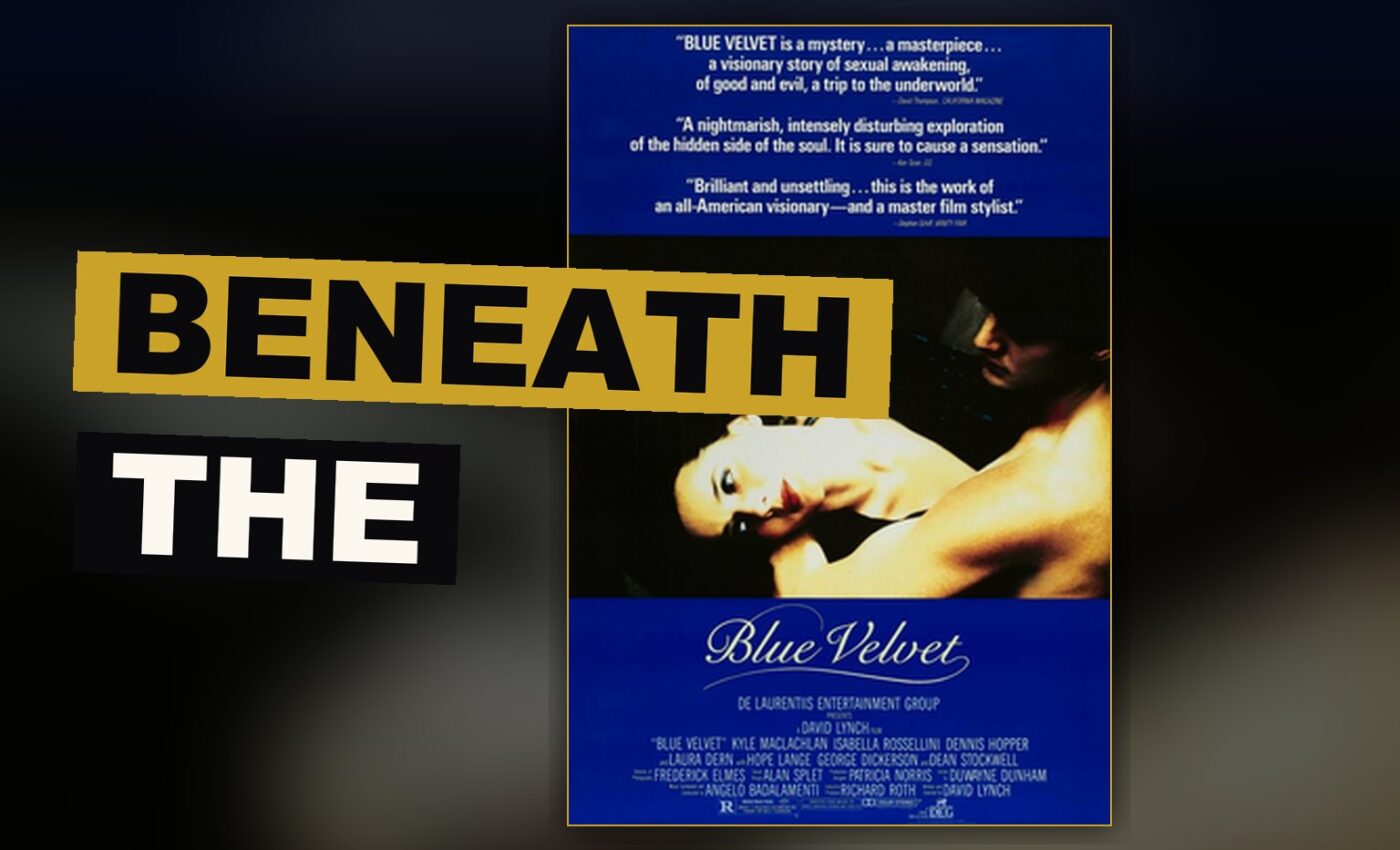
A severed ear in a field opens Blue Velvet, and nothing about David Lynch’s 1986 film settles down after that. It starts as a quiet mystery and turns into something closer to a nightmare, one that never fully explains itself and never needs to.
A Field, an Ear, a Young Man
The story follows a college student who comes home after his father falls sick. Walking through a field near his house, he finds a severed human ear, and the discovery draws him into a case involving a woman who sings at a club and a violent man who treats her with cruelty.
The young man starts looking into the matter on his own, with help from a friend whose father works as a police detective. What he finds inside the singer’s apartment building sets the rest of the film in motion.
The Violent Man at the Center
The violent man is the film’s center of gravity. The actor who plays him gives a performance built on rage and something like need, breathing from a gas mask and calling out lines that still trouble audiences decades later. The work is loud, but it never feels like acting for its own sake. It feels like a real threat sitting in the room.
The singer carries a different kind of weight. Her scenes with the young man are quiet, strange, and hard to watch in ways that have nothing to do with sheer force. The film asks a great deal of the actress who plays her, and she gives it.
A Town That Looks Too Perfect
Lynch opens the film with pictures of a town that looks almost too perfect: blue skies, red roses, a man waving from a truck. Then the camera moves down into the grass and finds small creatures at work beneath it. That single move sets up the whole film’s method: the surface is calm, and what lies beneath it is not.
The town itself plays almost like a character. Diners, church socials, a girl next door. Blue Velvet keeps returning to these settings just long enough to make the darker scenes land harder by contrast.
The music matters just as much as the setting.
The score, composed for the film, runs through it like its own current, at times soft and warm, at other times bending toward dread within the same scene. A recording of the song “Blue Velvet” gives the film its title and its central mood, and a version of the same song sung within the story ties the music directly to the singer’s fate.
A Rough Timeline of the Story
| Story Beat | What Happens |
|---|---|
| Opening | The young man’s father falls sick; he finds a severed ear in a field |
| Early Search | He teams up with his friend to look into the ear |
| First Visit | He stays out of sight in the singer’s apartment and sees the violent man at work |
| Deeper In | He is drawn further into the violent man’s world and the singer’s life |
| Final Turn | The mystery reaches its brutal conclusion |
The Young Man and His Friend
The actor who plays the young man shows him as curious first and afraid second, which is part of what makes the film work. He is not a man practiced in the ways of detection. He is a young man who keeps choosing to go further into a situation he clearly knows is dangerous, and the film never lets him, or the audience, off the hook for that choice.
His friend offers a kind of balance, standing in for the ordinary world the young man is supposed to belong to. The distance between that world and the singer’s world is where much of the film’s trouble sits.
Some scenes are hard by design. Lynch shows the violent man’s cruelty and the singer’s suffering plainly, without turning away from either, and that choice has split audiences since the film opened in 1986. It remains one of the reasons the film is still talked about today.
Why the Film Still Holds Up
Blue Velvet does not offer a neat explanation for the violent man’s cruelty or the singer’s circumstances. It shows them, sits with them, and moves on. That refusal to explain is part of what makes the film stay with a viewer rather than resolve.
The look of the film matters too. The camera work paints the town in bright, cheerful color, then lets the singer’s rooms go dim and close. The contrast between the two builds on the same idea running through the music and the story: nothing here is only one thing.
Blue Velvet is not a comfortable watch, and it was never meant to be one. It is a film about looking too closely at something ordinary and finding out what sits beneath it. Decades on, that idea still holds up, and so does the film built around it.