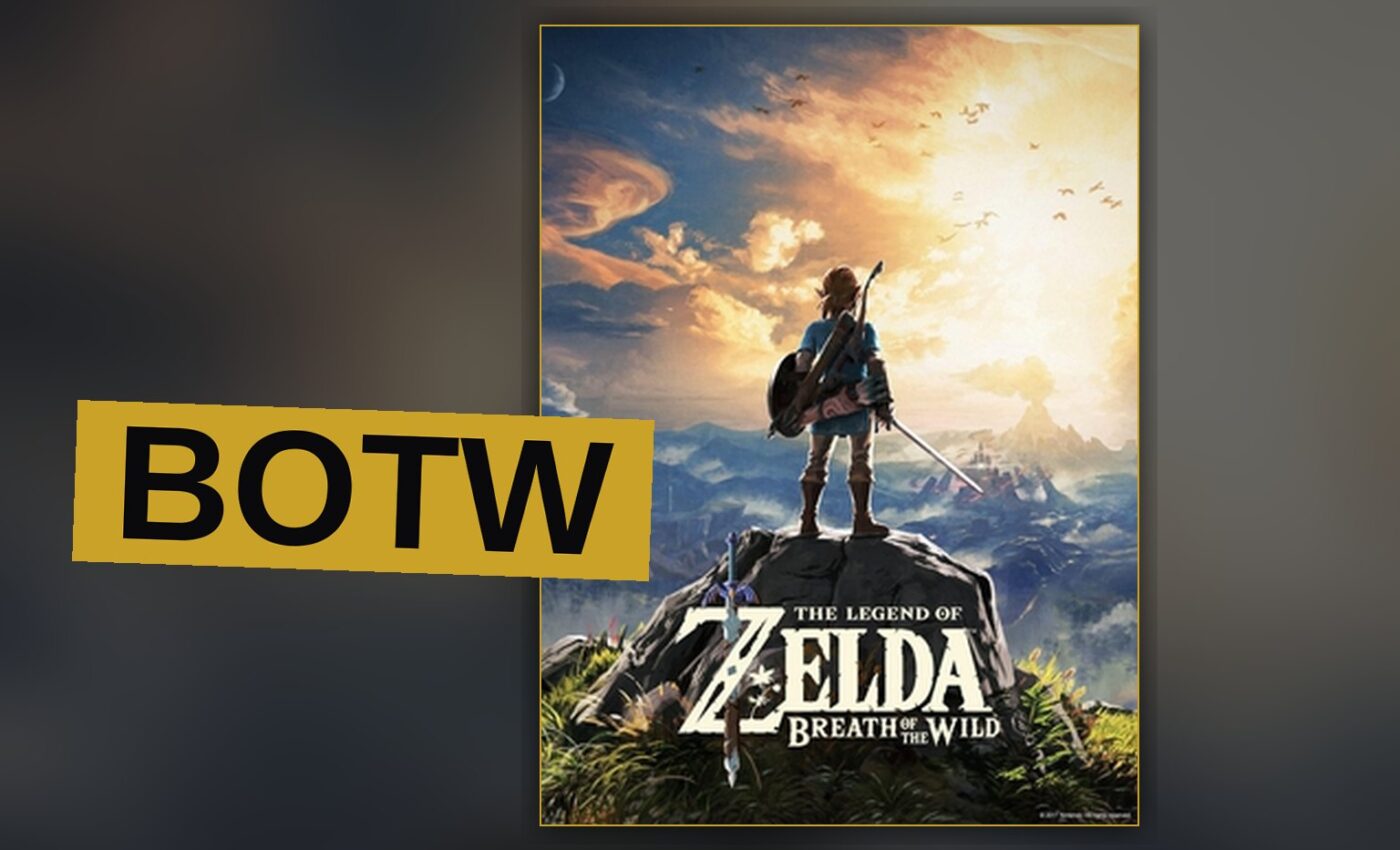
Nintendo did something strange with The Legend of Zelda: Breath of the Wild. It took the oldest, most rigid series in its catalog and pulled out the floor.
The 2017 action-adventure game, developed by Nintendo EPD and released on Wii U and Nintendo Switch, is the first 3D open-world entry in the Zelda line. Link wakes in a chamber called the Shrine of Resurrection on the Great Plateau with no memory. He learns he slept for 100 years after failing to stop Calamity Ganon, and that Princess Zelda is holding the monster inside Hyrule Castle while its power grows.
That is the setup. What follows is one of the best games ever made, and our score matches the published critical aggregate: 9.8 of 10.
The Great Plateau teaches nothing
Breath of the Wild hands the player almost no instruction. There are no defined entrances or exits to areas. The game gives scant guidance and then expects you to walk off a cliff and see what happens.
You meet an old man who turns out to be the lingering spirit of Rhoam, the last king of Hyrule. He explains the century of sleep and the history behind it. Then he stops talking and the world opens.
Link can run, climb, swim and glide with a paraglider. Stamina limits all of it. That single constraint does more design work than any menu in the series’ history. You cannot climb everything at the start. You have to look at a wall and decide.
A physics engine and a chemistry engine
The technical foundation here is the reason the game holds up. Nintendo EPD built a consistent physics engine and a “chemistry engine” that defines the physical properties of most objects and governs how they interact with Link and with each other.
The clearest example is weather. During thunderstorms, metal objects attract powerful lightning strikes. Carrying metal is dangerous. Throwing a metal object at an enemy draws the lightning to them instead.
That is one interaction out of many, and it is the whole design philosophy in miniature. The game does not want you to find the single correct solution. It wants you to find your solution.
Weapons and shields degrade through use and eventually shatter. This is the most divisive choice in the game, and it is also the correct one. It forces improvisation. It keeps you picking up whatever the world offers instead of hoarding one good sword for the whole run.
Many items have multiple uses:
- Wooden weapons can light fires
- Wooden shields can collect incoming enemy arrows
- Certain shields can be used as makeshift snowboards
- Food and materials for elixirs come from hunting animals, gathering wild fruit, or collecting parts of defeated enemies
- Cooking combinations produces meals and elixirs that replenish Link’s health and stamina
None of this is explained in a tutorial box. You find it, or you do not.
Four Champions and a century of failure
The plot sits at the end of the Zelda timeline, in the kingdom of Hyrule. Ten millennia before the game, the Sheikah race built Hyrule into an advanced civilization protected by four enormous animalistic machines called the Divine Beasts and an army of autonomous weapons called Guardians.
When Calamity Ganon appeared, four great warriors were given the title of Champion, each piloting one of the Divine Beasts to weaken Ganon. The princess, who possessed the blood of the Goddess Hylia, sealed Ganon away while her appointed knight protected her.
The Champions are the emotional center of the story:
- Mipha, princess of the aquatic Zora
- Revali, archer of the birdlike Rito
- Daruk, warrior of the mountainous Gorons
- Urbosa, chief of the desert-dwelling Gerudo
Hyrule regressed to a medieval state in the intervening ten thousand years. Its peoples read their ancestors’ prophecies, recognized the signs of Ganon’s return, and excavated the Divine Beasts and Guardians. Zelda trained to awaken the sealing magic. Link was appointed as her knight because he could wield the Master Sword.
Then it all went wrong. Link failed, and he slept for 100 years. Zelda has been holding the line in Hyrule Castle ever since.
Nonlinear by design, not by accident
Breath of the Wild does not impose an order on its quests or dungeons. The story can be completed in a nonlinear fashion. That is not a marketing line. It is the structural fact of the game.
Most open-world games build a corridor and hide it under a map. Breath of the Wild builds a map and lets you draw the corridor yourself. The environmental obstacles are real — weather effects, inhospitable lands, powerful enemies — but almost every one of them can be overcome with the right method.
The result is a world that rewards experimentation.
Nintendo EPD led development under director Hidemaro Fujibayashi and producer Eiji Aonuma. The five-year project started after The Legend of Zelda: Skyward Sword shipped in 2011. The team drew inspiration from Shadow of the Colossus (2005) and The Elder Scrolls V: Skyrim (2011). Monolith Soft, the developer of the Xenoblade series, assisted with landscapes and topography because of its open-world experience.
That list of influences is worth noting because the finished game does not feel like any of them. It feels like Nintendo took the assignment seriously and then discarded the reference material.
Where the cracks show
Technical performance is the weak point. Some reviewers criticized it, and they were right to.
The weapon degradation will keep some players away permanently. The stamina meter will frustrate anyone who wants to climb without thinking. The game’s refusal to explain itself is a feature until it is a wall.
None of that outweighs what is here. Breath of the Wild won Game of the Year at the 2017 Game Awards and took the 21st Annual D.I.C.E. Award, among numerous year-end accolades. It released on March 3, 2017, as the final Nintendo-published Wii U game and as a launch title for the Switch.
Nine years on, that launch still stands as the Switch’s defining one.
What the score means
A 9.8 is not a claim that Breath of the Wild is flawless. It is a claim that the flaws do not matter much against what the game actually accomplishes.
The Zelda series spent decades teaching players to solve puzzles in the order the designers intended. Breath of the Wild threw that out and trusted the audience to figure out a world governed by physics and chemistry rather than by script. That trust is the entire game. It is also why the game still gets talked about nine years later.
The weapon degradation is noise. The frame rate is noise. The thing that matters is that Breath of the Wild made Hyrule feel like a place rather than a level, and then let Link walk into it with no memory and no instructions.
That is the achievement. It is not a small one.
Get the Notebook.
The day's best stories and every fresh verdict, in plain English, in your inbox by seven. One email a day, no more.