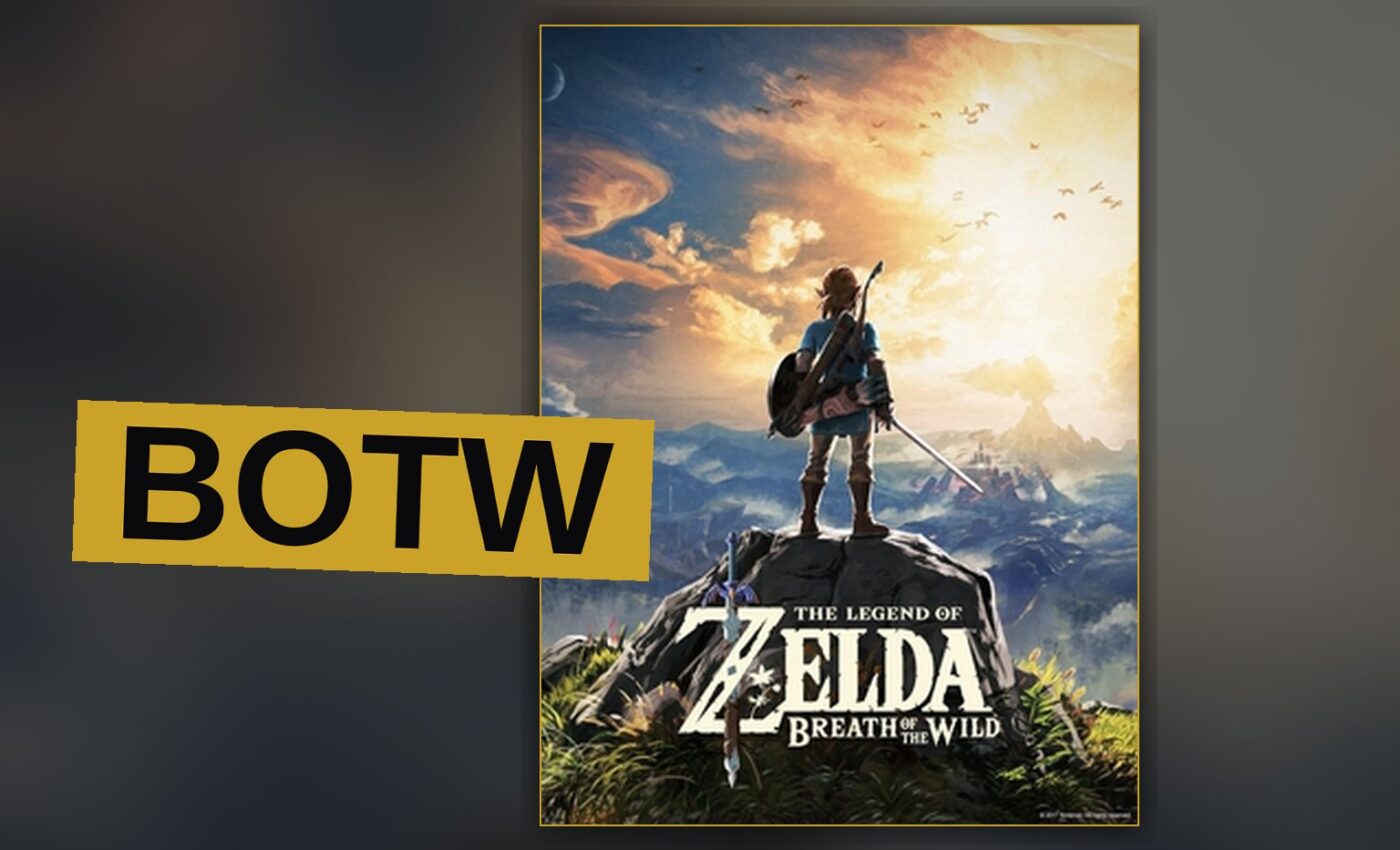
In 2017, Nintendo released The Legend of Zelda: Breath of the Wild for Wii U and Switch. It changed what an open-world game could be. It also changed Zelda itself.
Learning on the Great Plateau
The game opens on the Great Plateau, a small region that acts as a tutorial. You wake with no memory, no sword, and no guidance beyond a glowing tower. The game trusts you to figure things out. You climb, you cook, you cut down trees. You learn that fire spreads, metal conducts lightning, and wind matters.
This is not the Zelda of dungeons and keys. It is a physics sandbox with a story attached. Every system interacts with every other system. Roll a boulder into a camp of enemies and they scatter. Set grass on fire and the updraft lifts your paraglider. The game never tells you to do these things. It simply allows them.
Runes, Shrines, and the Sheikah Slate
Your main tool is the Sheikah Slate, a tablet that gives you runes. Bombs, magnesis, stasis, and cryonis. Each one solves puzzles and breaks the world in equal measure. The puzzles are spread across 120 shrines, small chambers that test your understanding of the mechanics. Some are trivial. Some are brilliant. A few are infuriating.
The shrines replace the traditional dungeons. Instead of a dozen large temples, you get a hundred small ones. The trade-off works. The pacing is faster, and the rewards are tangible. Every four shrines give you a heart or a stamina vessel. The loop is simple: explore, solve, improve.
| Event | Location | Time |
|---|---|---|
| Blood Moon rises | Anywhere in Hyrule | Roughly every seven in-game nights |
| Divine Beast Vah Ruta | Zora’s Domain | After main quest start |
| Divine Beast Vah Medoh | Rito Village | After main quest start |
| Final battle vs. Calamity Ganon | Hyrule Castle | Anytime after freeing all Beasts |
Hyrule’s Silence and the Blood Moon
Hyrule is vast and mostly empty. That emptiness is the point. You ride a horse across plains, watch storms roll in, and find ruins that tell no story. The game does not fill the map with icons. It fills it with geography. A mountain is worth climbing because you can see the next one from the top.
The story is thin. You fight Calamity Ganon, a force of darkness sealed beneath Hyrule Castle. The memory fragments, recovered by visiting locations, fill in the past. The voice acting is sparse. The plot is not the reason to stay. The reason to stay is the moment you glide off a cliff and decide where to land.
“The blood moon rises once again.”
That line, spoken by the game’s narrator, marks the game’s strangest mechanic. Every few nights, a blood moon resets all defeated enemies and refreshes resources. It is a system that keeps the world alive. It also creates dread, because you know the camps you cleared will be full again.
Champions, Divine Beasts, and the Road to Ganon
The main quest sends you to four Divine Beasts, giant mechanical creatures piloted by the ghosts of fallen champions. Each one is a dungeon. Each one has a boss. Each one grants a new ability: Mipha’s Grace revives you, Revali’s Gale launches you skyward, Daruk’s Protection blocks incoming hits, and Urbosa’s Fury strikes enemies with lightning.
The bosses are not the highlight. The highlight is the approach. To reach each Beast, you solve a regional puzzle that ties into the landscape. One requires you to assault Vah Naboris through a howling sandstorm. Another forces you to navigate a labyrinth of rock. The game uses its systems to gate progress, not keys.
The Legend of Zelda: Breath of the Wild is not perfect.
The weapon durability system frustrates. The final boss is easier than the journey to him. The frame rate drops on the Wii U version. But the whole is greater than the sum of its parts.
It is a game about curiosity. It rewards patience and punishes haste. It does not hold your hand, and it does not apologize. It is the best Zelda game, and one of the best games ever made.