
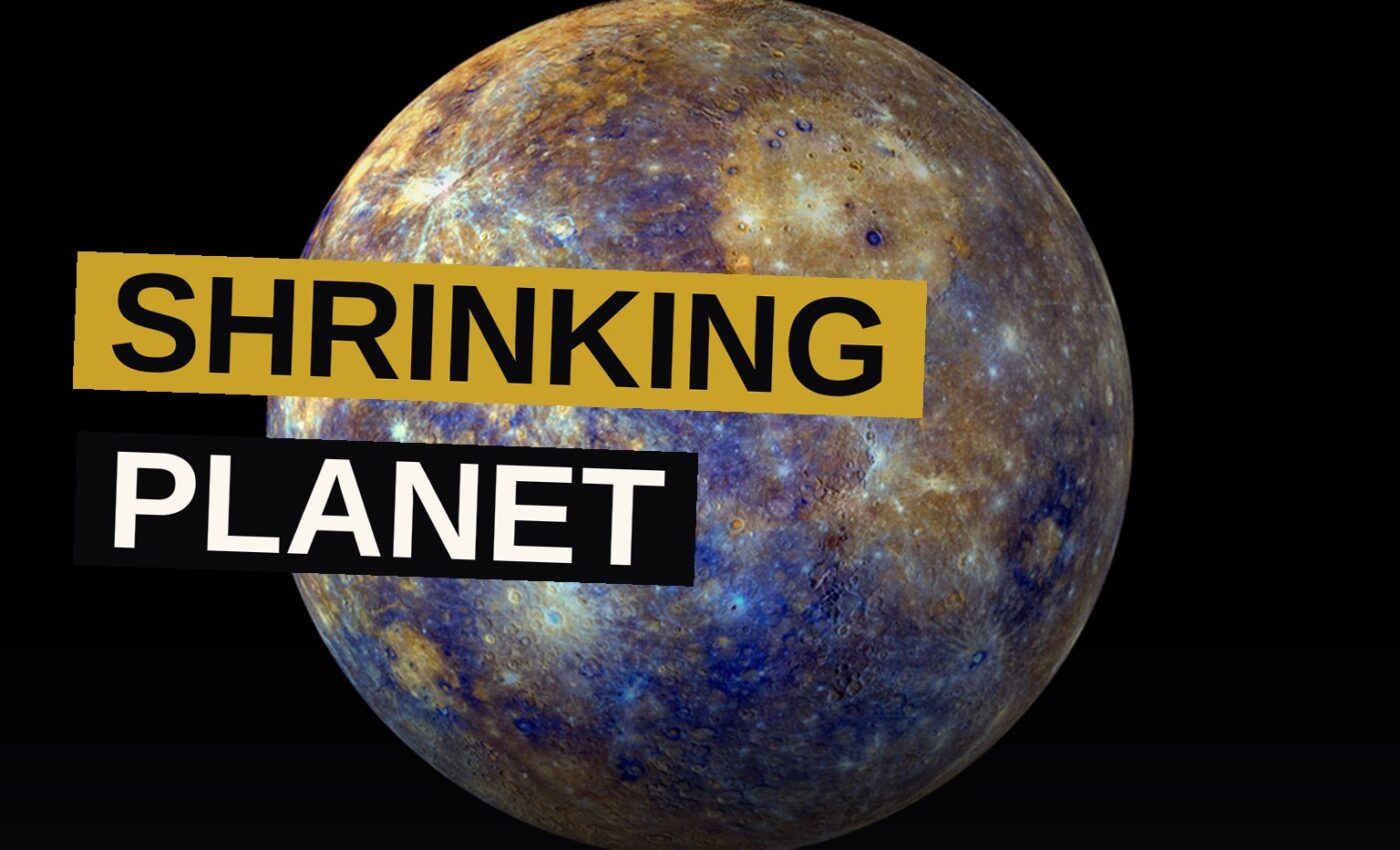
A fresh investigation suggests that Mercury could have shrunk far more than earlier estimates indicated. The diminutive world is roughly one-third as large as our own planet, and researchers now believe it may have contracted to a greater degree than they had assumed before.
New research indicates that Mercury shrank between 10% and 30% more than older models predicted. The planet’s overall diameter has decreased by nearly 12 miles (19 km) since its formation. Its current size measures roughly 3,032 miles (4,880 km).
The study, published Thursday (Sept. 10) in Geophysical Research Letters, says earlier missions failed to measure the full scale of the shrinkage because debris from meteorite impacts on Mercury’s surface concealed the evidence.
The Cooling Planet
The planets in our solar system, including Mercury, came to be through the slow joining together of rock and gas found on asteroids and comets. Many of these collisions produced a large amount of heat. Since that time, Mercury has cooled gradually from those old impacts, and its interior has grown smaller as it cools.
The gap between the two sizes has bearing on how scientists look back at the planet’s past, according to Gaku Nishiyama, who works as a planetary scientist at the German Aerospace Center Institute of Space Research and is one of the authors of the study.
Nishiyama told Live Science in an email that because Mercury’s development depends on it getting cooler, how much it has shrunk — a sign of how much cooling has taken place — stands out as one of the key things that can be measured against models to estimate how the planet developed.
A greater amount of shrinking on Mercury might also change what the planet is made of. According to a statement from the American Geophysical Union, it would point to a larger metal core with fewer light elements, such as silicon, within it.
Nishiyama said that the inside of Mercury would mirror its creation, and might reveal something about the innermost part of our solar system. He added that “to understand how our solar system has evolved up to now, information that can be extracted from this estimation — such as core composition and initial temperature condition — is critical.”
How Craters Hid the Evidence
The planet’s whole landscape is cooled, but craters left by crashes into the surface hide that fact from view. Every such collision produces its own alterations, including thrown material and new hollows. These marks pile up over time, covering older geology beneath them so it becomes hard to see.
A group led by Nishiyama contrasted two sets of charts of Mercury, relying on information gathered by NASA’s MESSENGER probe, which circled the planet from 2011 through 2015. One set mapped signs of shrinking across the surface. The second set gauged how uneven the planet’s surface is.
The full surface was documented, revealing that the most rugged parts of the planet carry less evidence of shrinking. As Nishiyama explained, material from more recent collisions has hidden the signs of that process.
The MESSENGER Data
Two mapping tools were central to the research effort. One recorded signs of shrinking ground. The second estimated surface roughness.
A comparison of the maps showed a clear pattern: regions with the roughest terrain had fewer signs of contraction, because fresh material from recent craters was covering up older evidence of shrinking.
The BepiColombo Mission
The estimate can be confirmed with additional information, according to Nishiyama. That data might arrive from the European Space Agency’s BepiColombo spacecraft, which started its arrival sequence at Mercury earlier this month after nearly eight years of space travel.
After the mission gets established, the spacecraft will capture more detailed images of the surface than MESSENGER ever managed. The researchers expect BepiColombo to detect smaller impact craters, along with scarps and ridges, which would help improve the measurements.
Nishiyama said that more measurements of Mercury’s shape are coming from BepiColombo, adding that future data from the mission’s laser altimeter will provide better detail on how the planet has shrunk over time by measuring its topography with greater precision.
Comparing the Missions
| Mission | Operator | Mercury Orbit | Key Capability |
|---|---|---|---|
| MESSENGER | NASA | 2011–2015 | Geological features and surface roughness |
| BepiColombo | European Space Agency | Arrival sequence began this month | Higher-resolution imagery, laser altimetry |
The entire basis for the new study comes from MESSENGER information. BepiColombo’s planned observations may either back up the new shrinkage figure or sharpen it.
What More Shrinkage Means
A bigger reduction in size could alter how researchers view Mercury’s interior. A world that shrunk further would hold a larger metal core with less of the lighter elements, such as silicon, within it, according to an announcement from the American Geophysical Union.
Nishiyama explained that the inside of Mercury would reveal its creation, and might also show the very center of our solar system. He added that to grasp how our solar system has developed up to now, data drawn from this estimate — including what makes up its core and the conditions when it first formed — are essential.
When scientists look at the planet’s past, the scale of the world makes a real difference. The planet’s growth is shaped by its cooling, and any sign of shrinking shows just how much that cooling has taken place.
Why This Matters
Studying how Mercury has shrunk gives researchers insight into the solar system’s beginnings. The planet’s insides carry signs of how all of it came to be.
A paper appearing in Geophysical Research Letters argues that Mercury shrank more extensively than earlier models had projected. The results indicate a world whose violent beginnings continue to shape its current form.
Source: livescience.com
Get the Notebook.
The day's best stories and every fresh verdict, in plain English, in your inbox by seven. One email a day, no more.