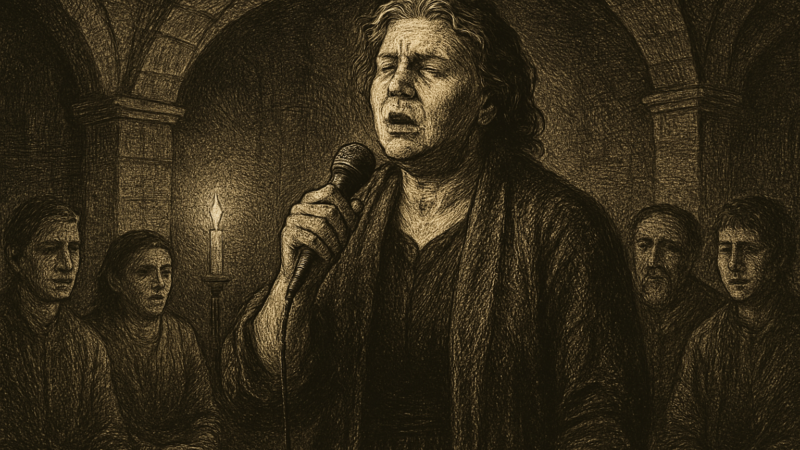
Top of the Lake is a slow-burn mystery that refuses to be a procedural. Created by Jane Campion and Gerard Lee, the series premiered on SundanceTV and BBC Two in 2013, and it follows Detective Robin Griffin, played by Elisabeth Moss, as she investigates the disappearance of a 12-year-old girl who is also pregnant. The setting is New Zealand, and the tone is bleak, atmospheric, and often uncomfortable.
What sets Top of the Lake apart is its refusal to treat the case as a puzzle to be solved quickly. The investigation spans the entire first season, and the show spends equal time on Griffin’s personal history, her troubled relationship with her family, and the wider social and cultural landscape of the town. It is a crime drama that feels more like a psychological portrait than a police thriller.
Trailer, via BBC.
Elisabeth Moss as Robin Griffin
Moss carries the weight of the series from start to finish. Her performance is restrained and powerful, and she brings a weariness to Griffin that feels earned rather than imposed. The character is a detective who specializes in sexual assault, and her own history with trauma colors every interaction. She is not a hero in the conventional sense; she is a woman doing a difficult job while being pulled back into her own past.
The show also gives Griffin a full backstory that includes her father, her mother, and her sister. These relationships are complicated and often painful, and they drive the emotional core of the narrative. Griffin’s work is not separate from her life; it bleeds into it, and vice versa.
The Case of the Missing Girl
The central case involves a 12-year-old girl who has disappeared, and the revelation that she is pregnant adds a layer of horror to the proceedings. The show does not rush to explain what happened. Instead, it lets the community react, the police investigate, and the audience feel the mounting dread.
The investigation is thorough and methodical, but the show is less interested in the mechanics of forensics than in the human cost. The townspeople are not caricatures. They are flawed individuals with secrets, and the show treats them with a degree of empathy that is rare in crime dramas.
The Supporting Cast
The ensemble around Moss is strong, particularly David Dencik as Alexander “Puss,” Nicole Kidman as Julia, and Gwendoline Christie as Miranda. Each actor brings a distinct presence to the series, and their interactions with Moss are some of the most compelling scenes. The show also features Alice Englert as Mary, Linda Ngo as Sinn, Jacqueline Joe as Tui, Jenny Wu as Kiki, and Jay Ryan as Mark, giving the small town a rich tapestry of personalities.
These characters are not just background. They are fully realized people with their own arcs, and the show trusts the audience to follow them. The result is a community that feels lived-in and real, even when the events are surreal.
Jane Campion’s Direction
Campion directs the series with a visual style that is both intimate and expansive. The landscapes of New Zealand are used as characters in themselves, and the show frequently lingers on wide shots of empty roads and dense forests. This is not a gritty urban crime drama. It is a rural one, and the isolation is part of the tension.
The direction is patient, and the pacing is deliberate. There are moments of quiet that other shows would cut away from, but Campion holds the frame, letting the actors breathe and letting the story unfold naturally. This approach can be frustrating for viewers who want quick answers, but it pays off over time.
The Sequel and the Legacy
Top of the Lake was followed by a sequel, Top of the Lake: China Girl, which aired in 2017. That series continues Griffin’s story five years later, as she investigates the death of an unidentified Asian girl found at Bondi Beach in Sydney. The original series stands on its own, but it clearly sets up the later installment.
The show has been generally well received, though it has not achieved the same level of acclaim as Campion’s earlier work. Its reception has been positive, but it has not reached the heights of her films.
Why It Works
Top of the Lake succeeds because it trusts the audience to sit with discomfort. It is not a show that offers easy answers or neat resolutions. It is a show about grief, memory, and the difficulty of moving forward.
The score of 8.7 out of 10 reflects this judgment. It is a demanding watch, but it rewards patience.
- Elisabeth Moss delivers a career-best turn as Detective Robin Griffin
- The investigation spans the entire first season, with no quick resolution
- The supporting cast is strong, including Nicole Kidman, David Dencik, and Gwendoline Christie
- Jane Campion directs with a deliberate, patient visual style
- The show’s reception has been positive, though it has not matched her earlier work
| Element | Strength | Weakness |
|---|---|---|
| Lead Performance | Elisabeth Moss delivers a career-best turn | Some viewers may find the pace too slow |
| Writing | Complex character arcs, sharp dialogue | Some plot threads feel underdeveloped |
| Directing | Cinematography is stunning, pacing is deliberate | The runtime can test attention span |
| Ensemble | Strong supporting cast, memorable secondary characters | Some side stories feel tangential |
Final Word
Top of the Lake is a remarkable piece of television. It is not for everyone, and its slow burn may frustrate those looking for a fast-moving thriller. But for viewers willing to engage with its world, it offers a rich, rewarding experience.
The show is a reminder that crime drama can be more than a genre exercise. It can be a study of a person, a community, and the wounds that never fully heal.
Get the Notebook.
The day's best stories and every fresh verdict, in plain English, in your inbox by seven. One email a day, no more.