
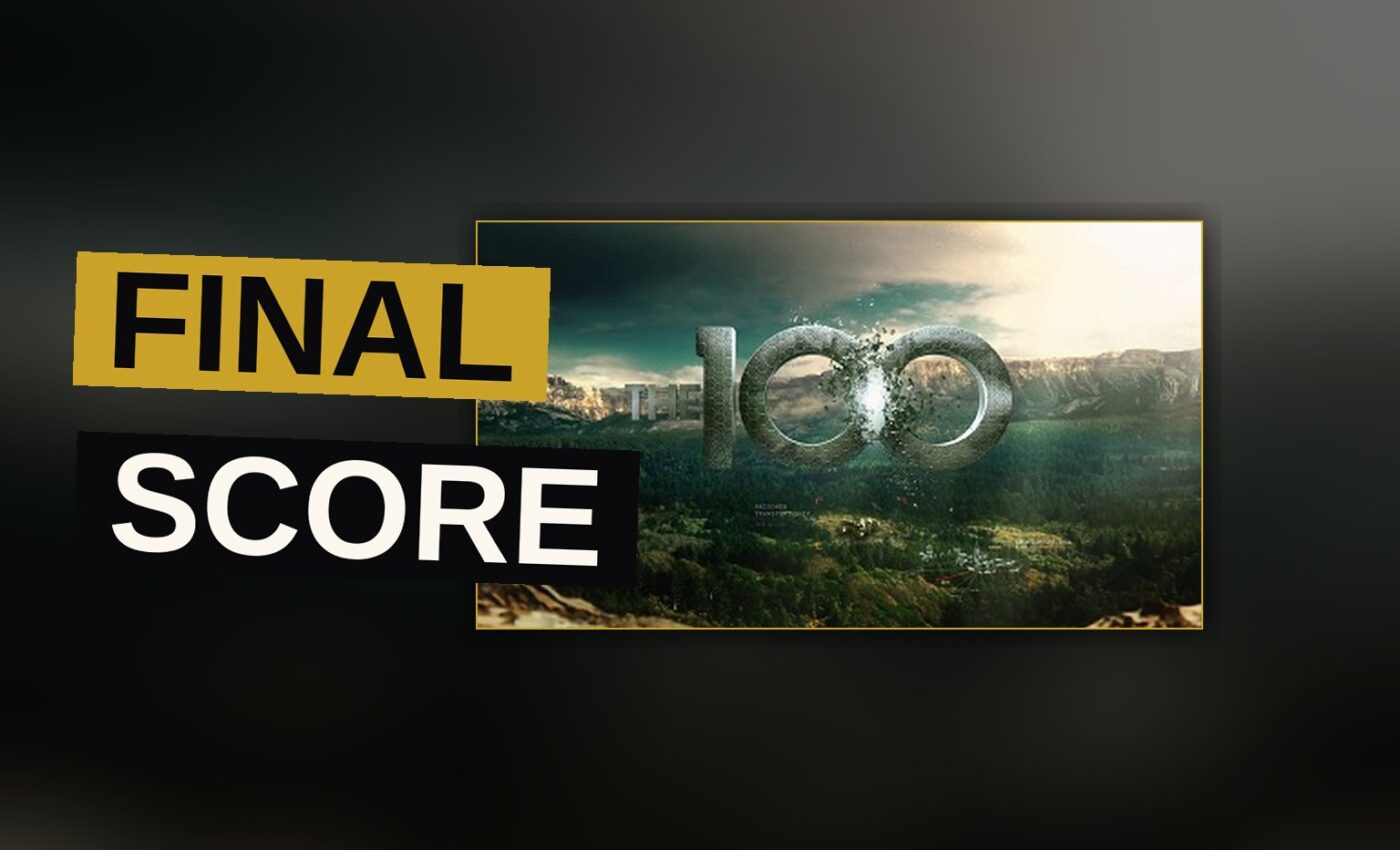
The 100 premiered on The CW on March 19, 2014, with a premise built to end quickly: ninety-seven years after a nuclear apocalypse, the last humans live on a failing space station called the Ark, and its leaders send one hundred juvenile detainees to the surface to find out whether Earth can still be lived on. The show ran seven seasons and 100 episodes, ending September 30, 2020. It was developed by Jason Rothenberg from Kass Morgan’s young adult novels. The first season is a survival story about teenagers with no adults, no rules and no idea what is waiting for them.
Trailer, via Warner Bros. UK & Ireland.
Clarke Griffin and the First Hundred
The juveniles sent down include Clarke Griffin (Eliza Taylor), Bellamy Blake (Bob Morley), Octavia Blake (Marie Avgeropoulos), Finn Collins (Thomas McDonell), Jasper Jordan (Devon Bostick), Monty Green (Christopher Larkin) and John Murphy (Richard Harmon). On the Ark, the council members are Clarke’s mother Dr. Abby Griffin (Paige Turco), Marcus Kane (Henry Ian Cusick) and Chancellor Thelonious Jaha (Isaiah Washington). Raven Reyes (Lindsey Morgan), a mechanic, joins as a recurring player in season one before becoming a lead.
That split — delinquents on the ground, adults in orbit — is the engine of the early episodes. The kids fight each other, then the planet. The adults fight over who gets to breathe.
The Grounders, the Reapers and Mount Weather
The show does not keep its first mystery for long. The hundred discover that humans survived the apocalypse. There are the Grounders, living in clans locked in a power struggle. There are the Reapers, Grounders turned into cannibals by the Mountain Men. And there are the Mountain Men, descended from those who sealed themselves inside Mount Weather before the bombs fell.
Under Clarke and Bellamy, the juveniles try to survive the surface, fight hostile Grounders and reestablish contact with the Ark. Season two raises the stakes: the Mountain Men harvest the survivors’ bone marrow to survive radiation, and Clarke forms a fragile alliance with the Grounders to get her people back. The season ends with Clarke making a devastating choice to save them all.
That choice is the show’s best argument for itself. The 100 is at its strongest when it lets its teenagers be wrong in permanent ways.
A.L.I.E. and the Reactor Meltdown
Season three turns inward. Power struggles break out between the Arkadians and the Grounders after a controversial new leader takes charge, while an AI named A.L.I.E. — the intelligence responsible for the original apocalypse — starts taking control of people’s minds. Clarke destroys A.L.I.E. and learns another disaster is coming.
Season four makes that disaster concrete: nuclear reactors are melting down, threatening to wipe out life a second time. Clarke and her friends look for ways to survive, experimenting with radiation-resistant blood and hunting for an underground bunker.
The show keeps escalating because it has to. Each season replaces one countdown with a bigger one.
The Cast Turns Over
The 100 cycled through its ensemble at a rate that would sink most network dramas. Paige Turco left as a lead after season six and returned as a guest in season seven. Thomas McDonell exited after season two. Isaiah Washington left after season five, Henry Ian Cusick after season six, Christopher Larkin after season five, Devon Bostick after season four.
The survivors became the show. Richard Harmon’s John Murphy moved from recurring in seasons one and two to a lead from season three through season seven. Tasya Teles’s Echo did the same, recurring in season four and leading from season five. JR Bourne, Shannon Kook and Chuku Modu joined as leads for the final season, with Shelby Flannery as Hope Diyoza.
The 100 follows descendants of post-apocalyptic survivors from a space habitat, the Ark, who return to Earth nearly a century after a devastating nuclear apocalypse.
What the Ark Cost
The Ark’s council picks one hundred detainees to send down as a test, not a rescue. That is the show’s clearest statement of what it is about: institutions spending children to buy time. The 100 returns to that idea in every season, whether the threat is Grounders, radiation or an AI. The early episodes are uneven, but the moral arithmetic is set from the first hour.
Where the Show Stands
The 100 earned a Metacritic score of 63 out of 100, a 6.3/10. That number is fair, and it is fair for a specific reason: the show’s reach regularly exceeded its grip. The premise is one of the better science fiction setups of its decade — a generation born in space, sent to a planet their grandparents destroyed, told to find out if it will take them back. The execution was uneven from the start, and the first season in particular spends too long on the wrong conflicts.
What the show got right, it got right for a long time. It treated its young cast as capable of moral weight rather than as set dressing, and it let the consequences of their decisions pile up across seasons instead of resetting. The bone marrow harvest, Clarke’s choice at the end of season two, the A.L.I.E. arc — these are the moments the series will be remembered for, and they work because the show committed to them.
What holds the score down is consistency. Seven seasons and 100 episodes is a long run for a premise this narrow, and the back half leans on new threats arriving on schedule. The cast turnover, however necessary, thinned the relationships that made the early seasons land.
The 100 is worth watching for its first four seasons and worth finishing for the people who started it. It is not a great show. It is a show that knew what it was about — survival, and the bill that comes due afterward — and said it more than once.
Get the Notebook.
The day's best stories and every fresh verdict, in plain English, in your inbox by seven. One email a day, no more.