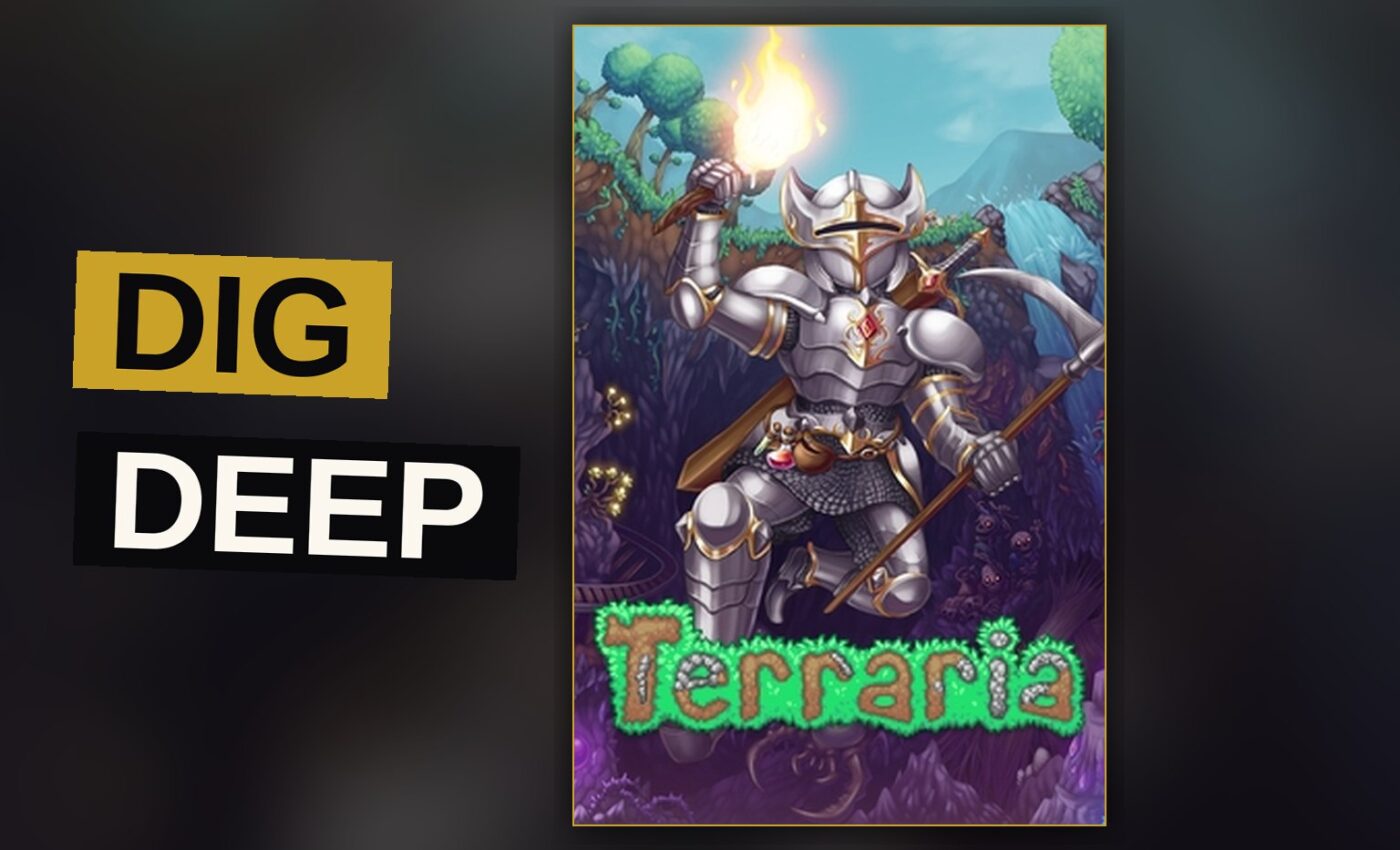
Terraria arrived in May 2011 with no set goals and a 16-bit look, and it has refused to stop growing since. Re-Logic built a two-dimensional world where a player mines, crafts, builds and fights, and then kept adding to it for more than a decade. The game is now playable on more than a dozen platforms, from PC and Mac to the Nintendo 3DS and Google Stadia. It earns an 8.1 out of 10.
Trailer, via Re-Logic.
A Sandbox That Never Hands You a List
Terraria is a sandbox, action-adventure, role-playing and platformer game. It has no set goals. After creating a character and choosing a difficulty, the player is placed in a procedurally generated world and left to explore, fight enemies, gather resources and craft equipment.
The graphical style is reminiscent of the 16-bit sprites found on the Super Nintendo Entertainment System. That look is not nostalgia for its own sake. It keeps the screen readable while the world grows dense with biomes, enemies and items.
Worlds come in three sizes, chosen at creation. Each world is divided into biomes, and each biome has unique enemies and resources. Some resources appear only in specific areas, sit inside containers, or drop from enemies.
Corruption, Crimson and the Wiki
Evil biomes such as Corruption and Crimson are populated with tougher enemies. They can spread and infect other biomes. That spread gives the sandbox a clock. A player who ignores it will find the map itself working against them.
Players start with basic tools and a non-player character guide. The guide introduces aspects of the game and provides information on other NPCs and item recipes. Scholar Ji Soo Lim found in his study that participants had to rely on a wiki to learn more about the game.
That finding is the honest description of Terraria. The guide is a start, not an answer key. The game’s real manual lives outside the game.
Bosses Open the Next Tier
Progression is driven by defeating bosses, a tougher variety of enemies. Beating them unlocks new tiers of items, biomes and challenges.
The class system is based on equipped gear rather than a choice made at character creation. A player becomes a mage or a warrior by what they carry, not by what they picked on a menu. That is a quiet, flexible design decision, and it is one of the best things in the game.
Health and mana both start low. Both can be increased by finding and crafting specific equipment or items. The early hours are accordingly thin. A player with low health and low mana cannot wander far, and the world is built to punish wandering.
Classic, Expert and Master
Terraria has several difficulty modes. “Classic” is the baseline. “Expert” and “Master” both increase the difficulty in exchange for exclusive items.
That structure is the game’s answer to its own length. Classic teaches the systems. Expert and Master assume the player already knows them and want the rewards that only come with the harder setting.
- Single-player and multiplayer modes
- Co-operative play
- Side-view perspective
- Procedurally generated worlds in three sizes
- Class system based on equipped gear
- NPC recruitment tied to achievements
- Official modding support through the tModLoader framework
Eleven People and a Decade of Patches
Andrew Spinks commenced development in January 2011, assisted by a team of game testers and designers. As of 2025, Terraria is developed by eleven members of Re-Logic. The game first released in May 2011 on the Steam digital store.
It was originally set to end development in 2012, but it resumed in 2013. Since then it has received continuous content updates that have considerably changed it from its first version. New items, NPCs, enemies and world difficulties have arrived, along with quality-of-life improvements and crossovers with different games.
The game has also been ported to home video game consoles, handheld consoles, mobile phones and operating systems. That port list is not a footnote. It is the reason a 2011 game still has a live audience.
What the Ports Actually Ask
The platform spread runs from PlayStation 3 and Xbox 360 to the Nintendo Switch, the PlayStation Vita, the Wii U, iOS, Android, Linux, Mac and Windows Phone. Google Stadia is on that list too.
A sandbox that depends on crafting menus, inventory sorting and precise building does not obviously belong on a handheld or a phone. Re-Logic shipped it there anyway. The result is a game that follows the player rather than waiting for them.
Modding support through tModLoader extends the same logic. The framework lets players add to a game that its own developers have already spent more than a decade adding to.
Crossovers and the Long Tail
The crossovers with different games are the clearest sign of how Terraria sees itself. It is not a story with an ending. It is a place other games can visit.
That is also its central weakness. A game with no set goals asks the player to supply the goals. The guide points at NPCs and recipes. The wiki does the rest. Anyone who wants a directed campaign will find the opening hours formless, and the difficulty modes will not fix that.
What fixes it, when it gets fixed, is the boss ladder. Defeating a boss opens a tier. A tier opens a biome. A biome opens resources. The loop is legible even when the map is not.
Where Terraria Stands
Terraria’s reputation rests on a simple fact: it kept going. The 2012 ending was called off, development resumed in 2013, and the game has been rebuilt in public ever since. Very few 2011 releases can say that.
The design holds up because it withholds. No set goals, low starting health and mana, evil biomes that spread, bosses that gate the good equipment. Every system pushes the player toward the next thing without telling them what the next thing is.
The cost is real. Ji Soo Lim’s finding that players had to rely on a wiki is not a small complaint. A game that requires an external reference to explain its own recipes has outsourced part of its job.
Set that against what the game does well. The class system based on equipped gear lets a player change identity without starting over. NPC recruitment tied to achievements turns side tasks into a town. Multiplayer and co-operative modes turn a solitary sandbox into a shared project.
The platform list is the other half of the argument. PlayStation 3, PlayStation 4, PlayStation Vita, Xbox 360, Xbox One, Nintendo 3DS, Nintendo Switch, Wii U, PC, Mac, Linux, iOS, Android, Windows Phone and Google Stadia. A game that runs nearly everywhere is a game people keep returning to.
Terraria is not flawless. Its opening is thin, its guidance is weak, and its reliance on outside documentation is a genuine design failure. But the boss-driven progression, the gear-based classes and the modding framework give it a spine that most sandbox games never build.
Eleven developers, more than a decade of updates, and a version history that keeps changing what the game is. That is the whole case. Terraria is worth the time it asks for, and it asks for a lot.
Key facts
- Release: May 2011, Steam
- Developer: Re-Logic
- Publishers: Headup Games, Re-Logic, 505 Games
- Development started: January 2011, by Andrew Spinks
- Re-Logic team as of 2025: eleven members
- Planned end of development: 2012; resumed 2013
- Difficulty modes: Classic, Expert, Master
- Critic aggregate: 8.1/10 across 13 outlets
Get the Notebook.
The day's best stories and every fresh verdict, in plain English, in your inbox by seven. One email a day, no more.