
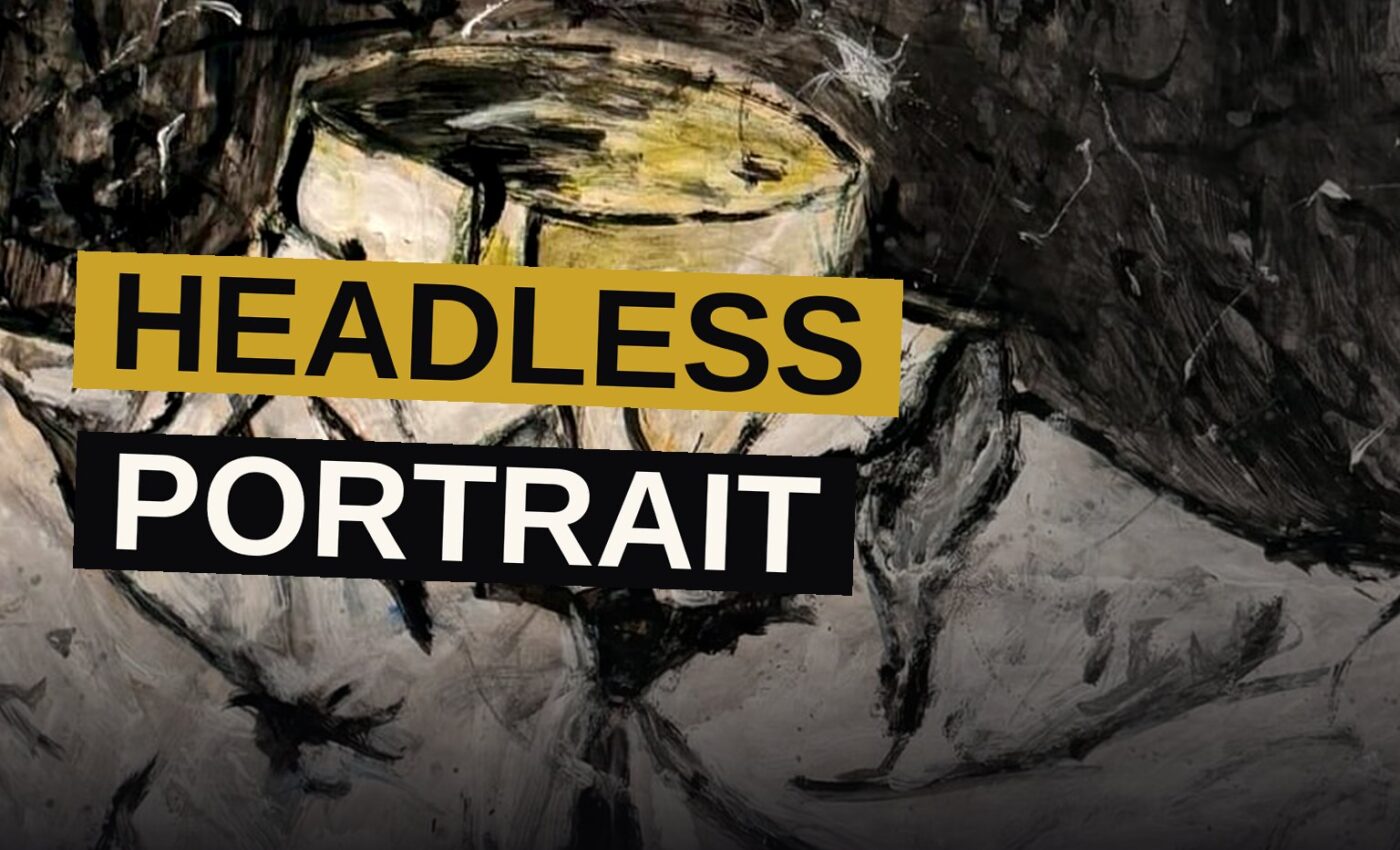
The Drawing Center’s current exhibition brings together a headless portrait, a collection of 161 exhibition catalogues, and a library of Black authors, treating the buildup of material itself as commentary on American history. It is a retrospective look at the work of “Certainly an Act: Works on Paper by Pope.L,” presented after his death, covering his interdisciplinary practice.
The main work is “Portrait a.k.a The American Dream Is to Be Able to Think”, spanning 1989 to 90. It is a portrait without eyes, face, or neck, made from acrylic, oil pastel, marker, pencil, and tape. This painting draws its inspiration from the headless figure who inaugurates Ralph Ellison’s 1952 novel Invisible Man, and it sits at the center of a sprawling survey of Pope.L’s interdisciplinary approach.
The Headless Portrait
This picture has no eyes, no face, and no neck. It is plain, without strength, and missing a countenance for identification or eyes for sight. Though it is merely one piece among those on display, it bears the burden of the entire exhibition.
This portrait study mirrors Ellison’s novel on both an aesthetic and a thematic level, drawing viewers into the troubled physical reality of race that launched this nation and has kept pushing it forward ever since.
Race and the American Dream
The exhibition presents Pope.L’s examination of the racial contradictions that created the American Dream, marking its 250th year. It comes with sharper provocations: if the American Dream is the ability to think, then perhaps newer ways of thinking are required.
The exhibition wall text states that for Pope.L, “drawing was never merely a medium but a mode of thinking about the world.” That framing sets the tone for the entire installation.
The Archive Wall
Thought in all its forms fills the room as soon as one enters it, and two walls are arranged with books.
The Drawing Center is marking two milestones at once. One is an archive of 161 past exhibition catalogues from its own history. The other is a celebration of its 162nd show, “Certainly an Act,” produced in collaboration with the Detroit-based Black Art Library.
The selected texts which populate the Black Art Library could help someone unfamiliar with Pope.L shape their expectations before seeing the show. I arrived at Soho on a breezy August afternoon. The library features names such as Zora Neale Hurston and Faith Ringgold, along with titles referencing Black art and African American mythology.
Comparing the Walls
| Wall | Content |
|---|---|
| Archive wall | 161 previous exhibition catalogues |
| Black Art Library wall | Celebration of the Center’s 162nd exhibition |
The Library’s Role
From the start, the Black Art Library made it clear that Blackness would be the central focus of aesthetic thought in this exhibition.
What the Show Asks
The show asks viewers to think through the American Dream, to consider what it means to think within a nation founded on racial contradiction. The exhibition wall text states that for Pope.L, “drawing was never merely a medium but a mode of thinking about the world.” That framing sets the tone for the entire installation.
Our Verdict
Patience is what this production demands from its audience. It wants viewers to study carefully, to move at a deliberate pace, and to think about how history actually feels and looks. The severed portrait introduces the idea, but it’s the collection and the reading room that do the real work, driving the whole thing forward.
The show serves as a reminder that the dream does not stand still as something settled and certain. Instead, it presents itself as a disputed territory that demands ongoing questioning.
The show is on view at the Drawing Center.
Get the Notebook.
The day's best stories and every fresh verdict, in plain English, in your inbox by seven. One email a day, no more.