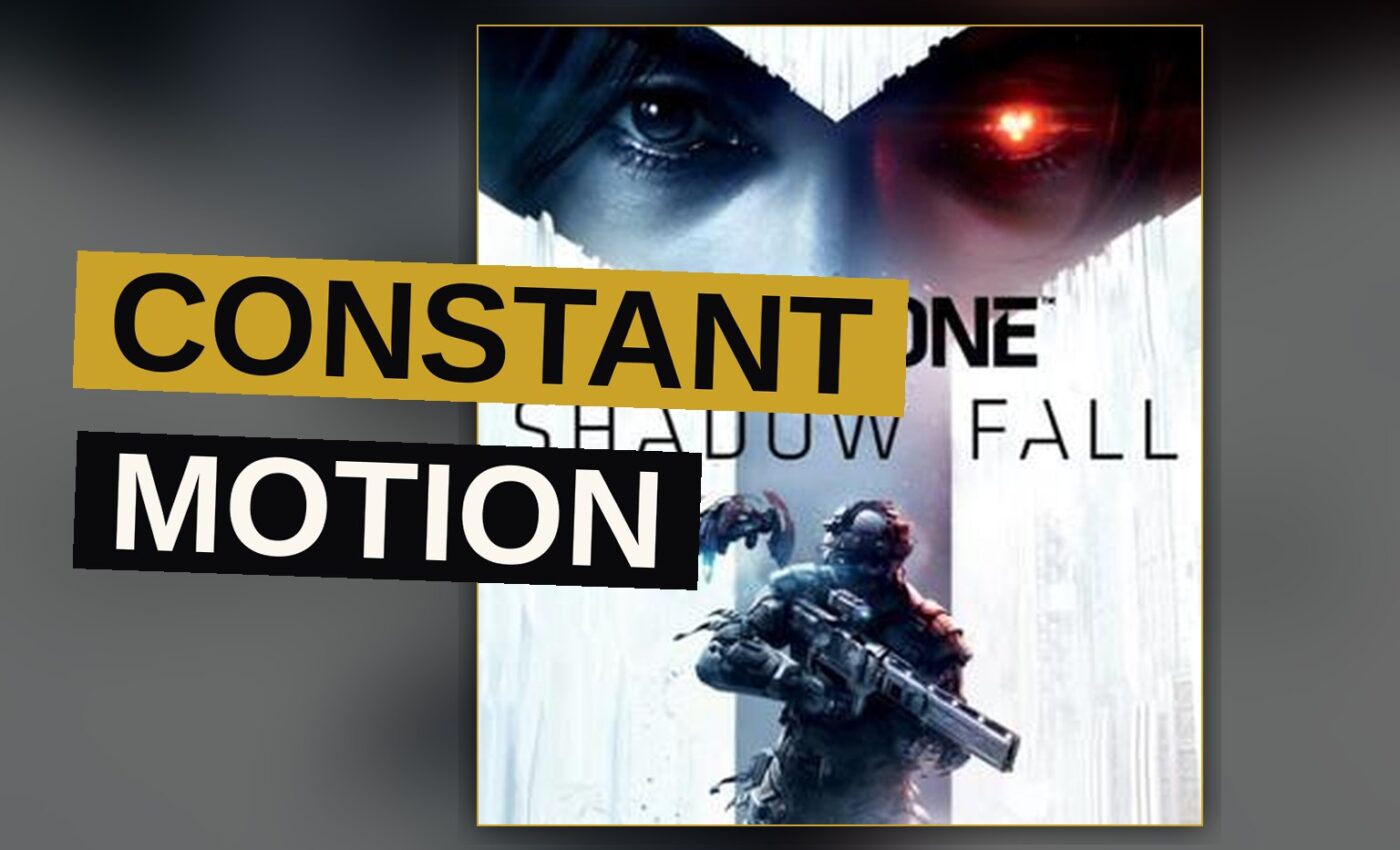
Killzone: Shadow Fall arrives as a technical showcase for the PlayStation 4, and as a shooter built around constant motion and constant pressure. The game asks players to move, roll, fire and reload in tight quarters, often without much room to think about it. That tension is the point. It is also the problem.
Trailer, via PlayStation.
The Helghan Invasion
The story opens with Helghan forces invading the city of Haven, home to the ISA, the human resistance fighting the alien occupation. The invasion is sudden and brutal. Players control the ISA soldier Alex Mason, who is pulled from cover to cover as Helghan troops storm the streets. The setup is simple: the enemy is everywhere, the ground is broken, and there is no safe place to stand.
The campaign leans on spectacle over depth. Helghan forces arrive in waves, and the game expects players to keep moving while firing. The pacing is frantic, and it rarely lets up. This is a shooter that favors momentum over precision, and it is clear from the first mission that the design is built around constant forward motion rather than careful positioning.
A City Under Siege
Haven is a dense urban setting, full of narrow alleys, crumbling buildings and open squares. The game uses this space to create vertical combat, with enemies arriving from above and below. Players can climb ladders, jump between ledges and drop down from height to gain the upper hand. This verticality is one of the game’s strengths, giving the environment a sense of layered danger.
The visual presentation is strong. The lighting is moody, and the destruction effects are impressive. Explosions rock buildings, debris flies, and the game maintains a steady frame rate even during busy scenes. For a launch title, the technical performance holds up well. The audio design is also solid, with loud gun sounds, distant explosions and the mechanical hum of the Helghan equipment creating a tense atmosphere.
Cover, Fire, Move
The cover system is the heart of the gameplay loop. Players enter cover automatically when approaching a wall, and they exit cover by pressing a button to move forward. This creates a rhythm of moving, finding cover, firing, and moving again. The game encourages players to stay in motion, rewarding those who keep moving with a steady stream of kills.
The cover system is fast, but it can feel imprecise. Players may find themselves overshooting a target or getting stuck behind a wall that offers no protection. The game also introduces a sprinting mechanic that allows players to move faster between cover points. This adds a layer of risk, as sprinting leaves the player exposed to fire.
The weapons are varied, with assault rifles, shotguns, sniper rifles and grenades all available. Each weapon has a distinct feel, and the game encourages players to switch between them depending on the situation. The shotgun is best at close range, the sniper rifle is effective at distance, and the assault rifle covers everything in between. The game also includes a melee attack, which can be used to finish off enemies at close range.
The Resistance
The ISA forces are not just a backdrop. The game introduces a cast of characters, including Mason’s fellow soldiers and the ISA leadership. These characters provide context for the invasion, and their conversations add some weight to the story. However, the dialogue is often thin, and the plot relies on familiar tropes of military conflict. The story is serviceable, but it rarely rises above the level of a standard action movie.
The multiplayer component is a separate mode that runs alongside the campaign. It offers a suite of modes, including team deathmatch, capture the flag and domination. The multiplayer is built for competitive play, with ranks, unlocks and a progression system. It is competent, but it does not offer anything radically new compared to other shooters in the genre.
Performance on PS4
As a launch title, Killzone: Shadow Fall sets a benchmark for what the PlayStation 4 can do. The game pushes the hardware with its visuals, and it handles large-scale battles with a steady frame rate. The game runs at a smooth pace, even during busy moments, which is a credit to the development team.
The game also introduces a new feature called the “Dynamics Engine.” This engine is designed to handle the physics of destruction, allowing buildings to collapse, rubble to scatter and explosions to deform objects in real time. The result is a game that looks spectacular, with explosions that shake the screen and debris that fills the air.
The sound design is also notable. The game uses directional audio to enhance the experience, making it easier to locate enemies based on the sound of their footsteps or gunfire. This is a small touch, but it adds to the immersion.
Technical Issues
The game is not without flaws. The AI can be erratic, with enemies sometimes failing to react to the player’s movements or taking cover in strange locations. This can break the flow of combat, especially during intense moments. The game also suffers from occasional frame rate drops, though these are infrequent and usually tied to busy scenes.
The game’s difficulty curve is uneven. Some missions are easy, with enemies that fall quickly to gunfire. Other missions are punishing, requiring precise movement and quick reactions. This inconsistency can frustrate players who expect a balanced challenge.
The game also lacks a strong sense of narrative pacing. The story moves quickly, but it rarely takes the time to let players breathe or explore the world. The game is focused on delivering action, and it does not spend much time on character development or world building.
A Shooter With Ambition
Killzone: Shadow Fall is a solid shooter with a strong technical foundation. It is ambitious in its goals, attempting to push the PlayStation 4 to its limits while delivering a fast-paced action experience. The game succeeds in creating a tense, immersive environment that rewards quick reflexes and constant motion.
However, the game’s flaws are significant enough to hold it back from greatness. The uneven difficulty, inconsistent AI and thin narrative are issues that cannot be ignored. Despite these problems, the game remains a worthy addition to the shooter library.
“The game succeeds in creating a tense, immersive environment that rewards quick reflexes and constant motion.”
Final Score
Killzone: Shadow Fall is a mixed bag. It is a technical achievement that shows what the PlayStation 4 can do, and it delivers a shooter that is fast and demanding. But the game’s weaknesses are real, and they keep it from being a standout entry in the genre. The game is worth playing for its technical merits, but it is not essential for everyone.
- Strong visual presentation
- Fast cover system
- Vertical combat design
- Solid multiplayer modes
- Occasional frame rate drops
- Uneven difficulty curve
- Thin narrative
The game is a product of its moment. As a launch title, it carries the weight of expectation, and it mostly meets that weight. It is a game that is best enjoyed for its pure action, not for its storytelling.
The score is 6.5 out of 10.
Get the Notebook.
The day's best stories and every fresh verdict, in plain English, in your inbox by seven. One email a day, no more.