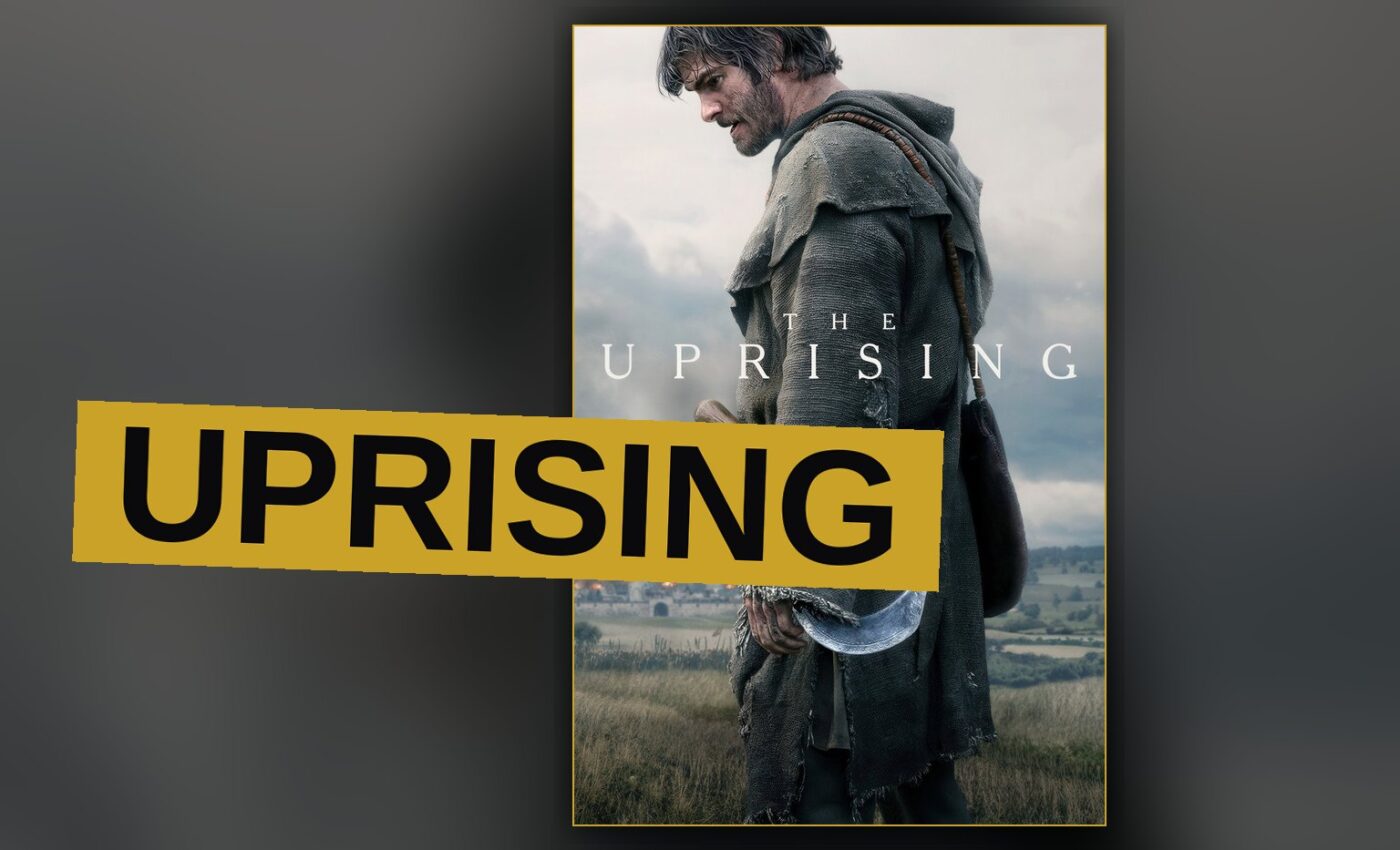
Paul Greengrass has spent decades turning history into shaken-camera chaos, and The Uprising is his boldest attempt yet. Set in 14th-century England, the film follows a humble peasant named Ploughman who leads a rebellion against the King’s tyranny, uniting commoners in a desperate fight for justice and survival. It is loud, grim, and often compelling, though its ending is a blunt joke dressed up as a moral.
Andrew Garfield plays Ploughman, a simple man whose anger grows into a full-scale uprising. Jamie Bell plays John Ball, a preacher who gives the movement its voice. Stephen Dillane plays Simon Sudbury, a powerful figure who stands against the rebels. Tom Hollander plays Sir Robert Hales, and Cosmo Jarvis plays Wat Tyler, while Thomasin McKenzie plays Alyce. The ensemble is strong, and Greengrass knows how to put them in motion.
Trailer, via Focus Features.
The Premise
The rebellion is not abstract. War and plague devastate England, and the film makes that devastation visible. Commoners are starving, dying, and losing everything to a system they cannot touch. Ploughman’s rage is not personal; it is collective. That shared grievance is the engine of the picture, and Greengrass leans on it heavily.
The Style
Greengrass’ handheld, shaky-cam style is his signature, and it works here. Battles are frantic, intimate, and chaotic. The camera never lets you sit back. This is a film that wants you to feel the mud, the blood, and the fear. It is exhausting, but it is also effective.
The bleak tone is less successful. Greengrass does not offer much warmth, and the film’s grimness can become oppressive. There is no respite, no moment of relief. That relentless pressure is the film’s biggest flaw.
The Performances
Garfield is the standout. He carries the weight of the rebellion on his shoulders, and his delivery of the film’s key line — “I am what I do” — is the moment the movie finds its center. It is a simple statement, but it captures everything Ploughman stands for. It is a line that tells you exactly who he is. Bell is also excellent as John Ball, giving the preacher’s speeches a genuine sense of conviction.
What Works
- Garfield’s central performance
- The film’s commitment to its premise
- The chaotic energy of the battles
What Doesn’t Work
- The grim, relentless tone
- Greengrass’ handheld camera style, which some viewers will find too jarring
- The Robin Hood-inspired epilogue, which feels tacked on
The Verdict
The Uprising is a flawed but ambitious film. It takes a serious historical subject and treats it with urgency. The performances are strong, the action is thrilling, and the message is clear. But the grimness is too much, and the ending is a letdown. It is a film that wants to matter, and mostly does, even when it stumbles.
The audience score sits at 7.2 out of 10 from 8 TMDB votes, which is a fair middle ground. Early reviews praise Garfield’s performance and the film’s action and social relevance, but criticize its bleak tone, Greengrass’ handheld camera style, and the Robin Hood-inspired epilogue. Our own verdict aligns with that split: the film is a solid, often great achievement, marred by a few missteps.
| Element | Score |
|---|---|
| Garfield’s performance | 8/10 |
| Tone | 6/10 |
| Camera style | 6/10 |
| Overall | 7/10 |
Early reviews have praised Garfield’s performance and the film’s action and social relevance, while criticizing its bleak tone, Greengrass’ handheld camera style, and the Robin Hood-inspired epilogue. Our own verdict aligns with that split: the film is a solid, often great achievement, marred by a few missteps.