
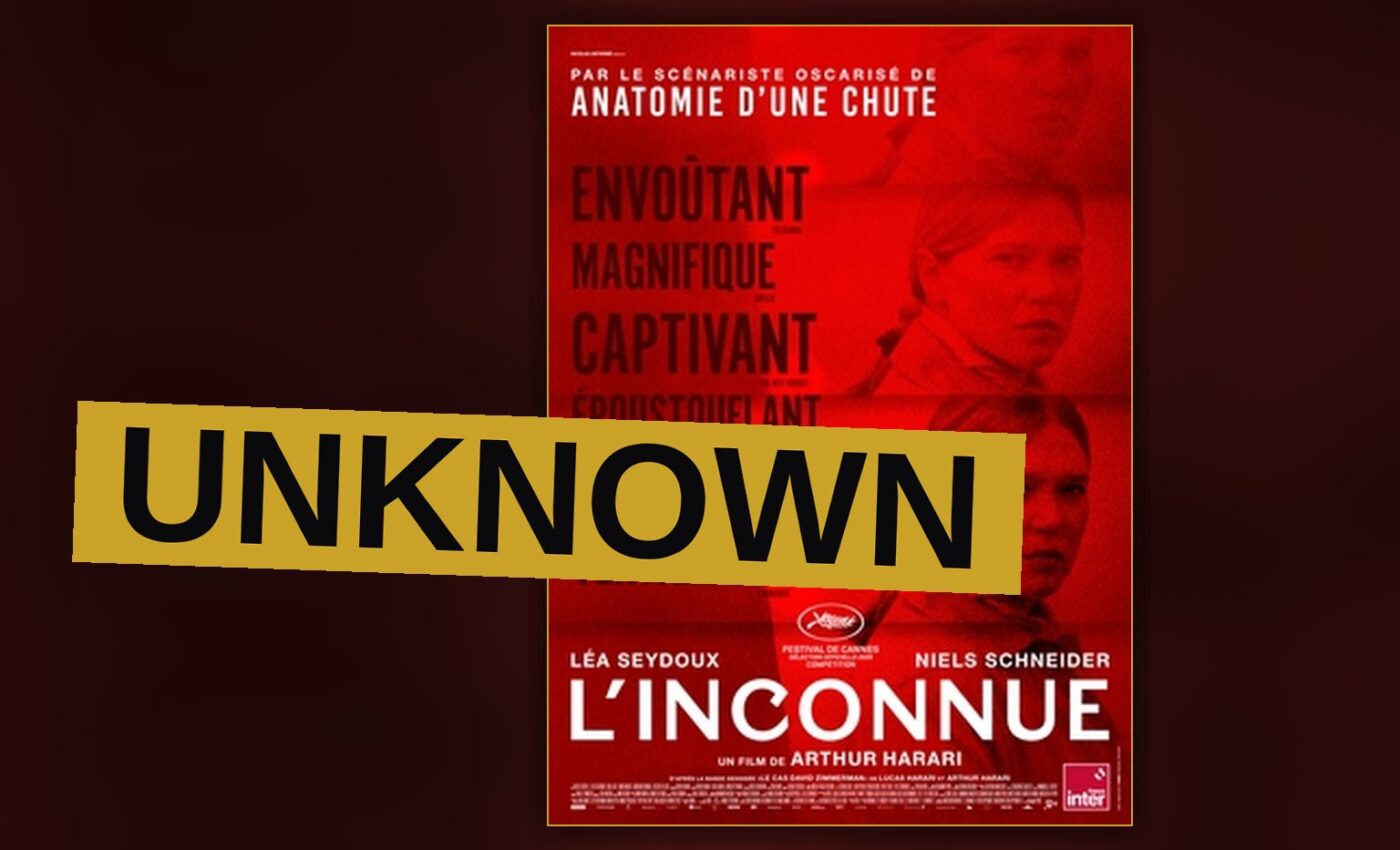
Arthur Harari’s The Unknown opens with a photographer who will not leave his apartment. Friends drag David Zimmerman to a wild party. He fixates on a mysterious woman and follows her. By dawn he wakes in her body.
Trailer, via Pathe.
Léa Seydoux and Niels Schneider Trade Places
The mechanic is blunt. In The Unknown, an entity forces its victims to swap bodies after sexual intercourse. Harari wrote the screenplay with Vincent Poymiro and Lucas Harari, loosely drawing on the graphic novel Le cas David Zimmerman, which Arthur Harari co-wrote with his brother Lucas.
That premise puts an unusual load on the cast. Léa Seydoux plays Eva Helsinger and David Zimmerman. Niels Schneider plays David Zimmerman and Malia. Both performers are asked to carry two characters across one body.
The supporting cast is deep. Valérie Dréville plays Gabi Zimmerman, David’s mother. Lilith Grasmug plays Malia. Radu Jude plays Malia’s father. Shanti Masud is Alice, Jonathan Turnbull is Chris Caro, Victoire du Bois is Sophie Caro, and Anne Rotger is credited as Psychologue.
Cannes, Pathé and the 26 August Release
The Unknown premiered in the main competition at the 2026 Cannes Film Festival on 18 May, where it competed for the Palme d’Or. Pathé released it in French theaters on 26 August under the title L’Inconnue.
That is a serious slot for a body-swap fantasy. The film runs 140 minutes. It is billed as fantasy, drama and mystery.
What the Body Swap Actually Changes
David is a Parisian photographer. The source describes him as rarely leaving home until his friends intervene. The encounter with the entity is not something he chooses. It is something that happens to him, and the premise states plainly that the change to his life is irreversible.
The two credited roles for each lead tell the story:
- Léa Seydoux as Eva Helsinger / David Zimmerman
- Niels Schneider as David Zimmerman / Malia
- Valérie Dréville as Gabi Zimmerman
- Lilith Grasmug as Malia
- Radu Jude as Malia’s father
Two Films, One Premise
The Unknown sits in a long line of body-swap pictures, but the details separate it from the pack.
| Element | The Unknown (2026) | Typical body-swap comedy |
|---|---|---|
| Trigger | Sexual intercourse with an entity | Accident, wish or magic |
| Tone | Fantasy, drama, mystery | Comedy |
| Festival slot | Cannes main competition, 18 May | Rarely festival-bound |
| Source | Le cas David Zimmerman graphic novel | Original or remake |
| Leads | Léa Seydoux, Niels Schneider | Often comedic actors |
The table is not decoration. It shows where Harari is aiming. A drama about forced body exchange, programmed into the Cannes main competition, is not trying to be a crowd-pleaser about a swapped mortgage.
The Problem With a Long Mystery
Here is where The Unknown gets hard to defend. The premise is a single idea, and mystery is listed as a genre. What the source does not describe is how the film resolves anything the premise sets up.
What it does describe is a structure built on two performances sharing one role each. That is the whole of what is on the record.
Harari adapted a graphic novel he co-wrote with his brother Lucas, expanded with Poymiro, and then handed to a Cannes jury. That is a specific kind of authorship, and it is the most concrete thing the film’s credits establish.
Radu Jude and the Rest of the Ensemble
The most interesting credit on the list is Radu Jude as Malia’s father. The source gives the role and nothing else about it.
The rest of the ensemble fills out the cast sheet. Gabi Zimmerman is David’s mother. Alice, Chris Caro and Sophie Caro are listed among the players. Anne Rotger is credited as Psychologue.
The Unknown is not an empty art object. It has a mother, a father, a photographer’s apartment, and a woman named Eva Helsinger.
The Verdict on The Unknown
The Unknown is a real swing. A Cannes main competition slot, a premise about forced body exchange, and two leads each playing a double role — that is not a safe film.
The risk is that the mechanic swallows the drama. The Unknown has the cast for it: Seydoux, Schneider, Dréville, Grasmug, du Bois. It has the source material, a graphic novel its director co-wrote.
That is the part worth watching. The premise is strong enough to carry a film, and the Cannes slot is the strongest signal the source gives that someone with taste thought so. Everything else is unproven.
Get the Notebook.
The day's best stories and every fresh verdict, in plain English, in your inbox by seven. One email a day, no more.


