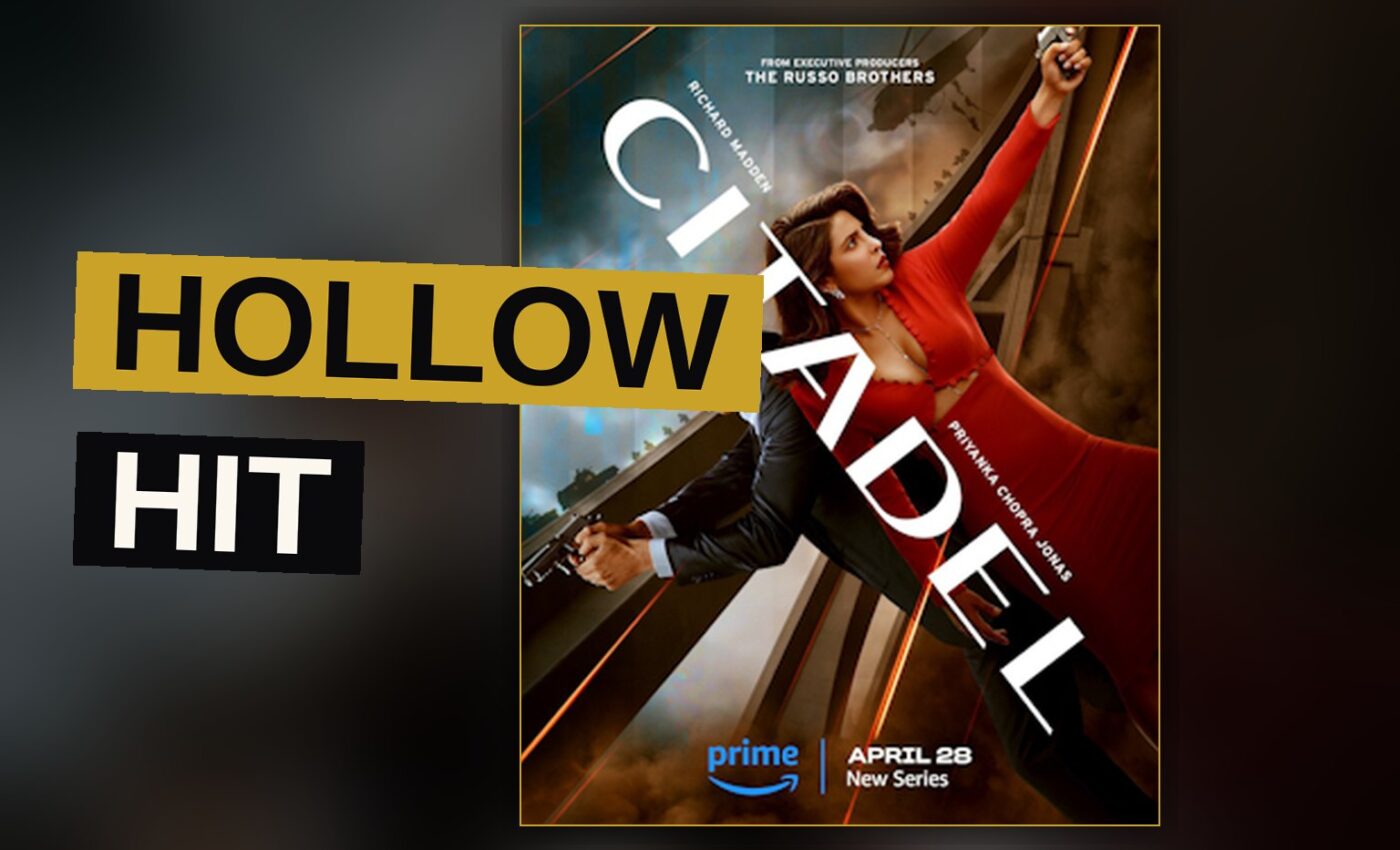
Citadel is one of the most expensive television series ever made, and it looks like it. The budget is on screen in every frame, from the gleaming European locations to the slick fight choreography to the star wattage of Priyanka Chopra Jonas and Richard Madden. What the money did not buy is a story worth telling.
The series, created by David Weil for Amazon Prime Video, is a globe-trotting spy thriller that wants to be the next big franchise. It has the pieces: a fallen secret agency, two agents with erased memories, a sinister syndicate, and a child caught in the middle. It assembles those pieces with the confidence of a show that assumes ambition is enough. It is not enough.
The result is a show that is frequently watchable and rarely memorable. It moves fast, looks sharp, and says nothing. By the end of its six episodes, the only real mystery is why so much talent and treasure went into something so hollow.
Trailer, via Prime Video Canada.
Mason Kane and Nadia Sinh
The premise is simple on paper. Citadel is a global spy agency that operates outside the law. Its rival, Manticore, is a global syndicate that wants to rule the world. Eight years before the series begins, Manticore wiped out Citadel in a single attack. Agents Mason Kane (Madden) and Nadia Sinh (Chopra Jonas) survived, but their memories were erased. They think they are ordinary people.
Then a former Citadel handler named Bernard Orlick (Stanley Tucci) finds them. He needs their help. Manticore is back, and it has a weapon that could end the world. Mason and Nadia have to recover their skills, their trust, and their pasts, all while dodging a Manticore operative played by Lesley Manville.
That is a workable skeleton. The problem is the flesh. The amnesia device means the show can withhold information at will, and it does so constantly. Every revelation is teased, delayed, and then delivered with a shrug. The audience is asked to care about a history we never see, a romance we never feel, and a threat we never understand.
The dialogue does not help. Characters speak in mission briefings and emotional platitudes. A typical exchange involves Mason telling Nadia that he does not know who to trust, and Nadia replying that she does not trust anyone. Then they kiss. Then they fight. The words are placeholders, not writing.
The Action and the Cast
The action sequences are the show’s best feature, which is faint praise. A train-top fight in the first episode is choreographed with real energy. A kitchen brawl in episode three is brutal and clear. Chopra Jonas moves like a professional, and Madden sells the physicality of a man rediscovering his violence.
But none of it is new. The fights borrow from Bourne, the car chases from Bond, and the rooftop escapes from Mission: Impossible. The show is a collage of better movies, assembled with polish but no point of view. Every stunt is competent. Nothing is surprising.
The set pieces also suffer from a lack of stakes. Because Mason and Nadia are superhumanly capable, every fight ends the same way. They get hurt, they get up, they win. The only tension is procedural: which henchman goes down next. The show never makes you believe its heroes are in danger, so the spectacle becomes a routine.
The cast is the reason Citadel is not a disaster. Chopra Jonas brings a coiled intensity to Nadia, playing her as a woman who is angry at the world for taking her memories. She is the emotional center of the show, and she sells the tragedy of a mother who cannot remember her child.
Madden has the harder job. Mason is written as a blank slate, a man who is literally a different person in each timeline. Madden plays him with a guarded charm that works in the present-day scenes, but the flashbacks give him nothing to do. He is a handsome action figure, not a character.
Tucci is the best thing in the show. Bernard is a weary, cynical spy who has seen too much, and Tucci plays him with the dry wit that made him a star. His scenes are the only ones with a pulse. Manville is wasted as the villain, given a single note of cold malice and asked to play it for six hours.
The child actor, Caoilinn Springall, does fine work as Mason’s daughter, but her character exists to be a damsel in distress. The show keeps threatening to harm her for emotional impact, and the threat never lands because the show has not earned that weight.
Flashbacks and Pacing
Citadel tells its story out of order, which is a choice. The present-day timeline is interrupted by flashbacks to the characters’ old lives, and the flashbacks are interrupted by even older memories. The intent is to create mystery. The effect is confusion.
The first two episodes are nearly incomprehensible. The show throws names, locations, and betrayals at the audience without context. By the time the plot becomes clear, around episode four, the viewer has already made peace with not caring. The reveal that Mason and Nadia were once married and had a child together should be a gut punch. It lands as a footnote.
The season also ends on a cliffhanger that is less a promise than a threat. The final scene sets up a second season, a spin-off, and a shared universe. None of it feels earned. The show is so busy building a franchise that it forgets to be a show.
The pacing is a separate problem. Each episode runs about 40 minutes, but the story could fit in a two-hour movie. The middle episodes drag, padded with chase scenes and exposition. The finale rushes to resolve plot threads that were never developed. The result is a series that is both too long and too short.
The Production and Its Limits
The production values are undeniable. The show was filmed across multiple countries, and the locations are gorgeous. The costume design is sharp, the sets are opulent, and the cinematography is clean. It looks like a movie, not a television show.
The score, by Alex Belcher, is a thumping orchestral affair that does its job. It rises when the action rises, falls when the drama falls, and never leaves an impression. The sound design is crisp. The visual effects are mostly seamless, though a few digital backgrounds are obvious.
But polish is not personality. The show looks expensive because it was expensive, reported at over $200 million. That money bought competence, not vision. Every frame is composed, lit, and graded to perfection. None of it has a soul.
The show also suffers from a tonal inconsistency. It wants to be a gritty thriller, a family drama, and a globe-trotting adventure all at once. It shifts between these modes without warning. A tender scene between Mason and his daughter is followed by a shootout, which is followed by a quippy one-liner. The whiplash is constant.
Any spy story will be compared to the giants of the genre, and Citadel invites the comparison by borrowing so freely. It is worse than every one of its models. The Bourne films have a sense of paranoia. Bond has charisma. Mission: Impossible has stunts that defy physics and logic with joy. Citadel has none of those.
It is also worse than its own peers on television. The Americans, Killing Eve, and even the later seasons of Homeland all did the espionage genre with more wit, more tension, and more character. Citadel is a generic product, a spy show scrubbed of any identity.
Ranking the Six Episodes
If you are going to watch Citadel, you may as well know which hours are worth your time. The episodes are not equal. Here is how they rank, from best to worst:
- Episode 3 — “Infinite Shadows” — The kitchen brawl and the first real character moment for Nadia. The only episode with a pulse.
- Episode 1 — “The Human Enigma” — The train-top fight is a strong hook, even if the rest is a blur.
- Episode 6 — “Secrets in Night Need Early Rains” — The finale has energy, but the cliffhanger is a cheat.
- Episode 2 — “Spies Appear in Night Time” — Overstuffed with exposition and flashbacks that go nowhere.
- Episode 5 — “Time Renders Us Enemies” — Mostly padding, with a single reveal buried under chases.
- Episode 4 — “Tell Her Everything” — The nadir. A long stretch of characters explaining the plot to each other.
The ranking is not a recommendation. Even the best episode is a solid 6 out of 10, and the worst is a slog. The show is a curve of competence, not a ladder of quality.
The Episode Schedule
For those who want to plan their viewing, Citadel released its six episodes on a weekly schedule. The full running order is below, with the original release dates on Amazon Prime Video:
| Episode | Title | Release Date |
|---|---|---|
| 1 | The Human Enigma | April 28, 2023 |
| 2 | Spies Appear in Night Time | April 28, 2023 |
| 3 | Infinite Shadows | May 5, 2023 |
| 4 | Tell Her Everything | May 12, 2023 |
| 5 | Time Renders Us Enemies | May 19, 2023 |
| 6 | Secrets in Night Need Early Rains | May 26, 2023 |
The first two episodes dropped together, which was a smart move. It gave the audience a chance to get lost twice before the weekly wait began. The schedule did not help the show build momentum. The audience did not show up in the numbers Amazon wanted, and the weekly format only highlighted the pacing problems.
The Verdict
The critical consensus is not kind. Citadel holds a 5.1 out of 10 on the review aggregation site Rotten Tomatoes, based on the Tomatometer average of critic scores. That number feels right. It is a show that is technically proficient, intermittently entertaining, and fundamentally hollow.
It is not a disaster. It is not a triumph. It is a product, engineered to fill a slot in a streaming library and to launch a universe. It does that job. It does nothing more.
The final episode ends with a twist that is meant to shock. A character who appeared to be dead is alive. A character who appeared to be an ally is a traitor. The camera lingers on a shocked face. The music swells. The screen cuts to black.
It is the kind of ending that is designed to make you watch the next season. It does not make you want to watch the next season. It makes you wonder why you watched this one.
Citadel is a show about secrets, and its biggest secret is that it has nothing to say. It is a beautiful, expensive, empty box. Open it, look inside, and close it again. There is nothing there.
Get the Notebook.
The day's best stories and every fresh verdict, in plain English, in your inbox by seven. One email a day, no more.