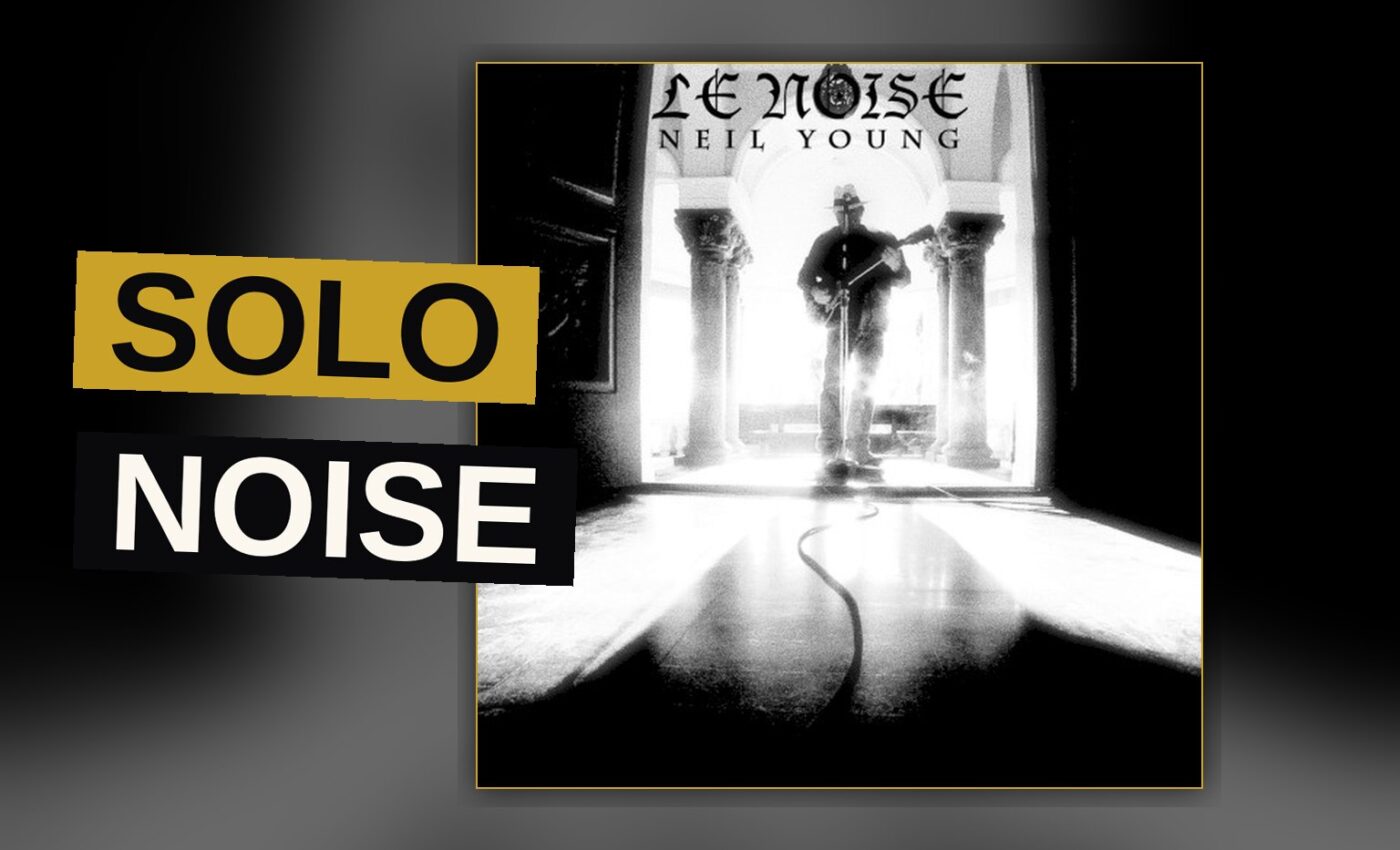
Neil Young has spent fifty years making music on his own terms, and Le Noise finds him stripping everything back to a single electric guitar and a microphone. The 2010 album, produced by Daniel Lanois, is a bold and deliberate change. It is not a band record, and it is not a quiet record. It is a raw, atmospheric solo performance, recorded in a room with the speakers turned up and the echo turned on.
The experiment works more often than it fails. The record runs 38 minutes across eight tracks, and its best moments rank with Young’s late-period work. Its weaker stretches are brief. The result is a bold, distinctive statement from an artist who still has something to prove, even if he does not need to.
The Eight Tracks in Order
The album opens with “Walk With Me,” a four-and-a-half-minute surge of distorted guitar and closely recorded vocals. It sets the tone immediately: this is not a polished radio record. The song’s chorus is simple and direct, and the production puts Young’s voice right in your ear. It is a strong start, and a personal favorite.
“Sign of Love” follows at under four minutes. It is lighter and more melodic, but the production keeps the edges rough. The song does not land as hard as the opener, but it holds the mood. “Someone’s Gonna Rescue You” is the first real stumble. The track is a mid-tempo plea that never quite catches fire, and its chorus feels like a lesser version of Young’s earlier anthems. It is not bad, but it is easy to pass over.
“Love and War” is a strong piece. At 5:37, it is one of the longest tracks on the record, and it earns its length. Young sings about the weight of writing about conflict, and the guitar work is furious and loose. This is the sound of an artist working through something real. The song stands out to me, and it deserves the attention.
“Angry World” is a short, sharp blast. The title says it all, and the track is a compact burst of anger. It does not wear out its welcome, and it sets up the album’s main event. “Hitchhiker” runs 5:32 and is the record’s core. It is a long, rambling story song, with Young recounting a life of movement and trouble. The production gives it a wide, dark feel. This is the track that defines Le Noise, and it is the one that will stick with you after the record ends.
The Back Half and the Verdict
“Peaceful Valley Boulevard” is the other long track, at 7:10. It is a slow, thoughtful piece, and it tests the listener’s patience. The song has a strong central image, but it drags. “Rumblin’” closes the record. It is a short, driving number that adds some texture, but it feels like a sketch rather than a finished song. It works as a period on the sentence.
The record’s weaker tracks — “Someone’s Gonna Rescue You,” “Peaceful Valley Boulevard,” and “Rumblin’” — are not failures. They are just less essential than the peaks. The writing does not always reach the heights of Young’s classic work, and the experiment is not completely successful. But the ambition is real, and the execution is often striking.
| Track | Length | Verdict |
|---|---|---|
| “Walk With Me” | 4:26 | Strong opener, a favorite |
| “Hitchhiker” | 5:32 | The core, essential |
| “Peaceful Valley Boulevard” | 7:10 | Too long, a lesser moment |
Le Noise is a bold statement from an artist who shows no signs of slowing down. It is one of Young’s strangest studio records, and that is a compliment. The production is atmospheric and raw, and the solo guitar performances are intimate and forceful. It is not a perfect album, but it is an important moment in Neil Young’s ongoing story. On its own terms, it succeeds.
8 of 10.
Get the Notebook.
The day's best stories and every fresh verdict, in plain English, in your inbox by seven. One email a day, no more.
- Walk With Me4:26
- Sign of Love3:57
- Someone’s Gonna Rescue You3:29
- Love and War5:37
- Angry World4:14
- Hitchhiker5:32
- Peaceful Valley Boulevard7:10
- Rumblin’3:36
- End Credits0:35