
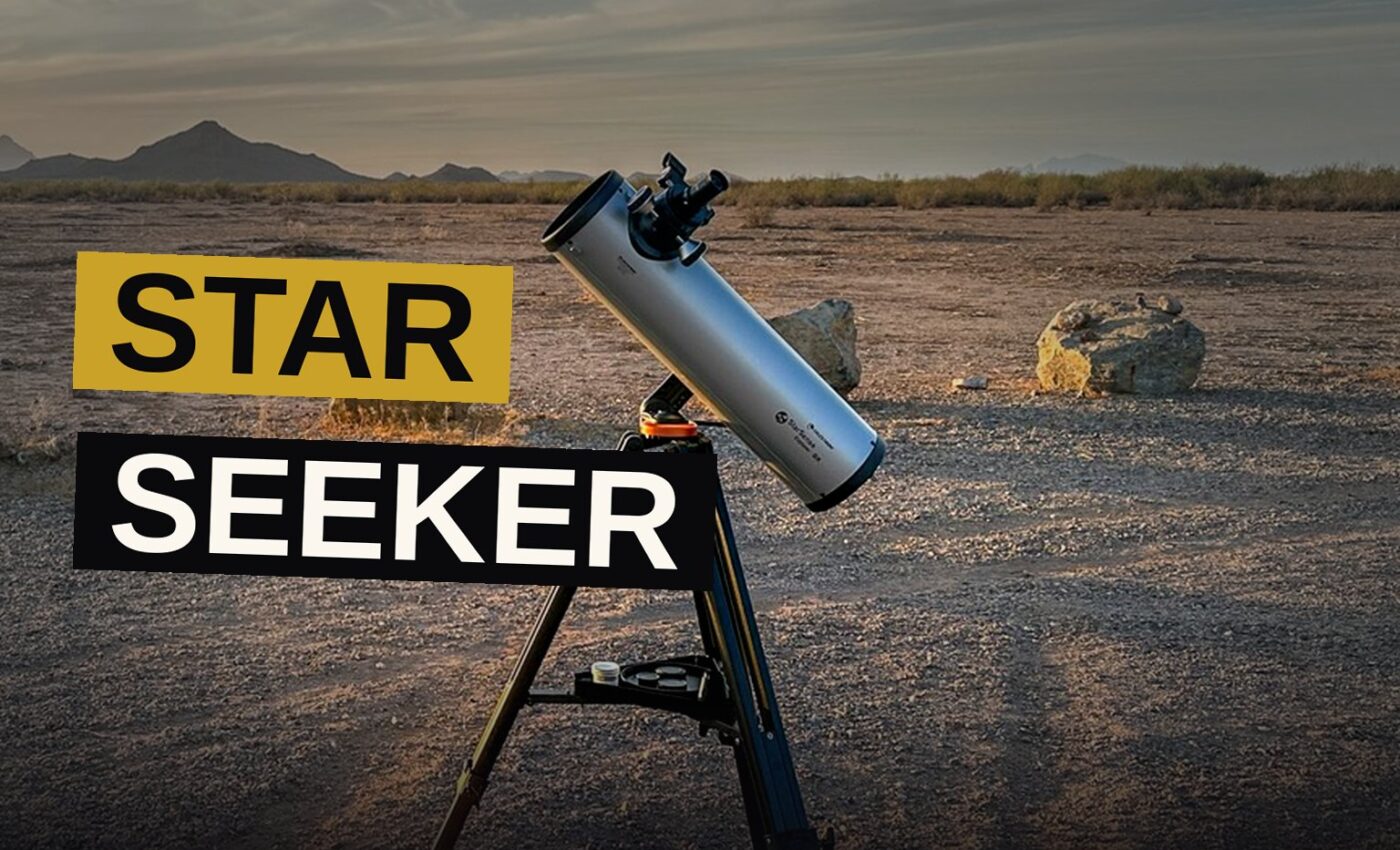
Celestron has built a portable telescope that finds its targets with a smartphone, and the StarSense Explorer DX 130AZ delivers sharp views of the solar system and bright deep-sky objects. The 5.1-inch (130mm) f/5 Newtonian reflector pairs a manual alt-azimuth mount with a phone dock, letting users point at objects without star-hopping.
The telescope is lightweight and genuinely portable, and its parabolic optics produce a wide field of view. It works well under dark skies, though the small aperture limits some deep-sky tracking. The included eyepieces are cheaply made, and the f/5 focal ratio demands better glass to shine.
What the Telescope Is
The DX 130AZ is a 130mm f/5 Newtonian reflector, one of many 130mm f/5 models Celestron offers. It shares its alt-azimuth mount and tripod with other StarSense Explorer DX models, and it uses a 2-inch focuser. The optical tube has a parabolic primary mirror and a flat secondary.
Two 1.25-inch eyepieces come with the package: a 25mm yielding 26x and a 10mm yielding 65x. Both are three-element designs, likely Konigs or reversed Kellners. The 25mm is blurry at the edges, and the 10mm shows chromatic aberration toward the edge. The housings are all plastic, producing internal reflections.
A red dot finder accompanies the StarSense technology for aiming. The mount has slow-motion controls with small gears for fine adjustments, though they have play in them.
Pointing Without Motors
The StarSense phone dock does the work of finding objects. Users point the telescope at the sky, and the app identifies stars around the target, calculating position and rotation to guide the user to the object.
This system makes star-hopping optional. It works well for beginners who want to find objects without learning coordinates.
The Mount’s Limitation
The mount has a practical ceiling. Pointing above about 70 to 75 degrees causes the tube to crash into the mount or the tripod legs. A workaround exists: deliberately setting the tripod up unlevel lets users reach the zenith without affecting the mount or the StarSense system.
The tripod is fairly stable in calm conditions. Adding sandbags, diving weights, or filling the hollow aluminum legs with sand or foam helps in windy spots. The mount is sturdy enough for casual use, though the slow-motion controls saw little use during testing — the reviewer nudged the scope by hand instead.
The Eyepiece Problem
The included eyepieces are the weakest link. Better aftermarket options would improve performance and offer a wider range of magnifications. A 6mm redline (108x), a 2x Barlow, and a wide-field eyepiece like the 24mm APM/StellaLyra UFF (27x) are recommended.
The 6mm redline gets closer than the provided 10mm and offers a much sharper view. The 24mm UFF is far crisper than the stock 25mm. With a Barlow and the 6mm, users can reach 216x on the moon, planets, and double stars — about the highest magnification this telescope can manage.
Collimation and Weight
Being a Newtonian, the DX 130 will usually need collimation for sharp images. Celestron does not include a collimation tool, which is mildly annoying. A basic collimation cap is cheap, easy to 3D-print, or can be improvised from a film canister.
The focuser is a 2.5-inch rack-and-pinion unit with a metal drawtube and plastic body. There is some play in it, but it works acceptably as long as users do not overload it with too much weight. Adapters let the provided 1.25-inch eyepieces and aftermarket 2-inch wide-field eyepieces fit, though at f/5, a coma corrector is needed for the latter.
Performance Under Dark Skies
Under dark skies, the DX 130AZ shows plenty of deep-sky objects, even with modest light pollution. The moon and planets deliver stunning detail. The telescope is definitely on the small end of what can be called a “serious” instrument, but it performs well within its limits.
Final Word
The DX 130AZ is a solid buy if a tripod-mounted, smartphone-guided telescope fits your needs. It is lightweight, portable, and easy to use. The StarSense pointing system removes the friction of star-hopping, and the manual mount keeps things simple.
But buyers should consider the alternatives first. Dobsonian reflectors and fully motorized GoTo options offer more automation and larger apertures. The included eyepieces are cheap, and the f/5 focal ratio demands better glass to shine.
For users willing to invest in aftermarket optics, the DX 130AZ is a worthwhile purchase. For those who want everything included, the value proposition is weaker.
Key Facts Box
– Aperture: 130mm (5.1 inches)
– Focal length: 650mm
– Focal ratio: f/5
– Magnification: ~260x (highest useful)
– Included eyepieces: 25mm (26x), 10mm (65x)
– Total kit weight: 18 pounds (8.16 kg)
The review’s assessment is that the DX 130AZ is sharp, wide-field, and genuinely portable, with a phone-guided pointing system that makes star-hopping optional. Its flaws — small aperture, cheap eyepieces, no collimation tool — are real but manageable with the right upgrades. It is a solid telescope for the right buyer.