
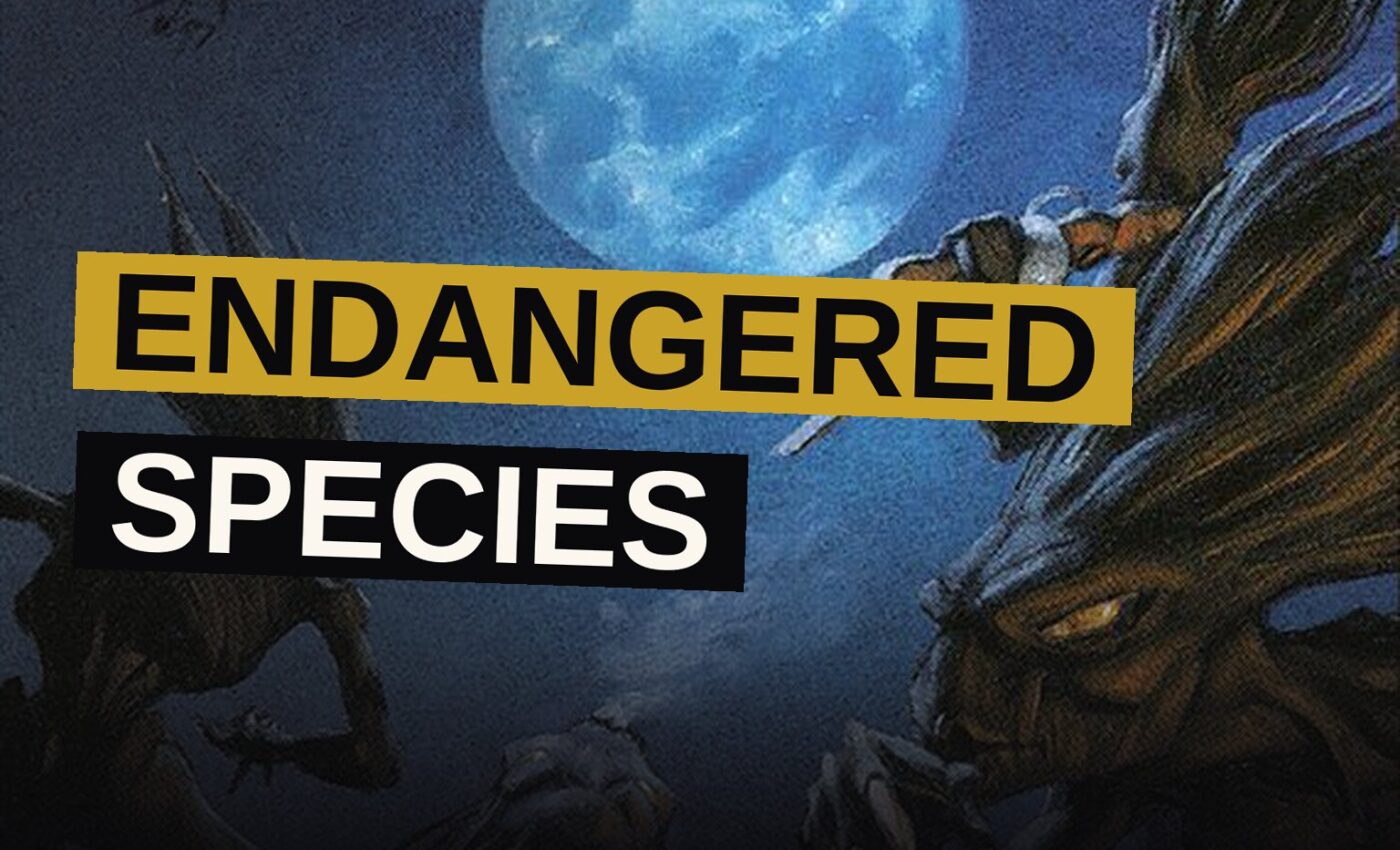
Did you know that Living Wall counts as a wall? Or that Lead-Belly Chimera counts as a chimera? Scandalously enough, Teeka’s Dragon counts as a dragon.
These seem like obvious facts. But in Magic: The Gathering, they were once the source of genuine confusion. Before the game standardized its creature type lines, cards like these carried no subtype at all. The phrase “counts as a wall” was a strange relic, a whisper from an older kind of Magic.
Now, a new essay titled “Endangered Species: On Renegade Creature Types” digs into that history. It traces how the game’s creature typing evolved from chaos to order, and how a few strange survivors slipped through the cracks. The result is a story about standardization, its failures, and the forgotten creatures caught in between.
The 2007 Purge That Reshaped Magic
The turning point came in 2007. Around the release of the Lorwyn set, rules manager Mark Gottlieb posted an article announcing a massive errata update. Wizards of the Coast would retroactively standardize the creature types on nearly every card printed since the game’s origin.
This event, called the Grand Creature Type Update, was the Chicxulub Meteorite of Magic’s history. It reshaped the game’s face, changing nearly 1,200 cards and obsoleting nearly 150 creature types.
Before that, the system was a mess. From Magic’s debut until 1998, creature spells were called “Summon” spells. The type line read like an instruction rather than a description. Where modern Llanowar Elves reads “Creature – Elf Druid,” the original Alpha printing reads “Summon Elves.”
The early type line often borrowed from a creature’s name. Bird Maiden was a summon bird maiden. Bog Wraith was a summon wraith. Some were absurdly specific. Arabian Nights’ Ali from Cairo was typed, in full, as a summon Ali from Cairo.
Things got complicated fast. Cards that cared about specific creature types existed from the very beginning. Lord of Atlantis, a Merfolk, buffed other Merfolk. But the typing was loose enough to create real ambiguity.
- Does Goblin King count as a Goblin? No. His type is “Goblin King.”
- Kobold Drill Sergeant is typed “Drill Sergeant.” Is it a Kobold? Also no.
- Kobold Overlord is typed “Lord.” Still not a Kobold.
Players had to fill the gap between art and mechanics with intuition. It doesn’t say Kobold Drill Sergeant is a Kobold, but it clearly is one.
From Chaos to Species-Class
The first real change came in 1998. The starter set Portal: Second Age broke convention and labeled creature types the way we recognize today. Vampiric Spirit was typed as a spirit, though amusingly not as a vampire.
The next year, Sixth Edition’s massive rules change universalized the format. Then 2003’s Mirrodin block went further, introducing the now-standard Species-Class template inspired by Dungeons & Dragons. Llanowar Elves became a Cleric as well as an Elf.
Along the way, creature types were folded together or errata’d out of existence. Sengir Autocrat changed from Autocrat to Minion, and eventually to Human. Sabretooth Tiger changed from Tiger to Cat. Evil Eye of Orms-by-Gore changed from Evil Eye to Horror, and later to Eye in Time Spiral.
The 2007 Grand Creature Type Update made a huge consolidated set of changes. Many types were lost in the process. Abomination, Lord, Hipparion, Maiden — all gone. By God, they even got Ali from Cairo.
But some survived. Strange renegade creatures that probably should have been obliterated but weren’t. Those survivors tell a story even more interesting than the ones that vanished.
Gottlieb’s Rationale and the Errata Escapees
In his post announcing the update, Gottlieb listed rationales for the changes. The most telling had to do with obsolescence. Obsolete creature types were eliminated, he wrote. A number of completely bizarre creature types were still on the books. Being? Entity? Gaea’s-Avenger? Gone, and their former owners now have more sensible types.
The essay also notes that some types were too specific to survive the purge. These are Magic’s forgotten creature types, defined by and defying the system at once.
The phrase “counts as a wall” is the key artifact. Living Wall, an Artifact Creature from the earliest days, carried that text because its type line originally listed no subtype at all. The rules text was a marker of that absence, a holdover from before the game standardized its type lines.
Now the type line reads “Artifact Creature – Wall.” The patch is invisible. The card just works.
What the Type Line Reveals
The essay argues that the uneven process of creature typing reveals how Magic’s flavor crystallized over three decades. The type line was a site of muddied confusion, and that confusion was telling.
The early game had no clear philosophy for creature types. They developed in juddery spurts, driven by individual card designs rather than a unified system. The result was a menagerie of strange and redundant labels.
Whispered in the gaps between the words “counts as a wall,” there’s a world, a history, and a menagerie, all at once. Inside that little phrase you can detect strained efforts at standardization, and also standardization’s very failures.
The survivors are the most interesting. They represent the limits of the system, the places where the rules couldn’t quite catch up. They are homogenized and hangers-on, defined by the typing system and defiant of it.
The Charm That Standardization Erased
The Grand Creature Type Update was arguably regrettable and probably necessary. The essay calls it both. It cleaned up decades of inconsistency, but it also erased a kind of charm.
The old type lines had personality. A summon Ali from Cairo is a delight. It’s specific, absurd, and oddly honest about what the card does. The standardized version is efficient, though one could argue it loses some of that character.
That reading is a matter of taste. The strange types were artifacts of a game still figuring itself out. They captured moments of design experimentation, of rules written on the fly, of flavor decisions made card by card.
The survivors keep that spirit alive. They are echoes of an older Magic, preserved in the type lines of cards that somehow escaped the purge.
Living Relics of an Older Game
This history matters because Magic is still a game built on categories. The Grand Creature Type Update was not the end of the story.
Games are built by people making decisions under pressure, and those decisions leave traces. The type line is one of those traces. For players who grew up with standardized typing, the old cards can look strange.
Why would a wall need to say it counts as a wall? The answer is that the game once needed that patch. Now it doesn’t, and the patch reads as a curiosity.
But curiosity is valuable. It points to history. It shows how a game became what it is.
The forgotten creature types are not just trivia. They are evidence of a process. They show the strain of standardization and the stubbornness of the strange. They are the survivors of a mass extinction, and their stories are worth telling.
Living Wall counts as a wall. That was once a necessary clarification. Now it’s a relic. But it’s a relic with a story, and that story is Magic’s own.
Source: hipstersofthecoast.com
Get the Notebook.
The day's best stories and every fresh verdict, in plain English, in your inbox by seven. One email a day, no more.