
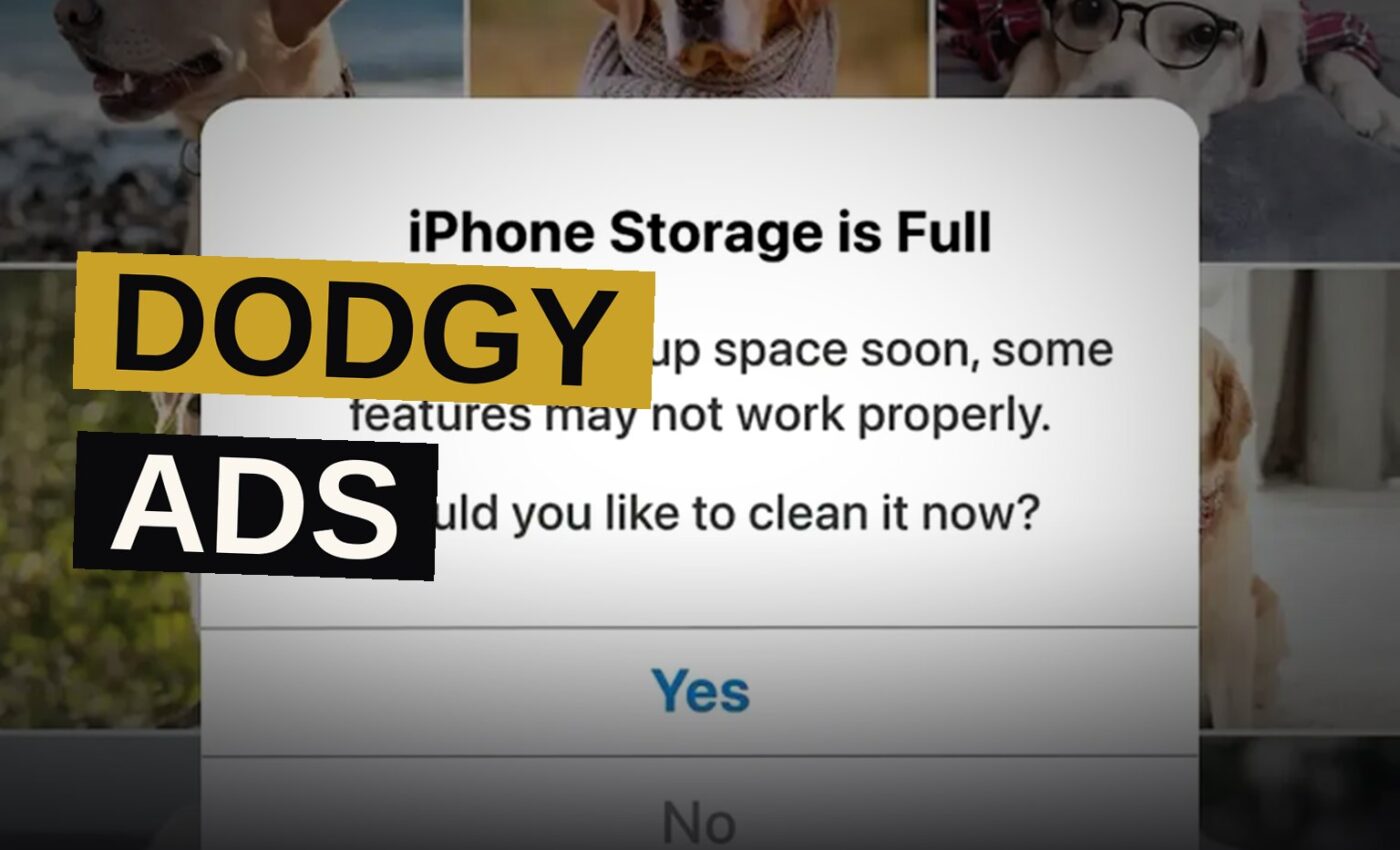
A reader recently spotted an ad in the YouTube app that looked a lot like an iPhone storage warning. They clicked it by accident because they were running low on space, and the ad pretended to be a native system alert. The reader did the right thing: they reported it. Twice. Each time, Google replied that the ad didn’t break its policies.
Then the reader tried Gemini, Google’s own AI model, and found that it flagged the ad in seconds. The ad’s deception was obvious to the machine — it mimicked an iOS system alert, used static “Yes” and “No” buttons that weren’t functional, and pushed a fear-based message about features failing if the phone wasn’t cleared. The model called it DISAPPROVED. The human reviewers missed it.
The question now is why. Why does Google’s AI catch a dodgy ad in seconds, while human reviewers approve it twice?
The Ad That Looked Like a Warning
The ad appeared in the YouTube app, and it was designed to look like a genuine warning from the iPhone itself. The text said the storage was full, and the design matched the standard iOS alert style — the same typography, the same container styling, the same “Yes” and “No” buttons.
The reader had a reason to pay attention: they were actually running out of space. A moment of distraction turned into a click. The ad then redirected to a store or landing page, which is the whole point of the trick. The buttons were not real system controls. They were static images meant to capture clicks.
This kind of deception is common in mobile advertising. The tactic relies on urgency — the ad tells the viewer that something bad will happen if they don’t act fast. In this case, the warning was about the phone itself failing. The ad claimed that some features might stop working if the storage wasn’t freed up soon.
The reader reported the ad after the first click. They expected a response. Instead, they got a form letter.
Reporting the Ad Twice
The first response from Google said the ad didn’t violate its policies. The company’s position was that the ad didn’t go against its rules, which prohibit content and practices it believes are harmful to users and the overall online ecosystem.
The reader wasn’t satisfied. They had just clicked an ad that looked like a system warning. The ad had tricked them into action. The response seemed to say the ad was fine.
So they reported it again. The second response was identical to the first. The ad didn’t break the rules.
The reader then shared their experience online, and other people came forward with the same story. They too had reported the ad and received the same form response. The pattern held across multiple reports: the ad was reported, the response came back, and the ad stayed live.
Hanlon’s Razor and the Interest Test
The reader leaned on Hanlon’s razor, a principle that suggests it’s often better to assume incompetence over malice. Sometimes things slip through even the best review processes, and people don’t always check things properly. That’s a reasonable starting point.
But the reader also acknowledged that the situation raises a question about interest. If Google removed ads that get lots of clicks, it might lose revenue. These ads are probably performing well and bringing in money. The reader noted that observation without drawing a conclusion, but the implication hangs in the air: maybe the ad stays because it pays.
There’s a simpler explanation too. Human reviewers can’t possibly catch every ad that comes through. The volume is enormous, the rules are complex, and the margins for error are small. Things get missed. That’s a structural problem, not a moral one.
The reader’s point is that AI should be able to help here. Google has some pretty good models, and surely they can put them to use. The ad in question was flagged by Gemini in seconds. So why isn’t the AI doing the job?
Gemini’s Review of the Ad
Gemini reviewed the ad and produced a detailed report. The model classified the ad as DISAPPROVED, with specific policy violations listed under Misrepresentation. The violations fall into three categories:
- Misrepresentation: Misleading Ad Design — the ad imitates operating system dialogs, system warnings, error messages, or interactive system notifications.
- Misrepresentation: Unreliable / Deceptive Claims — the ad contains false or unverified statements that could mislead users.
- Non-Functional / Deceptive UI Components — the ad includes static visuals that capture clicks anywhere on the banner but don’t act as true system controls.
The model’s evidence is direct. The banner inside the ad explicitly mimics an iOS system alert modal, complete with standard iOS typography, container styling, and mock system buttons. The “Yes” and “No” options inside the graphic are static visuals designed to capture clicks anywhere on the ad banner to trigger a store/landing page redirect, rather than acting as true system controls.
The model also notes the fear-based tactic. The ad states that “If you don’t free up space soon, some features may not work properly,” which fabricates an urgent state of failure on the user’s personal device. That’s a deceptive claim, and the model flags it as such.
The required action is straightforward: disapprove the ad creative immediately, issue a policy violation warning to the advertiser account under Misrepresentation (Misleading Ad Design), and warn that repeated violations may result in full account suspension for deceptive practices.
The Comparison Between Human and Machine Review
| Reviewer | Speed | Accuracy |
|---|---|---|
| Human reviewers | Slow | Variable |
| Gemini | Seconds | High |
The table shows the contrast clearly. Human reviewers are slow and variable. Gemini is fast and accurate. The reader’s frustration is directed at the gap between the two. Google’s own model can do the job, and yet the ad was approved twice by humans. That’s the puzzle. Why is the AI not doing the work?
What the Reader Wants
The reader is not asking for sympathy. They are asking for competence. They reported the ad. They got a form response. They reported it again. They got the same form response. They then shared their experience publicly.
The response to the story has been strong. The reader’s honest confusion resonated with many others who have encountered similar ads. The question is simple: why is Google still serving dodgy ads?
The reader’s final line is a plea to the people making these decisions. Come on, meatbags — use some of the amazing AI tools you have access to.
The Answer May Be Incompetence
The reader leans on Hanlon’s razor, which suggests it’s often better to assume incompetence over malice. That’s a reasonable starting point. But the question remains: why isn’t the AI doing the job?
The answer may be that the system is broken. The human review process is overwhelmed, the rules are complex, and the ad approval pipeline is opaque. The ad in question was caught by Gemini in seconds, and the human reviewers approved it twice. The machine knows the answer. The people running the system don’t seem to.
The reader’s hope is that this story changes something. The ad was reported. The response was form-letter dismissive. The ad stayed live. The reader wants the ad gone, and they want the system fixed.
The question is not rhetorical. It is practical. Why is Google still serving dodgy ads? The answer is not a mystery. It’s a choice, and the choice is visible in the gap between the model’s output and the human response.
The reader’s final line is a plea to the people making these decisions. Come on, meatbags — use some of the amazing AI tools you have access to. The technology exists. The ad was caught. The problem is that the people running the system are not using it.
The story ends with a question, and the question is unanswered. But the reader has done their part. They reported the ad. They shared the evidence. They made the case. The rest is up to Google.
Get the Notebook.
The day's best stories and every fresh verdict, in plain English, in your inbox by seven. One email a day, no more.