
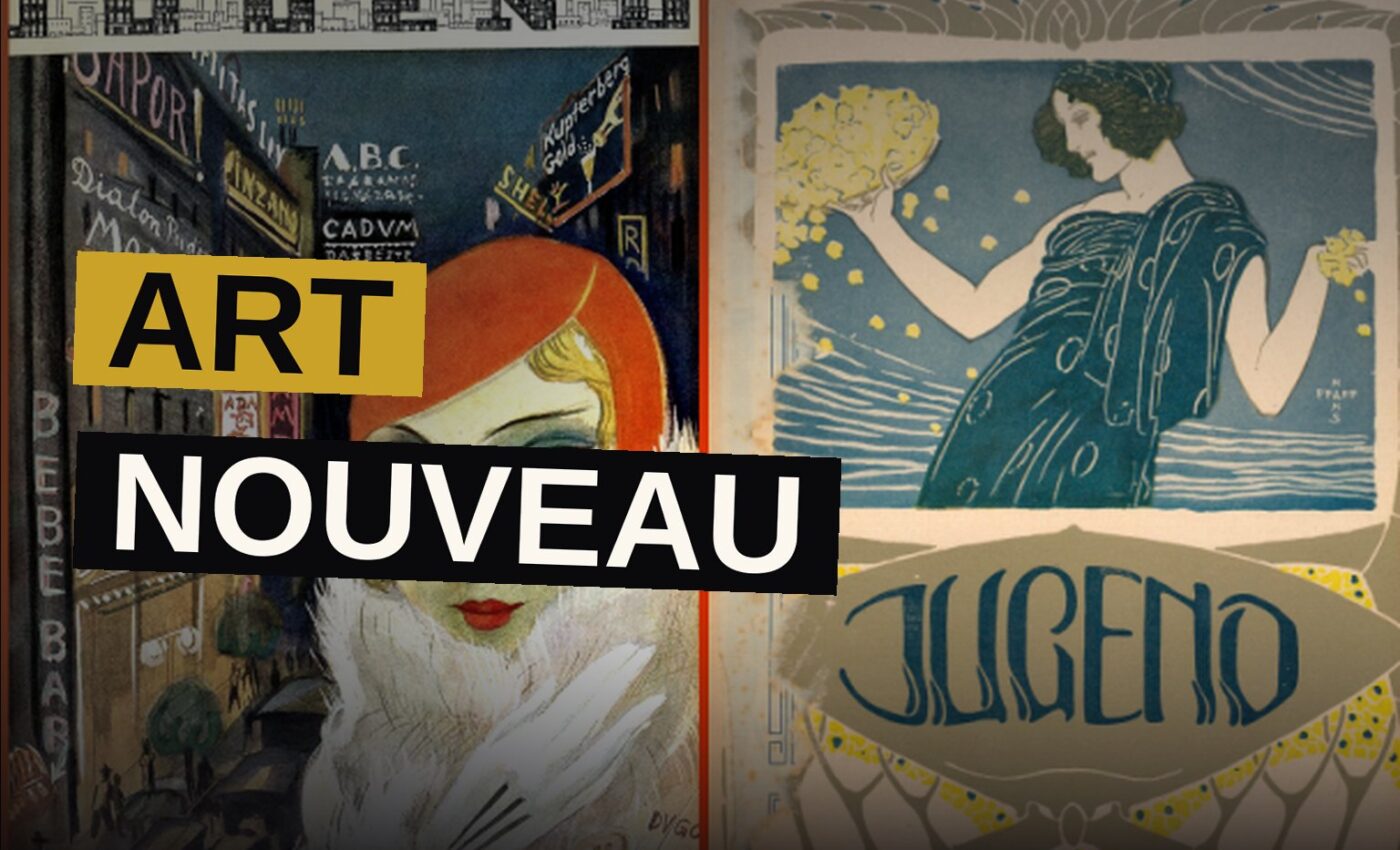
An archive of hundreds of scanned issues of Jugend, Germany’s pioneering Art Nouveau magazine, is now available online. The University of Heidelberg’s digital archive holds thousands of pages in PDF form, spanning the magazine’s forty-four-year history from 1896 to 1940.
The magazine was so influential that Art Nouveau in Germany became known as Jugendstil. Founded in 1896 by writer Georg Hirth, Jugend showcased the most avant-garde artists of its era. A critic in a 1904 issue of The Yale Literary Magazine called it possibly “the ‘brainiest’ periodical of the day,” adding that no comparable magazine existed in England or America.
Jugendstil and Its Munich Roots
The movement centered on Munich, with most of its artists, designers, and writers living and working there. Jugendstil drew from a range of sources, including post-Impressionist painting, Orientalist motifs, folk art, modernist advertising, book illustration, and graphic design.
According to the Art Encyclopedia, German Jugendstil went through two distinct periods: a pre-1900 era “dominated by floral motifs, themselves rooted in English Art Nouveau and Japanese art,” and a later phase “marked by a tendency towards abstract art.”. Very few German artists from this style achieved international fame, while Henri de Toulouse-Lautrec in France, Aubrey Beardsley in England, and Gustav Klimt in Austria did become celebrated worldwide.
What the Archive Holds
The Heidelberg collection offers hundreds of issues for download as PDF files. The same material is also found on Flickr, where images can be viewed.
According to the Oxford history, the magazine was “from the start a venue to promote the new cultural Renaissance without recourse to the established ‘vintage’ art.”, a fact noted by The Oxford Critical and Cultural History of Modernist Magazines. That source writes, “Among Jugend’s most important qualities—indeed, an essential aspect of Art Nouveau and its German equivalent Jugendstil—was its brilliant escapism.”
The Nazi Turn
In 1933, the nation transformed through what the U.S. Holocaust Memorial Museum calls “a concerted policy of ‘coordination’ (Gleichschaltung).” Culture, the economy, education, and law all came under Nazi control.
The movement that began as a protest against convention was forced to conform to the very conservatism it opposed. Its covers, which had been wild and unbridled, grew somber and neoclassical, as seen on a 1934 cover bearing a bust of Nietzsche. Many of its artists either vanished or fled into exile. In its final year, 1940, the magazine “had been turned largely into propaganda,” writes Messy Nessy Chic.
A Visible Transformation
The archive makes that transformation abrupt and visible.
| Period | Character |
|---|---|
| 1896–1933 | Avant-garde, oppositional, escapist |
| 1933–1940 | Somber, neoclassical, propaganda |
This collection was first reported by Josh Jones, who works as both a writer and musician in Durham, NC. An earlier version of his piece ran in 2017.
The staff clung to ideas about artistic quality, even as they were compelled to abandon everything that had made Jugend exciting, cutting-edge, and deserving of its name.
Source: openculture.com
Get the Notebook.
The day's best stories and every fresh verdict, in plain English, in your inbox by seven. One email a day, no more.