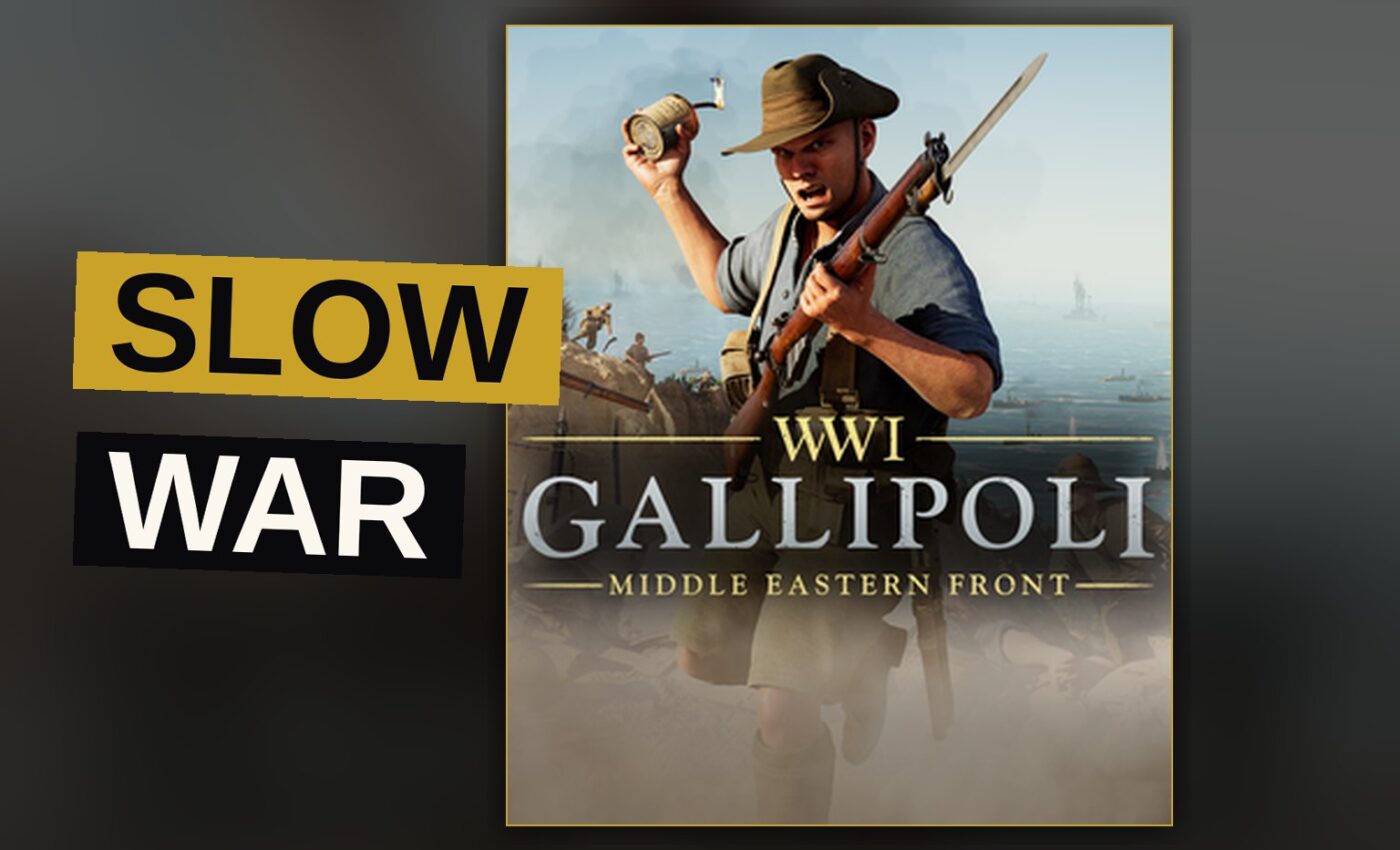
Gallipoli asks players to fight through the First World War as a private soldier, not a general, and it succeeds by staying small. The game puts players on the ground at Gallipoli in 1915, fighting Turkish forces across open hillsides, narrow trenches and rocky coastlines. It is a shooter built around slow, careful movement and tight cover systems, not fast combat. That choice shapes everything about how it plays, looks and feels.
Trailer, via FGS.
The Ground Is the Star
The design of Gallipoli’s levels is built around the idea that the battlefield is the enemy. Hillsides force players to move low, duck behind rocks and wait for cover. Trenches turn into long, narrow passages where visibility is limited and every step can draw fire. The game rarely puts players in wide open spaces where speed wins. Instead it rewards patience, forcing players to study the map, pick a route and move slowly toward their objective.
This approach pays off in the early hours, when the game teaches players to treat every hillside as a trap. Later missions ask players to hold positions while Turkish forces advance from multiple directions, forcing them to switch between cover points and watch for flanking attacks. The level design is consistent throughout, though some later missions stretch the pace further than earlier ones.
Guns Feel Heavy
Gallipoli does not offer a large arsenal of weapons. Instead it focuses on a few reliable rifles, pistols and grenades, letting players learn each gun’s weight and rhythm rather than chasing a new toy every hour. The guns feel heavy in the hands, with recoil that pushes back against the player’s aim after each shot. This makes aiming precise at range a real skill, not just a matter of pointing and shooting.
Players can also find bayonets and hand tools to use in close quarters, though these are rare enough that most fights stay at medium range. The game’s sound design backs this up, with rifle shots carrying weight and grenades producing a dull boom that fills the air. Nothing about the shooting feels empty or hollow.
The Story Holds the Line
The campaign follows a British soldier named Private Smith, who finds himself separated from his unit during the landing at Gallipoli. He spends the rest of the game moving from one position to another, meeting other soldiers along the way and piecing together the larger battle. The story is simple, but it gives the mission design a human shape rather than leaving players wandering between objectives.
The dialogue between soldiers is brief and often grim, with men talking about family, letters home and the war itself. There is little room for romance or heroism. Instead the game leans on exhaustion, fear and the sheer difficulty of surviving day after day under fire. This tone fits the setting well, even if it does not offer much in the way of character development beyond Private Smith.
Multiplayer Keeps the Pace Down
The multiplayer modes in Gallipoli follow the same design as the campaign, favoring teamwork over solo play. Players work together to hold positions, defend flags and push forward against enemy waves. The modes are straightforward, offering capture-the-flag, team deathmatch and objective-based maps that reward coordination over raw skill. There is no chaos mode or free-for-all here.
The online servers were stable during testing, with little lag reported. Matchmaking worked well, putting players into games quickly. The modes are enjoyable, but they lack the depth found in shooters with more varied classes and roles. Players looking for a constant stream of action may find themselves drifting away after a few sessions.
Technical Performance Holds Up
Gallipoli runs at a steady frame rate across its three platforms, with few drops during intense firefights. The game supports performance settings that let players trade visual detail for smoother motion, which is useful on lower-end machines. Load times are short, and the game rarely stutters when moving between missions.
The game’s presentation is clean, with clear markers showing enemy positions and friendly units. The sound design is strong, giving players a sense of space even when visibility is poor. On Series X|S and PC, the game offers higher resolution options for players with capable hardware. The PS5 version holds its own without sacrificing performance.
Where It Falls Short
Not every part of Gallipoli lands. Some missions repeat the same design of holding a position for too long, stretching the tension past its natural breaking point. The game also struggles with its difficulty curve in the later chapters, where enemy fire becomes nearly impossible to avoid. These moments break the careful pacing the game otherwise builds.
The campaign is short by modern standards, finishing in about ten hours. This is a deliberate choice, given the focus on quality over length, but it means there is less content than some players will want. The multiplayer modes are solid but thin, offering little reason to return once the initial novelty wears off.
Final Word
Gallipoli succeeds because it commits fully to a single vision of warfare as slow, exhausting and often unfair. It does not try to be a spectacle or a thrill ride. Instead it offers a grounded, honest look at what it meant to fight at Gallipoli in 1915, and it delivers that look with strong design, competent shooting and a clear sense of place. The rough edges show, but they do not spoil the whole experience.
Key Facts
– Platforms: Series X|S, PC, PS5
– Genre: Shooter
– Campaign: About ten hours
– Multiplayer modes: Capture the flag, team deathmatch, objective-based
– Setting: Gallipoli, 1915
– Lead character: Private Smith
Get the Notebook.
The day's best stories and every fresh verdict, in plain English, in your inbox by seven. One email a day, no more.