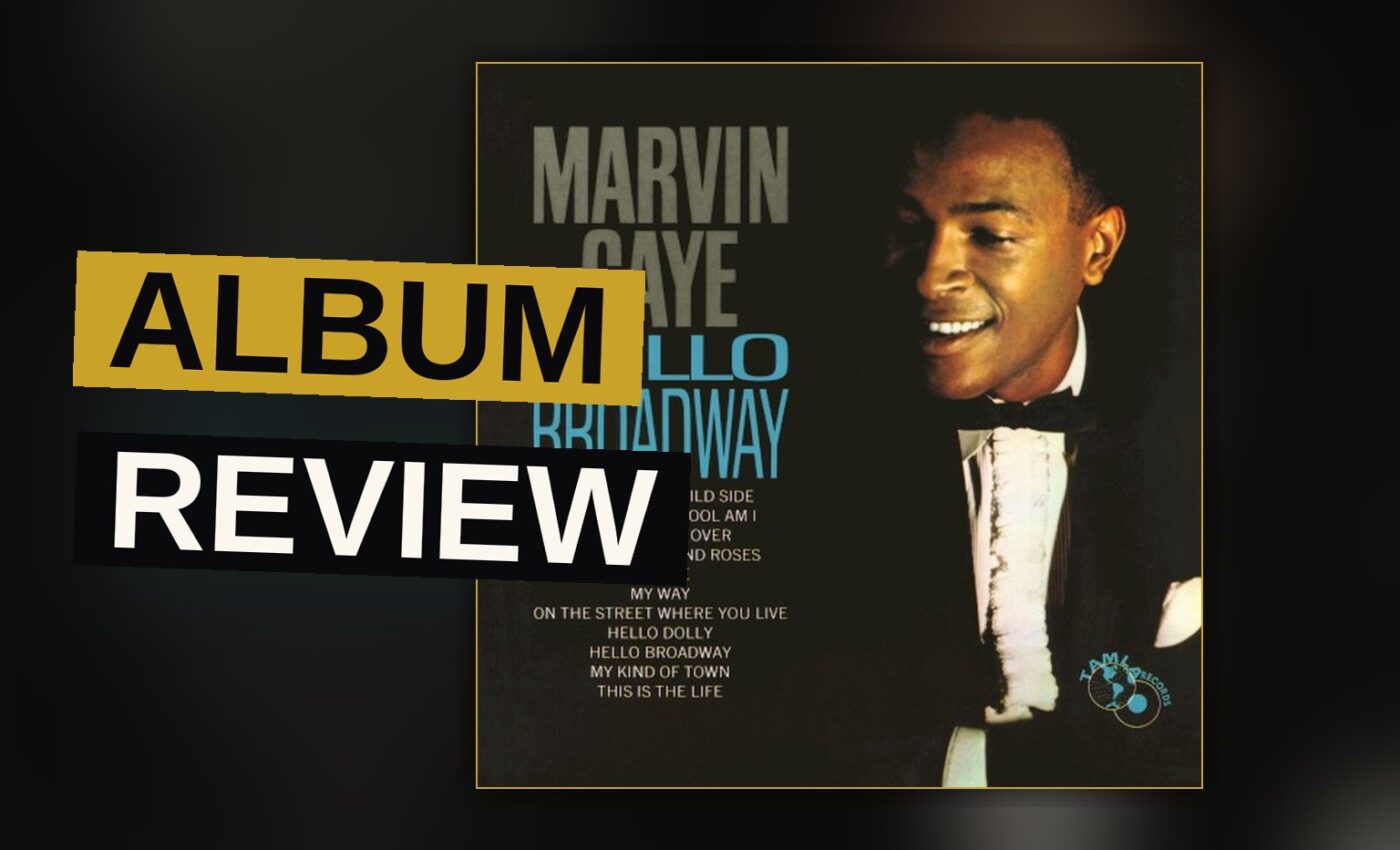
Marvin Gaye’s 1964 album Hello Broadway is exactly what its title promises: a sharp turn away from the pop charts and toward the theater. This is not the smooth soul of his earlier singles. Instead, Gaye steps onto a different stage entirely, trading the studio for the sound of Broadway orchestras.
The record is a collection of eleven standards, pulled from musicals and pop songbooks, arranged with sweeping strings and brass. It is a deliberate, almost defiant piece of genre-hopping, and it shows Gaye testing his voice against material written for a different kind of singer entirely. The album is a curiosity in his catalog, a moment when the label let him chase a different muse.
In 1964, the pop landscape was shifting, and Broadway cast albums were a different breed of product. This record sits in that gap, a bold experiment that asks whether a soul singer can own a show tune. The answer, across these eleven tracks, is mostly yes, with a few stumbles that make it a fascinating listen rather than a flawless one.
The Title Track Sets the Stage
The record starts with “Hello Broadway,” an overture of intent. Gaye greets the avenue with a confident swagger, his voice clear and direct over a brassy arrangement. It is a mission statement, a handshake with the material that follows.
This is a performance, not a confession. Gaye is playing a role, and he plays it well.
“People” follows, and it is a smart choice. The song, from Funny Girl, is a ballad about connection and loneliness, and Gaye leans into its tenderness. His phrasing is careful, almost reverent, and he lets the lyrics breathe. It is a quieter moment that shows his range, moving from the bold opener to something more intimate.
The Party’s Over and the Middle Stretch
“The Party’s Over” keeps the mood introspective. This is a song about the end of a celebration, and Gaye treats it with a measured sadness. He does not oversell the melancholy; instead, he lets the melody carry the weight. It is a solid reading, though it does not quite hit the emotional peak that the best versions of this standard reach.
“On the Street Where You Live” is a lighter turn. Taken from My Fair Lady, the song is a burst of romantic optimism, and Gaye sounds genuinely pleased to be singing it. His delivery is bright, almost playful, and the orchestration sparkles around him. This is where the album starts to click.
“What Kind of Fool Am I?” shifts the tone again. This is a heavier piece, a self-lacerating ballad about regret, and Gaye gives it a serious reading. His voice drops into a lower register, and he sounds weary, as if the foolishness of the title is a personal burden. The song builds slowly, and Gaye’s control is impressive.
“My Kind of Town” is a swaggering change of pace. This is a Chicago anthem of confidence and bravado, and Gaye tackles it with a grin in his voice. He gives it a soulful lean, making the city streets sound like a groove. It is a fun track, a moment of pure charisma that reminds you why Gaye was a star in the first place.
Days of Wine and Roses
“Days of Wine and Roses” slows things down again. The title song from the 1962 film, it is a wistful ballad about fleeting happiness, and Gaye treats it with a gentle touch. His voice is soft, almost hushed, and the arrangement is sparse, letting the melody do the work. It is a pretty performance, though it lacks the dramatic tension of “What Kind of Fool Am I?”
“This Is the Life” picks the tempo back up. It is a jaunty number, a celebration of living well, and Gaye sounds relaxed, almost playful. The song is slight, but Gaye’s delivery keeps it engaging. He sells the joy of the lyric, and the band keeps things light. It is a filler track in the best sense—it does not demand much, but it does not drag the album down either.
My Way
“My Way” is a lesser-known track here, not the famous standard that would come later. Gaye takes it seriously, delivering a slower, more introspective reading. He leans into the vulnerability of the lyric. He does not roar; he confesses.
He does not roar; he confesses.
The track sits comfortably within the album’s running time, and Gaye makes every second count. He strips away any theatrical excess and delivers the lyric with a plain, direct honesty. It is a performance that feels personal, even intimate, as if Gaye is singing to himself rather than to an audience.
Hello, Dolly
“Hello, Dolly!” is a burst of joy. The title song from the 1964 musical, it is a swinging, celebratory number, and Gaye embraces its theatricality. He sounds like he is having a blast, and the arrangement is full of brass and bounce. It is a crowd-pleaser, the kind of track that would close a show with a smile.
The song is a direct address, a greeting to the character Dolly, and Gaye plays it with a wink. He is not trying to be subtle; he is trying to entertain, and he succeeds. It is the most purely fun moment on the record.
Walk on the Wild Side
“Walk on the Wild Side” closes the album. The song, from the 1962 film, is a moody, atmospheric piece, and Gaye treats it with a dark edge. His voice is low and menacing, and the arrangement is tense, full of shadows. It is a strange ending, a step away from the brightness of “Hello, Dolly!” and into something more ambiguous.
The record is a snapshot of an artist in transition. Gaye was still a few years away from the social consciousness of his later work, but Hello Broadway shows him restless, eager to prove he was more than a hit machine. The album does not always cohere; the shifts between upbeat numbers and heavy ballads can feel jarring, and some tracks never quite ignite.
But the high points are real. “On the Street Where You Live” and “My Kind of Town” are pure fun, and “My Way” is a revelation, a glimpse of the emotional depth Gaye would later channel into his classic work. The production is clean, the arrangements are lush, and Gaye’s voice is in fine form throughout.
He never sounds lost, even when the material is not his natural home. The record is a detour, not a destination, but it is a detour worth taking. It is the sound of a great singer stretching, trying on a new coat to see if it fits. Sometimes it does, sometimes it does not, but the attempt itself is admirable.
Get the Notebook.
The day's best stories and every fresh verdict, in plain English, in your inbox by seven. One email a day, no more.
- Hello Broadway3:14
- People3:15
- The Party’s Over3:06
- On the Street Where You Live2:27
- What Kind of Fool Am I?3:43
- My Kind of Town2:39
- Days of Wine and Roses3:39
- This Is the Life2:39
- My Way2:55
- Hello, Dolly!2:56
- Walk on the Wild Side2:18